

Measuring Tech Monetization
AI makes ROI attribution harder than ever, because it augments people and arrives alongside many other changes. Set baselines and choose an attribution approach, such as before and after, A/B cohorts or regression, before the tool goes live. It costs a few extra hours of planning.

Taming the Agentic AI Genie · Real-world Governance for the Mid-market
Your employees are already using agentic AI, whether your governance framework acknowledges it or not. Design governance as a freeway, not a roadblock, so guardrails enable speed. Govern it well enough to capture the value safely.

The End of Cross-references · The Taxonomy AI Superpower Nobody is Talking About
AI can now work across systems that label the same information differently, which takes the pain out of definition fights. Stop waiting for your industry to agree on categories. Use your data instead of endlessly preparing it.

Why Most AI Projects are Failing, and How to Beat Those Odds
Most AI projects fail because organizations bolt transformative technology onto foundations that were never built for it. Data readiness and the org chart are the obstacles, so align AI with IT first. Fix the foundation before you add more pilots.

Every Company is in a Race in 2026, but Very Few Even Realize It
The bigger opportunity in Pokémon Go was the data its players built without knowing it, and your business may be hiding a similar asset. Look for architectures where your data asset grows stronger through the very act of being used.

The One Thing New CEOs Can’t Get From Their Own IT Team · An Honest Tech Assessment
New CEOs inherit technology they did not build, and an inside view is shaped by history and self-interest. An independent, vendor-neutral assessment in the first 90 days gives you the truth early enough to act. Lead with clarity rather than assumption.

How Change Management Works in the Real World, Where There Are Things Like Budgets
Most change initiatives fail because the frameworks were never designed for the budgets and constraints most companies actually face. Treat the budget as a design input, not a detail, and test any approach where the gap between theory and practice is widest.

When the World’s Biggest Firms Ignore Their Own Advice
Bloomberg spent $10 million on a custom language model that a general-purpose commercial one then outperformed. Even McKinsey and Samsung could not outrun commercial AI providers in zones where those providers hold every incentive. Check where you are building against vendors who keep advancing.

The Great Repricing · AI’s Coming Impact on Labor & Money
The coming AI disruption is less about jobs than about the price of thinking and the price of money. Repricing rewards the early and punishes the late, so prepare clear-eyed now rather than restructure in panic.

Innovation is a Process · Opportunity-space Matrices
Most companies start with a solution and hunt for a problem, which yields the same cost-reduction list every competitor has. Build an opportunity-space matrix so your team looks in all the places ideas might be hiding.

Beyond Sleeping at Night · Information Security as Strategic Advantage
Doing just enough on information security to sleep at night leaves you with minimal compliance and a stagnant posture. Treat security as a strategic advantage, a moat competitors cannot easily cross, because digital trust is becoming the primary currency.

Why Popular Innovation Frameworks Fail the Mid-Market
Popular innovation frameworks are serious work, but they cannot fix an organization that only asks how to cut cost or improve efficiency. Change the questions your company asks about technology before you adopt another methodology.

The “Status Quo” Lotus Flower You Are Eating May Kill Your Company
Calling IT stable at every quarterly review sedates a mid-market company into irrelevance. Stability is not resilience, and a stable IT department can be a liability. Stop treating stability as the goal and build resilience, because the safe baseline is a myth.
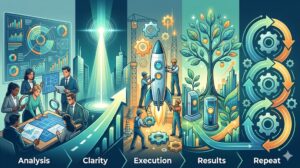
Analysis, Clarity, Execution, Results, Repeat · Success in Mid-market Innovation
A commercial real estate firm with roughly 2,000 employees had solid IT but no business impact on the P&L. Project Vista found one data project was a prerequisite for 15 others, and total benefits now exceed $3M against a $1M investment.

The Easy Answers are Free. The Wrong Questions are Fatal.
Answers are now free and certainty is cheap, so the advantage moves to asking the right questions. Optimizing the correct answer to the wrong problem is the efficiency trap, and wrong questions are fatal. Look past the dashboard to the horizon.

Considering Firing Your CIO? Read This First
Before you fire your CIO, get an outside view of whether the problem is the leader, the staff or the C-suite disconnect. If the CIO is the problem, you will have the data for the move and a profile of the successor.

When Obsolete Tech is Worse than Broken Tech
Broken technology is loud and visible, while obsolete technology hums along and hides the risk. Retire it while it is still working, because waiting for a crash to justify an upgrade is a luxury you can no longer afford.

Innovation is a Process · The CEO’s Magic Wand
Treat a decision point on innovation as a moment of identity, not just an approval of tactics. Target gaps that can be bridged, freeze the strategy to protect the culture, and carry the organization through with speed.

Innovation Vista Honored for the 3rd Straight Year as Top CIO Services Provider
Innovation Vista has been named Top CIO Service Provider by CIO Bulletin Magazine for the third straight year. The February 2026 edition featured an interview with the firm’s CEO on how its consultants help businesses optimize IT and find new growth.

Why Mid-Market Companies Outgrow Their MSPs · and How to Break Through That Ceiling
The MSP that supported your growth becomes an invisible ceiling as you scale, and it is breakable. Move from an IT model that merely supports the business to one that accelerates it. Watch for the three signs that you have hit the ceiling.
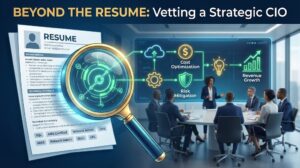
It’s the Mindset, Not the Acronyms · How Non-technical CEOs can Vet a Strategic CIO
A resume heavy with acronyms and big-name logos tells a non-technical CEO little about a strategic CIO. Hire for mindset: someone who translates tech into value, manages the P&L like an investor and spots the future early.

Google UCP · AI Agents Get a Commerce Hub
Google UCP gives AI agents a hub for transaction data, removing the largest structural barrier to agentic commerce. Commerce moves from click-based to intent-based, and the pipes are now laid. Fragmentation across merchants was what held agents back until now.

Wearing Your Jersey · How To Inject High-Power Strategy Without Disrupting Your Culture
An outsider who overhauls technology strategy can bruise a culture you spent years building. Use a leader who is embedded rather than outsourced and understands both the binary world of IT and the nuanced world of people. Your strategy must be compatible with your culture.

Bridging the Gap between your Tech and Boardroom Strategy · Who Can & Who Can’t
A strategic chasm between your boardroom and your IT department wastes budget and stalls transformation. Promoting from within and relying on vendors will not close it; a skilled CIO or CTO who tells the business the truth will.

Tech-Equity Bridge · Your Tech Strategy Counts More Than Your Systems
A CEO’s question about the right tech stack to scale misses the real issue, which is strategy. Ask what single red flag a potential buyer would find in your technology governance today. If you cannot answer clearly, you have a strategy gap, not a software problem.

Great at Ops, Cloudy on Strategy · The Hidden Gap in Your Tech Leadership
Humming servers and good uptime are often mistaken for strong technology leadership. Operational excellence can hide a gap in strategy, so ask your leaders hard questions about the future. If the answers are cloudy, you need a navigator who sees ahead.

The Growth Throttle · How Invisible Tech Friction is Capping Your Revenue Potential
If your product, sales team and lead flow are right but growth is flattening, invisible tech friction may be the brake. You do not need a three-year transformation; you need a targeted removal of the friction points slowing revenue.

Beyond the Pilot · Establishing AI Governance to Prevent a Boardroom “Blind Spot”
A flurry of AI pilots created an illusion of competence, and the board’s questions are now moving to governance. Look past the pilots to the infrastructure, data strategies and controls behind them. Build governance as steering, not braking, before it becomes a blind spot.

When your Single Point-of-Failure is a Developer · Avoiding Orphaned Software Risk
In many mid-market companies the riskiest single point of failure is not a server but one developer. Software that depends on one person’s goodwill and presence stops being an asset and becomes a liability. An objective audit finds that risk early.

Brighter Headlights · Seeing Where SaaS AI is Headed So You Can Build Elsewhere
Every enterprise software vendor is embedding AI, so stop building what your vendors are about to ship. Build cautiously across common system pairings, and put your effort into the proprietary data topology only your company can see.