
Credit Union IT & AI Consulting
Proven IT & AI Leaders with Credit Union Track Records
Credit Union IT & AI Experts
A credit union’s technology carries a weight its bank competitors never have to think about: every platform decision is made with members’ money, by an institution members own. Boards and leadership teams are being asked to deliver the digital experience of a fintech, satisfy NCUA examiners who now ask pointed questions about AI, and do it all on a cooperative’s margins; meanwhile the cost of keeping up has become one of the forces pushing healthy credit unions into mergers. In 2026, AI strategy IS IT strategy, and for credit unions it is also an independence strategy.
Innovation Vista works on the credit union’s side of that equation. Our Contract CIO+® service places fractional CIO leadership inside your organization, CIO IQ® provides standing advisory counsel, and our AI strategy practice helps cooperatives move deliberately on the technology reshaping lending and member service. All of it is independent and vendor-neutral: no hardware sales, no software resale, no commissions from core vendors or fintechs we evaluate. Across our network of 450+ consultants, engagements are staffed by sector, with people who have led technology inside credit unions and other member-focused institutions; they know what a core conversion actually involves and what an NCUA exam actually asks.
Credit unions are a core focus within our financial services IT & AI consulting practice, and the mid-market institutions we serve best look a lot like most of the movement: large enough that technology determines competitiveness, small enough that every dollar of spend has to defend itself. The typical starting point is an IT & AI Assessment, a short engagement that shows your board exactly where the technology estate and your AI readiness stand.
State of Innovation in Credit Unions
Our 2026 Summary of Innovation in the Credit Union sector
Primary shape of AI Dividend this year: Slow Melt
Credit unions in 2026 hold an unusual hand. The movement’s technology ambitions have never been higher; neither has the cost of sitting still. AI has moved from conference keynote to strategic-plan line item, and the question facing each cooperative is no longer whether the technology matters but how an institution of its size gets access to it without betting the balance sheet.
The cooperative answer to the scale problem is taking shape. What banks buy alone, credit unions increasingly build together. CUSOs have become the movement’s AI delivery vehicle: Zest AI, owned in part by dozens of credit unions, has deployed hundreds of lending models across the industry; the CU Lending Collective launched specifically to bring AI underwriting within reach of small credit unions; and Velera rolled out a cloud-native ecosystem that pairs a modern technology stack with a shared intelligence layer. Collaboration is the credit union scale strategy, and the institutions getting the most from it are the ones whose own data and integration layers are ready to plug in.
NCUA has put AI on the exam table. The agency’s 2026 supervisory priorities name AI and emerging technology explicitly; it has stood up an AI resource hub and added AI specialists to support examination teams. The posture is permissive but pointed: credit unions may use AI, and examiners will evaluate it through frameworks they already enforce, including fair lending, vendor management, BSA/AML, and enterprise risk. Expect questions about a board-approved AI policy, an inventory of AI in use including what is embedded in third-party platforms, and fair-lending testing wherever models touch credit decisions. Institutions experimenting without that scaffolding are accumulating exam findings, not advantage.
Consolidation is the backdrop to every technology decision. Merger activity surged through 2025, healthy credit unions are increasingly choosing combination over independence, and technology cost is cited again and again as a driver; 2026 is widely expected to set records. Add the steady pace of credit union acquisitions of community banks and the perennial noise around the federal tax exemption, and the strategic stakes of IT become plain: a credit union that gets its technology economics right preserves its independence and serves its field of membership on its own terms; one that does not eventually merges its way into someone else’s roadmap.
Fraud has gone after the member relationship itself. Voice cloning aimed at contact centers, deepfakes capable of passing video verification at account opening, and AI-polished phishing are rising sharply across the industry, and they exploit precisely what credit unions prize most: the presumption of trust between member and institution. FinCEN has formally warned financial institutions about deepfake schemes. Out-of-band verification, layered authentication that does not lean on voice alone, and fraud models that watch behavior rather than credentials are becoming standard equipment.
Payments and the core set the tempo. Most credit unions are still not live on instant payments, and many that are remain receive-only; meanwhile the Federal Reserve is adding network-level fraud intelligence to FedNow, a signal that real-time rails are becoming baseline infrastructure rather than early-adopter territory. Underneath it all sits the core, and a credit union’s practical AI roadmap is often whatever its core and digital banking vendors ship next. The institutions that keep control are building data and integration layers they own around the core, so the next CUSO partnership or AI capability does not wait on a vendor release. The thread running through 2026: cooperation gives credit unions reach, but readiness is earned one institution at a time.
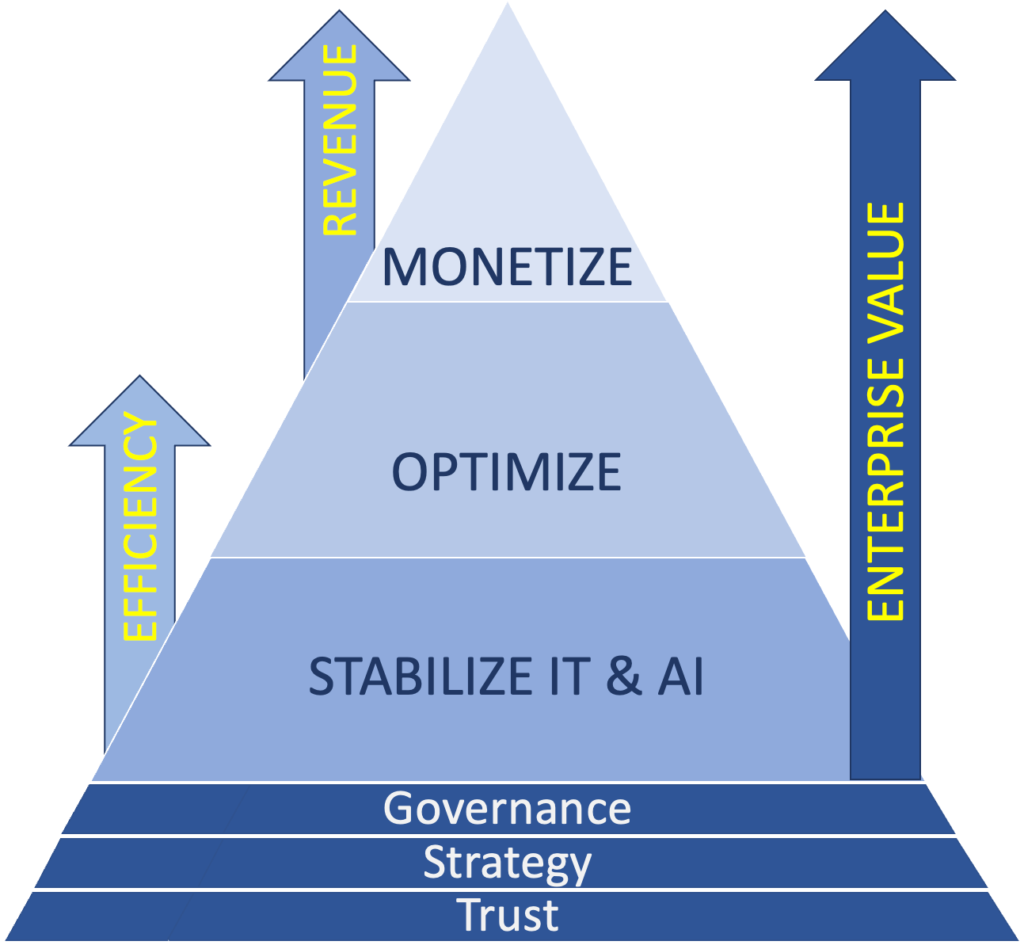

Citizen AI Is Not a Strategy
Why a Credit Union IT & AI Assessment Comes First
Inside most credit unions, AI arrived before any strategy did. A loan officer drafts language with a chatbot, marketing roughs out campaigns, someone in the back office summarizes policy documents. That scattered, individual use is citizen AI, and it is fine as far as it goes; it just does not move the institution. Production AI is another thing entirely: models and agents doing real work inside member-facing and back-office operations, in underwriting, onboarding, contact-center service, and fraud interdiction, integrated with the core and governed to NCUA expectations. The gap between the two is where credit unions will separate from their peers over the next few years, and crossing it takes readiness, not another pilot.
Our IT & AI Assessment maps that readiness for a credit union in weeks. It examines the questions that decide whether production AI can work here: how member data flows among the core, loan origination, digital banking, and the contact center, and how clean it is when it arrives; which CUSO and vendor relationships genuinely position you for AI and which quietly lock you in; whether your tech governance would stand up to an examiner working from NCUA’s current priorities, board policy, AI inventory, and fair-lending testing included; how the authentication stack holds up against voice cloning and synthetic identity; and where instant payments belong on the institution’s roadmap. The deliverable is a sequenced, board-ready set of recommendations tied to risk and member value, not a vendor list.
The bottom line: sometimes the truthful assessment answer is that the foundation is not ready, and hearing that early is far cheaper than discovering it mid-deployment with examiners in the building. More often the answer is a short, fundable list: the data to fix, the contract to renegotiate, and the one or two production AI moves your credit union can win first. For a cooperative, that discipline is how technology spend becomes member value instead of merger pressure.