Food Service IT & AI Consulting
Proven IT Leaders with Track Records in the Agriculture & Food Service Industries
Food Service IT Experts
Few industries run on margins as thin, or a clock as unforgiving, as food service: a perishable product, a labor line that only climbs, and a customer who decides in seconds. Technology has become the primary lever on all three, and it now runs the whole chain, from the farm and the fishery to the distributor, the drive-thru, and the app. The distance between operators that turn that technology into advantage and those that merely adopt it is widening fast; the menu board, the loyalty app, and the prep line have quietly become software.
The catch is that in food service, speed has never been enough by itself. Every gain has to clear a bar few industries share: a supply chain that spoils, food-safety and traceability rules that leave no room for error, and labor costs that are now permanently higher, all while the customer expects to order, pay, and be recognized in the time it takes to reach the window. The operators pulling ahead are the ones using AI to price the menu in real time, win the customer back from the delivery apps, and run the kitchen on prediction rather than guesswork; and that depends on a technology foundation most operators never built, one assembled to run a register and a back office rather than an algorithmic menu and a connected kitchen.
That foundation is the work we do. Through our flagship Contract CIO+® tech leadership service and our foundational CIO IQ® IT & AI advisory, Innovation Vista brings independent, vendor-neutral strategy to food and agriculture businesses. Our consultants have led technology across farming and food production, distribution, and multi-unit hospitality; they are sector veterans, not generalists assigned to an industry they have only read about. We know where general IT practice applies and where food service demands its own playbook, where a system outage or a data gap is not just a margin problem but a food-safety and customer-trust problem. That expertise extends to the operators cooking under contract rather than a menu board: contract dining, catering, and commissary kitchens running dozens of sites at once face their own version of this agenda, covered in Every Kitchen Is a Branch.
Achievements of our Consulting team for Agriculture & Food Services Clients
Our Food Services Scoreboard · Impact & Expertise
M.T. / Food Distribution co
As founder, built a Midwest food-service logistics and distribution operation from the ground up, creating a network to supply packaged-food products to retailers and restaurants.
J.C. / AgTech & Ag-Fintech
As co-founder and CTO, built an AI-powered agricultural loan-origination and farm-management platform from zero toward enterprise readiness.
D.H. / Food & Beverage Distributor
As board-appointed CIO/CTO of a $450M distributor, delivered a full SAP ERP transformation and integrated 7 acquisitions onto one platform; a disaster recovery plan he designed was validated during a live data center fire with zero business impact, averting $40M+ in losses.
M.D. / Global Agribusiness & Crop Science
As interim global CIO for the seeds division of a global chemical company and divisional CIO at a global crop-science firm, led IT through multibillion-dollar divestitures and post-merger integrations across more than 20 countries.
A.M. / Agriculture-Tech startup
As CTO and co-founder of an agriculture-technology startup, built and scaled the platform onto a high-availability, auto-scaling cloud architecture supporting more than 100,000 monthly sessions.
K.R. / Wholesale Food Distributor
As CIO for over seven years at a leading convenience-store supplier and wholesale food distributor carrying more than 11,000 branded products, led enterprise IT across the distribution operation.
K.E. / Multi-unit Restaurant chain
As Interim CIO for a multi-site restaurant company, led technology for an operation built around a substantial online-ordering business.
R.M. / Agriculture-Tech firm
As Fractional CTO for an agriculture-technology firm, set product and technology strategy and built a cloud-based farm-management platform, automating manual field operations with no-code tooling.
P.W. / Multi-brand Restaurant group
As CIO, drove the US-market launch of three restaurant brands and the turnaround of multi-unit restaurant operations.
M.D. / Global Agribusiness & Crop Science
As interim global CIO for the seeds division of a global chemical company and divisional CIO at a global crop-science firm, led IT through multibillion-dollar divestitures and post-merger integrations across more than 20 countries.
K.R. / Wholesale Food Distributor
As CIO for over seven years at a leading convenience-store supplier and wholesale food distributor carrying more than 11,000 branded products, led enterprise IT across the distribution operation.
P.W. / Multi-brand Restaurant group
As CIO, drove the US-market launch of three restaurant brands and the turnaround of multi-unit restaurant operations.
K.E. / Multi-unit Restaurant chain
As Interim CIO for a multi-site restaurant company, led technology for an operation built around a substantial online-ordering business.
R.M. / Agriculture-Tech firm
As Fractional CTO for an agriculture-technology firm, set product and technology strategy and built a cloud-based farm-management platform, automating manual field operations with no-code tooling.
A.M. / Agriculture-Tech startup
As CTO and co-founder of an agriculture-technology startup, built and scaled the platform onto a high-availability, auto-scaling cloud architecture supporting more than 100,000 monthly sessions.
J.C. / AgTech & Ag-Fintech
As co-founder and CTO, built an AI-powered agricultural loan-origination and farm-management platform from zero toward enterprise readiness.
M.T. / Food Distribution co
As founder, built a Midwest food-service logistics and distribution operation from the ground up, creating a network to supply packaged-food products to retailers and restaurants.
State of Innovation in Food Service & Agriculture
Our 2026 Summary of Innovation in the Food Services industry
Primary shape of AI Dividend this year: Rising Bar under platforms
The Algorithmic Menu & The Labor Pivot
The Food Service industry in 2026 has fully embraced the “Digital Front Door.” With labor costs permanently higher, technology is the primary lever for protecting margins and ensuring consistency across multi-unit operations.
Dynamic Pricing & Digital Menus: Static pricing is dead. Leading brands are utilizing AI-driven digital menu boards and apps to adjust pricing and featured items in real-time based on inventory levels, weather, and peak demand, protecting margins during surges.
Reclaiming the Customer: Brands are fighting back against third-party delivery apps. By enhancing first-party loyalty apps with exclusive AI-personalized offers, restaurants are converting “anonymous delivery orders” into “loyal direct customers,” saving the 20-30% commission fees.
Voice AI at the Drive-Thru: To combat labor shortages, conversational AI handles order taking at the drive-thru and phone lines. This isn’t replacing staff; it’s reallocating them to the window and kitchen to improve speed-of-service and order accuracy.
Back-of-House Predictive Prep: AI is now the “Kitchen Manager.” Systems predict exact prep quantities based on historical data and local events, drastically reducing food waste (COGS) and ensuring freshness without relying on guesswork.
Can Your Tech Stack Support Any of This? An Assessment is Step 1 to Finding Out.
Every shift above assumes a foundation underneath it: dynamic menu pricing only works if inventory, demand, and cost data are clean and connected in real time; a loyalty app that wins customers back from the delivery platforms needs first-party data and an ordering stack you actually own; voice AI at the drive-thru has to integrate with the POS and kitchen display, not sit beside them; and predictive prep is only as good as the historical and location data feeding it. Most operators find the gap only when a botched rollout, a food-safety or traceability audit, or a delivery-commission bill they can no longer absorb forces the question.
An IT & AI Assessment and Recommendations report lets you answer it on your own terms first. Our Food Service team diagnoses where your platform, data, and security actually stand against what these capabilities demand, then maps the shortest credible path to readiness.
AgriculturE and Food Service Leaders First - Then Tech Leaders
Our Unique Approach to Food Service Technology
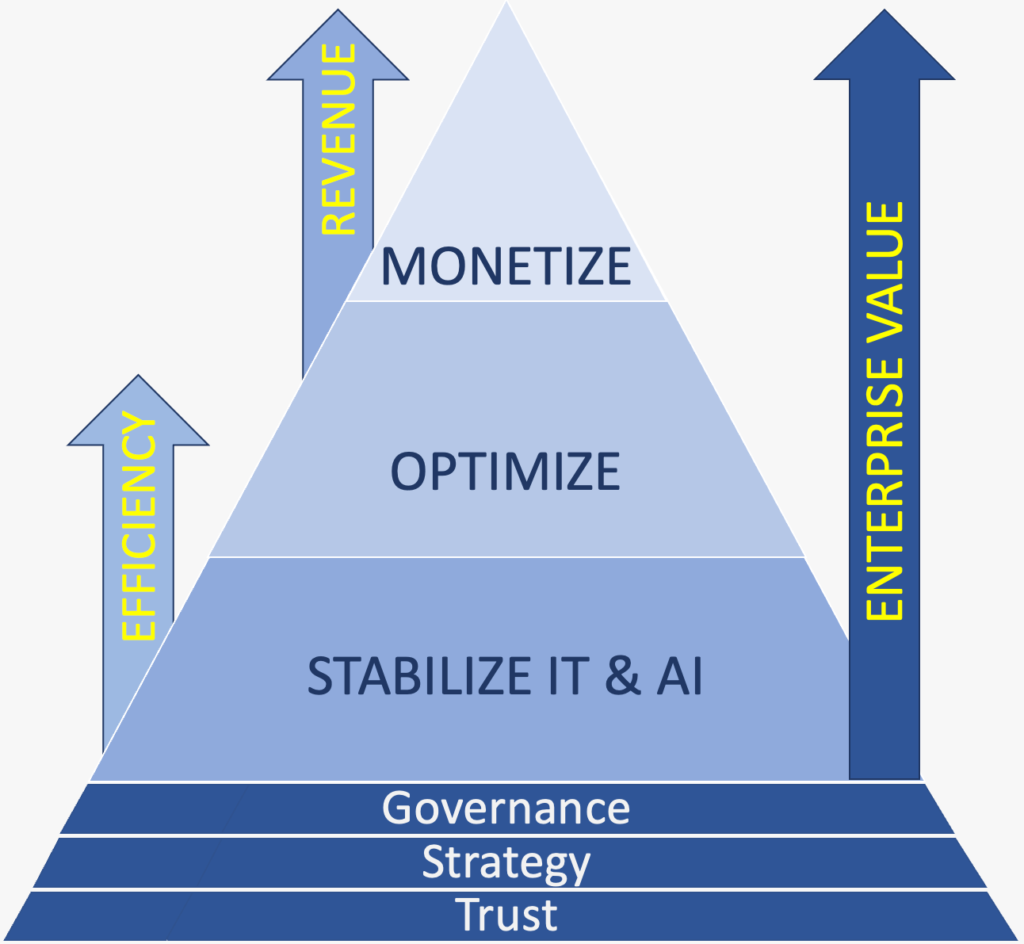
That readiness has a name and a sequence. Like many firms, we help operators Stabilize core platforms and secure their networks, then Optimize POS, supply-chain, and back-office systems. In food and agriculture these are not housekeeping; they are how the silos come down, how farm, distribution, kitchen, and customer data finally connect, and how that data gets clean enough to act on and traceable enough to satisfy an FDA or FSMA audit. Most firms stop here and call it transformation. For us it is step one.
From there, with Contract CIO+® and CIO IQ®, we align technology to how you actually make money. For a food distributor that may mean automating warehouse and delivery logistics; for a multi-unit restaurant brand, mobile ordering and a loyalty app that reclaims the customer from the delivery platforms; for a processor or grower, IoT monitoring, traceability, and forecasting against commodity and weather swings. The right move is always tied to your business model, your margins, and your compliance reality rather than a generic playbook, which is why a food and agriculture leader sets the strategy before a single tool is chosen.
Where we add the most value is in Monetizing technology, helping operators Innovate Beyond Efficiency® by turning that connected foundation into revenue. That looks like dynamic pricing that protects margin through every demand surge, first-party apps that turn anonymous delivery orders into repeat customers, and predictive prep that cuts food waste straight out of COGS. None of it works until the underlying supply-chain and customer data is unified, clean, and fast enough for AI to act on; but once it is, technology stops being back-office support and becomes a core ingredient of profitability, safety, and customer loyalty. More than half the measurable impact we have driven for clients is top-line, not cost savings, and in food service that is where the advantage compounds.
IT Strategy for Your Food Service Niche
Agricultural & Food Service Sectors Covered
- FDA, FSIS, SOC audit compliance
- Farming
- Ranching
- Farm & Ranch treatment & optimization
- Fishing & marine harvesting
- Packaged food processing
- Beverages
- Grocery stores
- Bars & Restaurants
- Food distribution
- Horticulture
- Renewables
- Animal products
- Custom software & model development
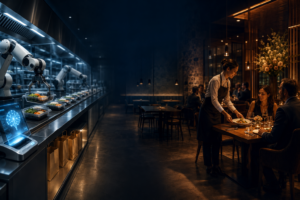
Restaurants in 2040 · Calories Get Automated, Hospitality Gets Expensive
Restaurants will not be replaced by robots, but food production gets automated while hospitality gets expensive. The change is uneven, and the middle of the menu empties first. Work out where your operation sits before the middle goes.
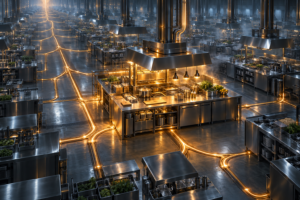
Every Kitchen Is a Branch · The Tech Agenda for Multi-Site Commercial Kitchens
Food safety investigators, client auditors and investors will all ask your multi-site kitchens to prove what they make and serve. Pass three tests: counted, compliant and consistent. Companies that run every kitchen as a branch will be the ones doing the buying.
Analytics Maturity in Food Services · Analyzing our 2026 Mid-market Survey
This page breaks down data, BI and AI maturity in agriculture and food service, using our 2026 mid-market survey. First movers will own the talent and infrastructure that followers struggle to replicate, while laggards face margin compression and acquisition by larger conglomerates.