
Pharmaceuticals IT & AI Consulting
Proven IT & AI Leaders from Inside the Pharmaceutical Industry
Pharmaceutical IT & AI Experts
Few industries pay a higher price for getting technology wrong than pharmaceuticals. A data integrity finding can idle a production line; a validation gap can stall a submission; an unmanaged AI tool can now draw a warning letter all by itself. Yet the pressure runs in the opposite direction too: boards want AI accelerating discovery, tech transfer, manufacturing, and supply, and they want it now. Threading that needle is an IT problem before it is a science problem. In pharma, AI strategy IS IT strategy, with GxP attached.
That is the work Innovation Vista does. We place fractional CIO leadership inside pharmaceutical organizations through Contract CIO+®, provide standing counsel through CIO IQ®, and guide regulated AI adoption through our dedicated AI strategy practice. The advice is independent and vendor-neutral in the strictest sense: we sell no systems, resell no software, and take nothing from the LIMS, MES, ERP, or AI vendors we may evaluate on your behalf. Engagements draw on a network of 450+ consultants matched by sector, leaders who have run technology for drug makers, CDMOs, and life-science suppliers, and who know the difference between a clever pilot and a system an inspector will accept.
Our pharmaceutical work sits alongside our broader healthcare IT & AI consulting practice, and the mid-market is our sweet spot: specialty and generic manufacturers, biotechs approaching commercialization, CDMOs, and the suppliers around them. The usual first step is an IT & AI Assessment, a few weeks of focused work that shows exactly where your systems, data, and validation posture stand before any larger commitment is made.
State of Innovation in Pharmaceuticals
Our 2026 Summary of Innovation in the Pharmaceutical sector
Primary shape of AI Dividend this year: The patent exception
Pharma’s 2026 technology story is a study in acceleration on every front at once. The science has never looked more promising, the regulators have never moved faster, and the trade environment has never been this disruptive. Each of those forces lands, eventually, on the same desk: whoever owns the company’s technology and data.
AI-originated medicines are now a clinical reality. More than 170 drug programs with AI-discovered origins are working through clinical development, and early-phase success rates for AI-designed molecules are running well above historical norms; large pharmas are committing meaningful shares of their R&D budgets, often cited at 5 to 10 percent, to AI and digital programs. No AI-discovered drug has crossed the finish line to full approval yet, but the industry is behaving as if that milestone is close. For mid-size companies the implication is less about building discovery engines and more about being a credible partner: clean, well-governed data is what makes licensing, co-development, and acquisition conversations possible.
Regulators are writing the AI rulebook in real time. FDA’s draft guidance on AI in regulatory decision-making introduced a risk-based credibility framework; in January 2026 FDA and EMA jointly published guiding principles for good AI practice in drug development; and the EU’s draft GMP Annex 22 is the first dedicated framework for AI in manufacturing, keeping humans in the loop for critical decisions like batch release. The direction is consistent and pragmatic: AI is welcome, provided it lives inside the quality system, risk-assessed, documented, and auditable.
Enforcement has already begun. In April 2026 FDA issued its first warning letter treating AI misuse as a standalone cGMP deficiency, citing a manufacturer that let AI agents generate specifications, SOPs, and master production records without adequate controls. The lesson is blunt: in this industry the constraint on AI is not capability, it is validation discipline, and companies that experiment outside the quality system are manufacturing findings rather than medicines.
Trade policy is redrawing the supply map. The 2026 tariff proclamation put patented imported drugs under 100% duties, with carve-outs for generics, US-origin products, and companies that struck pricing agreements; most-favored-nation pricing pressure arrived alongside it. The reshoring announcements that followed run to tens of billions of dollars per company, and every one of those new sites will be a greenfield digital plant: MES, historians, quality systems, and serialization built in from day one. Meanwhile DSCSA enforcement has made package-level electronic traceability a working requirement of doing business, not a future project.
The vendor stack is shipping agentic AI whether you are ready or not. The platforms pharma already runs on are embedding AI assistants and agents across regulatory, quality, clinical, and commercial workflows, which moves the question from procurement to governance: which of these capabilities will you turn on, under what validation, fed by which data. The common thread across 2026 is exactly there; in pharmaceuticals the binding constraint on AI is not the algorithm, it is whether the data and systems underneath it are clean, connected, and inspection-ready.
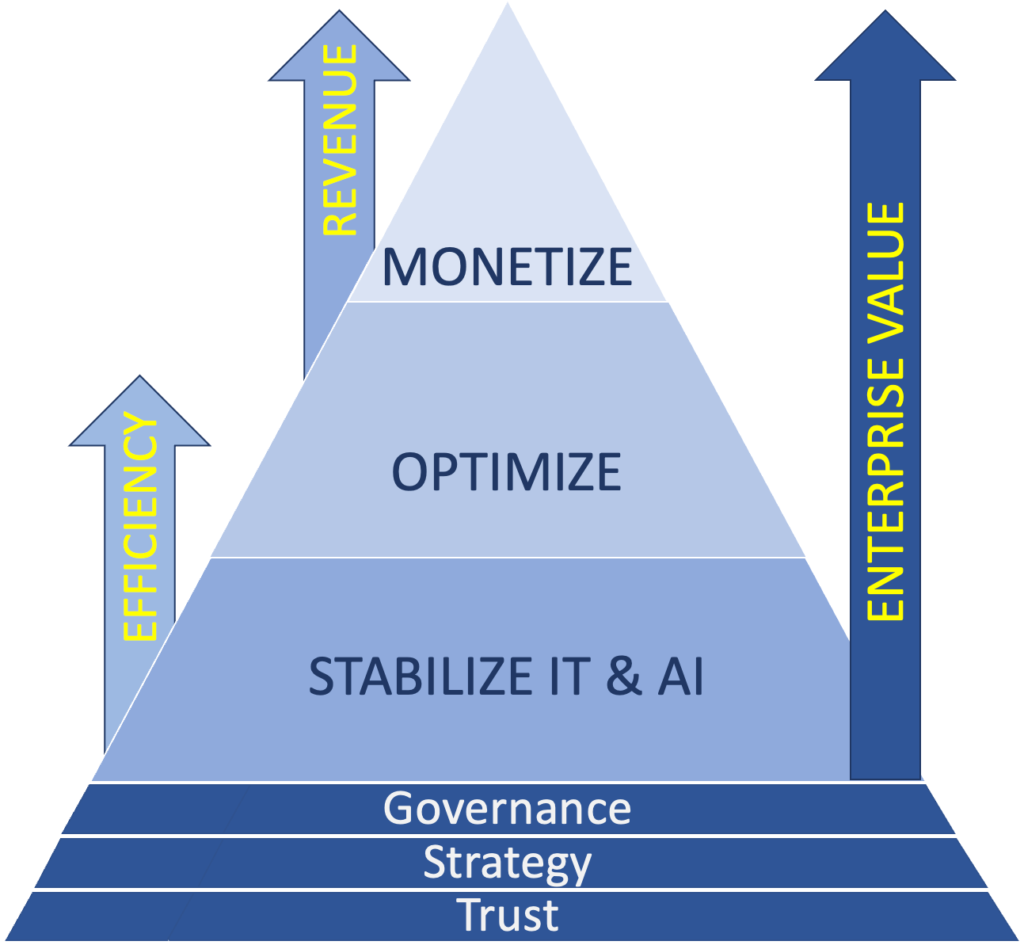

Where Citizen AI Ends and Validated AI Begins
Why a Pharma IT & AI Assessment Is the Right First Step
AI is already everywhere in pharma companies; it is just not anywhere that counts yet. A medicinal chemist asks a chatbot to summarize literature, regulatory affairs drafts response language, market access roughs out payer materials. This is citizen AI: individual people using general-purpose tools, useful and largely harmless so long as it stays away from GxP records. Production AI is a different animal, validated models doing consequential work inside the business: process monitoring and control, batch record review, deviation and complaint triage, pharmacovigilance case processing, demand and supply planning. It lives inside the quality system, carries the credibility evidence regulators now expect, and runs on data that can survive an audit. The distance between those two states is where pharmaceutical companies will separate competitively over the next several years, and it is a readiness question long before it is a model question.
Our IT & AI Assessment measures that readiness in weeks. For a pharmaceutical client it looks at what actually decides the outcome: how data moves among LIMS, MES, ERP, QMS, and the historian, and whether it arrives clean enough to act on; where your data integrity and ALCOA posture genuinely stands; which AI ambitions fall inside GxP boundaries and what validation burden each carries under the emerging FDA and EMA frameworks; how serialization and supply chain traceability hold up; and which vendor commitments help versus quietly constrain you. What comes out is a sequenced, board-ready plan tied to risk and return rather than a list of products to buy.
The bottom line: an honest assessment occasionally says the foundation is not ready for production AI, and in this industry that answer is worth a great deal; it is far cheaper delivered in a report than discovered by an investigator. More often the result is a short, specific agenda: the data to remediate, the integration to build, and the one or two validated AI use cases your company can win first. In pharmaceuticals, readiness is the moat; enthusiasm is just the press release.