
Airline IT & AI Consulting
Proven IT & AI Leaders with Aviation Track Records
Airline IT & AI Experts
No industry wears its technology failures more publicly than airlines. When a crew-scheduling system buckles or a vendor update goes wrong, the result is not a quiet incident report; it is stranded passengers, congressional letters, and a week of headlines, at a cost the industry now measures by the minute. At the same time, the commercial side of the business is racing through its biggest transformation in decades, from filed fares toward modern retailing, while AI moves into the operations center itself. An airline cannot treat any of this as an IT department problem. Here, AI strategy IS IT strategy, and both are, bluntly, an operational-resilience strategy.
Innovation Vista was built for decisions of exactly that weight. Through Contract CIO+® we place fractional CIO leadership inside the airline; through CIO IQ® we keep experienced counsel on call; and through our AI strategy practice we guide what gets automated, what gets augmented, and what stays human. Everything we advise is independent and vendor-neutral; we take nothing from the PSS, ops, MRO, or AI vendors whose products we may evaluate. Our 450+ consultant network is matched to engagements by sector, so the people advising your airline have run technology for carriers, airports, and the operators around them.
Airline work sits naturally beside our aerospace and logistics & transportation IT & AI consulting practices; the supply chain that builds and maintains your fleet and the networks that move freight share both vendors and failure modes with the airlines we serve. Our center of gravity is the mid-market: regional and leisure carriers, cargo and charter operators, and the aviation-services businesses around them. The first engagement is usually an IT & AI Assessment, a few weeks of work that shows leadership exactly where the systems, the data, and the AI readiness stand.
State of Innovation in Airlines
Our 2026 Summary of Innovation in the Airline sector
Primary shape of AI Dividend this year: Rising Bar, oligopoly by structure
Airlines are running two transformations at once in 2026: hardening operations against the failures that keep making national news, and rebuilding how they sell against the biggest commercial shift since e-tickets. Both run straight through technology, and both are exposing which carriers invested in foundations and which deferred.
The industry has learned where its glass jaw is. The defining airline IT lessons of this decade, Southwest’s 2022 meltdown and the extended recovery some carriers suffered after the 2024 CrowdStrike outage, traced not to the reservation system but to crew tracking and scheduling: bespoke, aging systems that could not absorb cascading disruption. The industry now understands that resilience is architecture, not luck; the carriers that can recover in hours rather than days have mapped their dependencies, tested their failure modes, and rebuilt the brittle links before the storm, not after.
Retailing is finally moving from talk to deployment. NDC channels are maturing, continuous pricing is spreading, and the offer-and-order transformation, retiring the PNR world for retail-style commerce, has moved from conference slideware into early production at real carriers. The next wrinkle is already visible: consumer AI agents that search, compare, and book on a traveler’s behalf, which will reward airlines whose offers are machine-readable, accurate, and instantly priced, and punish those whose content is buried in legacy distribution.
Pricing algorithms are drawing political heat. When reports framed one major carrier’s revenue-management AI as individualized pricing, senators demanded answers and the airline publicly clarified that the tool informs analysts using aggregated data rather than setting personal fares. The accuracy of the framing mattered less than the speed of the reaction. Any airline deploying AI in pricing should assume regulators, journalists, and customers will ask exactly how it works, and that clear governance and explainability are now part of the product.
AI is earning a seat in the operations center. The strongest current use cases are operational: models that combine weather, airport constraints, crew legality, aircraft rotations, and connection sensitivity to flag disruption risk before it materializes; predictive maintenance that lifts aircraft availability; and crew-planning tools that anticipate where reserves will be needed. The pattern across carriers is augmentation, AI proposing and humans disposing, and it only works when the underlying operational data is current, connected, and trusted.
The environment outside the fence line is strained. Air traffic control staffing and aging public infrastructure remain multi-year constraints no airline controls, which raises the value of everything an airline does control: schedule resilience, recovery speed, and honest, proactive passenger communication when things go wrong. Analysts expect AI investment in aviation to roughly triple by 2030; the carriers that convert that spending into advantage will be the ones whose data and systems were ready to receive it. That, more than any single tool, is the 2026 story.

Everyday AI Is Not Operational AI
Why the Right First Move Is an Airline IT & AI Assessment
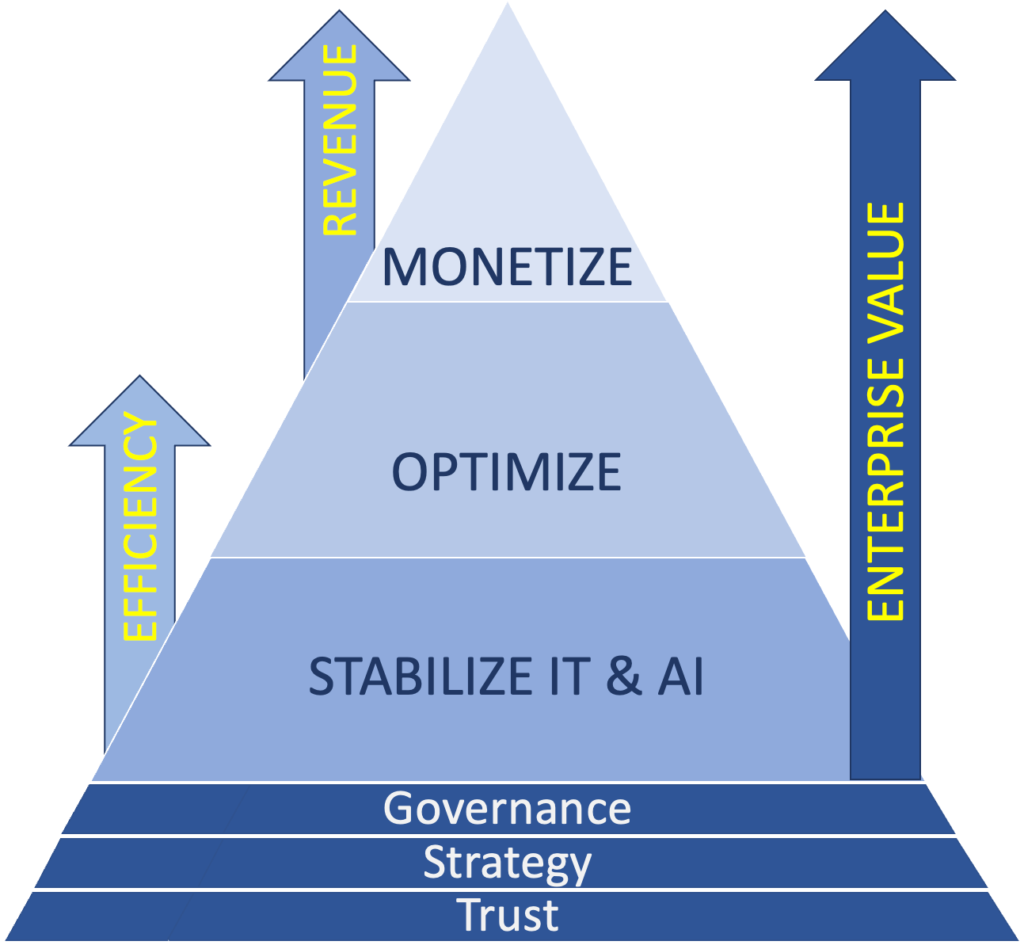
Ask around any airline and you will find AI in daily use: a dispatcher summarizing NOTAMs with a chatbot, marketing drafting campaigns, an analyst cleaning a spreadsheet with a copilot. That is everyday, individual AI, and it is welcome; it is also not what moves an airline. Operational AI is a different commitment: models embedded in the operation itself, disruption prediction the duty manager trusts, maintenance forecasting that changes the check schedule, offer and pricing engines that survive an auditor and a senator’s letter alike. Between scattered everyday use and trusted operational AI sits a readiness gap, and it is made of data quality, system dependencies, and governance rather than algorithms.
Our IT & AI Assessment maps that gap for an airline in weeks. It examines what actually determines outcomes here: the dependency map across PSS, crew, ops, maintenance, and loyalty systems, and where cascading failure hides; how cleanly operational data flows between those systems and whether the operation could trust a model built on it; how much of the roadmap is constrained by PSS and ops-vendor contracts and what leverage exists; whether the recovery architecture would stand up to the next vendor outage or weather event; readiness for NDC and offer-order commerce; and the governance any pricing or customer-facing AI will need before someone outside the building asks. The deliverable is a sequenced, board-ready plan tied to operational risk and commercial return, not a systems shopping list.
The bottom line: occasionally the honest answer is that the foundation cannot yet carry operational AI, and for an airline that finding is best delivered in a report, not discovered at 6 a.m. on a holiday weekend. Far more often the result is a short, fundable sequence: the dependency to de-risk, the data to connect, and the one or two operational AI capabilities that will pay for themselves first. In this industry, resilience and readiness are the same investment; carriers that make it stop making news for the wrong reasons.