
Biotech IT & AI Consulting
Proven IT & AI Leaders Who Have Scaled Life-Science Companies
Biotech IT & AI Experts
Biotech lives or dies on two things at once: the science, and the speed at which the company can turn that science into evidence investors and regulators will believe. Between those sits a technology estate that most emerging companies never planned, an ELN here, instrument software there, results in shared drives and spreadsheets, all of it accumulating faster than anyone can govern it. The moment AI enters the picture, that sprawl stops being an annoyance and becomes the rate limiter. In biotech, AI strategy IS IT strategy, and the data foundation is the experiment that has to work first.
That is the ground Innovation Vista covers. We bring fractional CIO leadership into life-science companies through Contract CIO+®, provide ongoing technology counsel through CIO IQ®, and guide scientifically credible AI adoption through our AI strategy practice. Our posture is independent and vendor-neutral by design: we take nothing from the ELN, LIMS, cloud, or AI platform vendors a growing biotech has to choose between, so the advice serves your runway rather than someone else’s quota. Within a network of 450+ sector-matched consultants, biotech engagements draw on leaders who have actually scaled research and early-commercial organizations, and who understand both a discovery workflow and the GxP wall it eventually has to cross.
Biotech is a focused part of our broader healthcare and life-science IT & AI consulting practice, and the companies we serve best are the emerging and mid-stage ones: therapeutics startups approaching the clinic, platform and tools companies, and scaleups outgrowing the systems that got them this far. Most relationships open with an IT & AI Assessment, a brief, high-leverage engagement that shows your board and investors exactly where the data and systems stand before the next capital-intensive bet.
State of Innovation in Biotech
Our 2026 Summary of Innovation in the Biotech sector
Primary shape of AI Dividend this year: Rising Bar, floor upstream
Biotech in 2026 is a story of recovery meeting reinvention. Capital is returning on more discriminating terms, AI is moving from slideware to the bench, and the companies that thrive will be the ones whose technology can keep pace with both.
The money is back, but it is selective. Biotech financing rebounded in 2025, and the IPO window, shut for the better part of two years, is reopening for companies with mature pipelines and real clinical data. Capital has concentrated into fewer, larger, later-stage rounds, which raises the bar on what a company must prove before the next raise. The throughline is evidence: investors are paying for de-risked data, and the institutions that can generate it cleanly and defend it credibly are the ones clearing the bar.
Dealmaking is being driven by a cliff. Big pharma faces a patent cliff that puts a large share of revenue at risk across the next several years, and the obvious refill is acquisition. Analysts expect a heavy 2026 of biotech M&A, including a string of billion-dollar deals. For an emerging biotech, that environment rewards being acquisition-ready in a way that is not only scientific: clean data lineage, sane systems, and defensible IT and security posture are exactly what diligence teams tear into, and what can move or sink a valuation.
TechBio is hunting for proof. The center of gravity in AI investment has shifted to R&D, with the great majority of AI dollars going to target identification, molecular design, and trial recruitment. The frontier conversation is about multimodal foundation models and increasingly autonomous, agentic lab workflows. But the field is openly transitioning from promise to proof points, and the companies that will show those proof points are the ones whose experimental data is structured, connected, and machine-ready rather than scattered across instruments and drives.
Data sprawl is the quiet killer. Life-science data volumes are exploding, yet surveys keep finding that scientists spend the majority of their time wrangling data rather than interpreting it, and that the leading reason AI initiatives fail is neglected data quality and governance early on. For a biotech trying to do more with a team that is not growing, this is decisive: throughput now comes from better systems, not more headcount, and AI amplifies whatever foundation it is given, including a bad one.
The GxP wall is coming, and it is worth planning for. Discovery-stage freedom collides, eventually, with regulated reality, and industry bodies are actively writing the rules for AI in that world; PIC/S has signaled a good-practice guide for AI in GMP, and GAMP 5 thinking is being extended to machine learning. The companies that fare best treat data integrity and traceability as something to build in from the research bench, not retrofit at the regulatory threshold. The pattern beneath every one of these trends is the same: in biotech the binding constraint on AI is rarely the model, it is whether the underlying data and systems are clean, connected, and ready to scale.
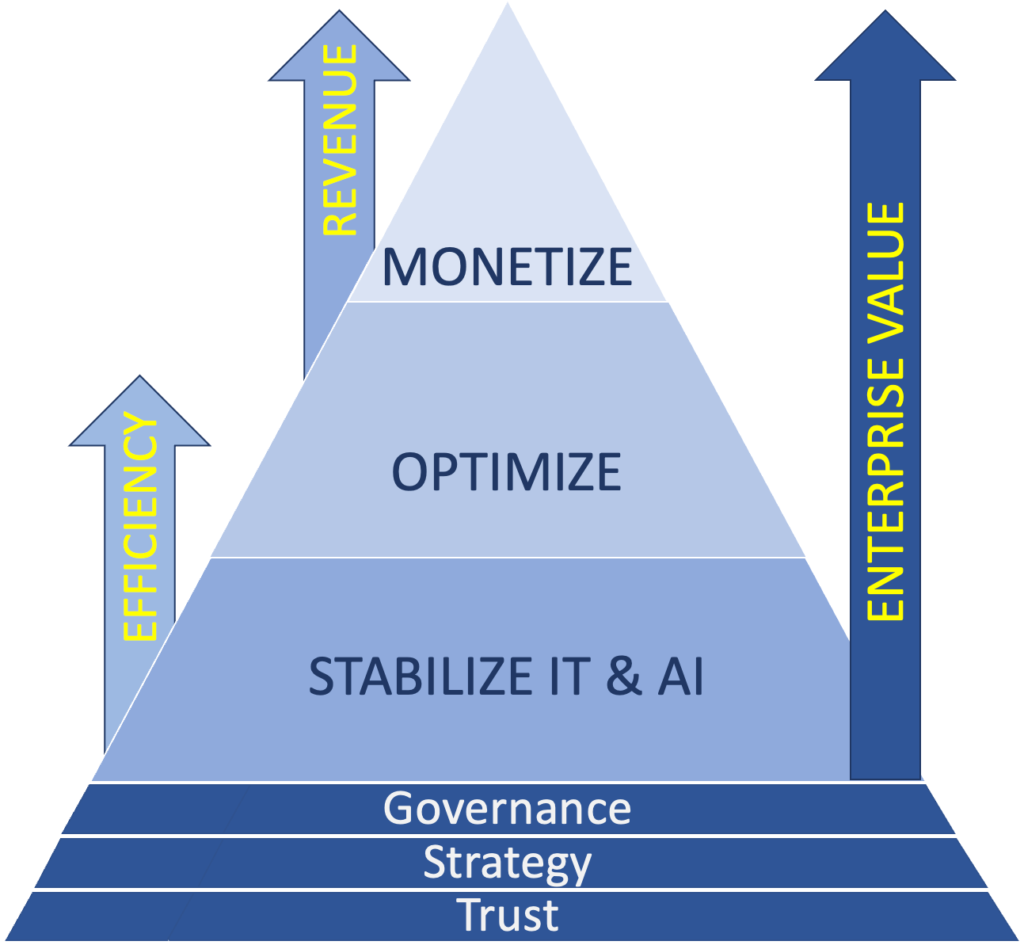

From Scattered Pilots to Production Science
Why a Biotech IT & AI Assessment Earns Its Place First
Every biotech is already using AI somewhere. A researcher prompts a model to summarize a body of literature, a writer drafts a grant section, an analyst cleans a dataset with a copilot. That is citizen AI, talented people reaching for general-purpose tools, and it is genuinely useful; it simply does not change the trajectory of the company. Production science is the other thing: models and agents woven into the actual work, prioritizing targets, designing experiments, flagging anomalies in instrument data, accelerating analysis, feeding decisions with results that can be trusted, governed, and, when the time comes, validated. The leap from one to the other is where biotechs pull ahead of their cohort, and it is overwhelmingly a readiness problem rather than a model problem.
Our IT & AI Assessment measures that readiness on a startup’s clock, in weeks. For a biotech it looks hard at the things that actually gate progress: whether experimental data flows cleanly from instruments, ELN, and LIMS into something analyzable, or dies in silos and spreadsheets; how much of your scientists’ time is lost to data wrangling that better architecture would erase; whether your data lineage and security would survive acquisition diligence or a future GxP audit; which platform and cloud commitments scale with you and which become anchors; and where AI can realistically create an edge given your stage and pipeline. What you get back is a sequenced, board- and investor-ready plan tied to risk and value, not a procurement list.
The bottom line: a candid assessment will sometimes say the data foundation is not ready to scale, and for a company spending investor capital that truth is a gift delivered early rather than a wall discovered late. More often it returns a tight, fundable agenda: the data to structure, the integration to build, and the one or two places AI can move your science now. In biotech, a foundation that scales is the difference between a platform and a science project.