

Project Vista®

AI & Tech Investments Chosen by Process, Not Politics

Every department has a project it is sure should come first. Finance wants the reporting overhaul. Sales was promised a CRM upgrade last year. Operations is still waiting on automation, and your board wants to know why AI is not moving faster. Nobody is wrong; every one of those needs is real. But your company cannot fund, staff, and absorb all of them at once. When seniority or persistence settles the order, your people are spread thin and the best ideas die quietly for lack of a sponsor.

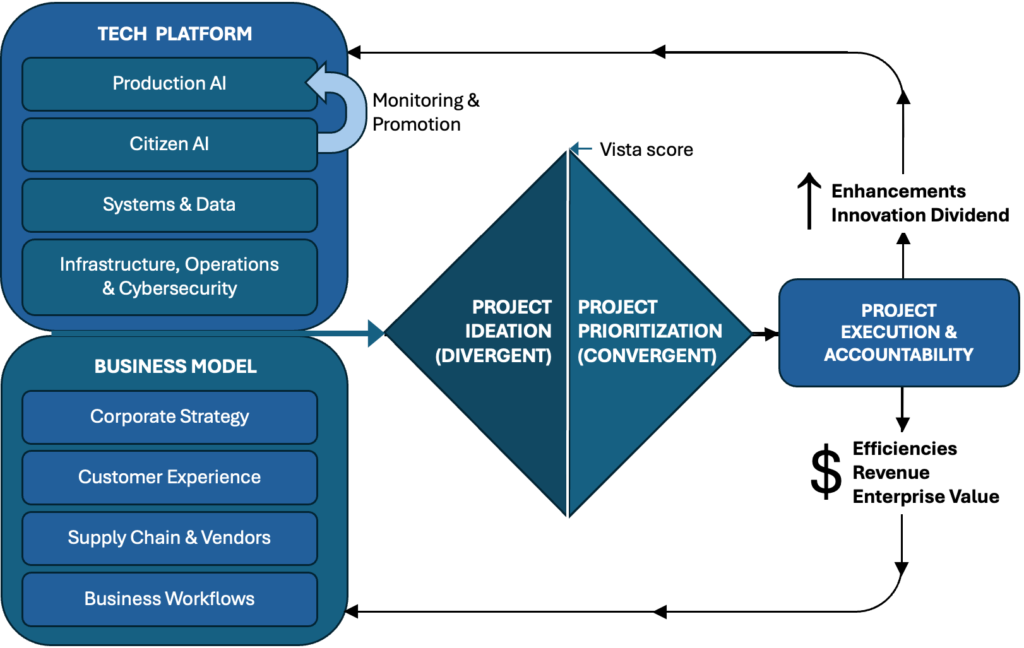
Project Vista is the process we use to replace that meeting. It goes wide to find everything your company could do, scores every idea on one scale, funds only what your leadership can absorb, and proves each result before the next round begins. Innovation is not lightning. It is a process, and it can run on a schedule.

Ideating needs freedom; Prioritizing needs a Rubric

Separating the Phases Which Need Different Kinds of Thinking

  • Surface · What could we do? We start wide and judge nothing: one-on-one conversations across functions and levels, a green-field look at what you would build if you were starting today, an opportunity matrix so no category of value goes unexamined, and brainstorms that begin with individual pre-work. The inventory includes the AI your people have already built on their own. The output is not a recommendation. It is the full list.
  • Score · What is each idea worth? Every idea meets the same yardstick, the Vista Score: what it returns, against what it costs and how hard it will be for your company to absorb. Rough sizes are enough to rank a long list in one working session; detailed estimates are saved for the ideas that make the cut.
  • Sequence · What will we do, and when? A ranked list is not a plan. Leadership attention is finite, so the portfolio is sized to what your company can run at once, with quick wins placed early and foundation work ahead of the projects that depend on it. Approval comes in two steps: first to plan, then to fund, once design has replaced estimates with real numbers. Saying “not yet” to a good idea is part of the method.
  • Prove · Did it move the number? Every funded project carries the result it was approved to produce. Checkpoints follow that result through delivery, and each bet ends in a verdict: scale it, rework it, or kill it cleanly. What you learned goes back into the inventory, and the cycle turns again.

First we go wide, then we go narrow; never both in the same session.

The Vista Score · One Yardstick for Every Idea

Prioritizing the Right Projects · the Vista Score
Vista score

Making decisions about scarce resources, on a portfolio of potential projects from across the organization, an objective rubric fills a key role. It removes the politics and helps the entire room view the projects from the perspective of the CEO and Board of Directors.

Beyond plain ROI: of course, the costs, efficiency and revenue a project promises (ROI) are key components of the Vista Score. But to that concept we add what is saved on the projects that follow, as well as the complexity and organizational friction of delivering each.

Difficulty multiplies cost. A hard project does not only cost more; it uses up the leadership attention every other project needs. So disruption to your people and oversight from your leaders sit under the line with investment, joined under a square root because the two usually arrive together.

Foundations get credit. Some projects matter most for what they make cheaper later: clean data, a shared integration layer, a data warehouse. The score counts those later savings, each weighted by the odds that the later project is ever funded. We call that payoff the innovation dividend; the right projects pay you twice.

Sizes before spreadsheets. Each input is sized XS to XL on an exponential scale set for each client’s situation. A transformative idea is not flattened into a list of small ones, and nobody builds a technical design spec and financial model for an idea that will not make the cut.

Two years by default. Return is judged as return on invested capital over two years. The ground moves too fast now to lean on year three, so we treat it as gravy.

A Key Process in the Overall Tech Governance Toolkit

Where Project Vista Fits

With governance. Governance decides which AI your company stands behind. Project Vista decides which projects earn the investment to get there. The two run as a cycle; each new production system feeds the next review.

With your stage. Project Vista works at every stage of Stabilize, Optimize, and Monetize; the stage changes what rises to the top. While core systems are still unsteady, stabilizing work rises first, on its own impact and because it lowers the cost of everything after it. Once the platform holds, the real choices begin, and revenue projects climb because the earlier work has cut what they cost.

With AI. For AI, the unit of work is the quarter, not the project: map what is already running, harden one or two candidates for production, then prove or kill each one against the number it was meant to move. One quarter is one turn of the cycle.

With your people. The wide half runs on collaboration, where every voice counts the same. The narrow half runs on teamwork, where everyone commits to the plan whether or not the idea was theirs. Both depend on a culture where ideas are safe to offer and on a team that knows the change is theirs to build.


An experienced leader, not a committee
A Named Leader for a Critical Oversight Cycle

Project Vista works best when it’s led by a person, not a committee. Every Project Vista cycle is led by a sector-matched CIO/CTO Consultant who has run technology inside a company like yours; they answer to you alone. We sell no software and support none, so nothing on your list is ours to push.

  • No CIO? A Contract CIO+® leader owns the cycle and its results, month to month.
  • A CIO with a full plate? A virtual CAIO owns the AI queue alongside them, or CIO IQ® advisory guides your own team through the scoring.
  • Not sure what is on your list? Start with an IT & AI Assessment. It produces the first map of what is running and the first ranked recommendations.
!nsights on Governing Innovation