
Tech Governance

Mid-Market Tech Governance Built for Speed & Innovation

Your people are already building with AI, and your vendors have already switched it on. What most mid-market companies lack is not a policy; it is someone whose job is deciding which of that AI the company stands behind. That gap exists with or without a CIO, because the job did not exist when the org chart was drawn.

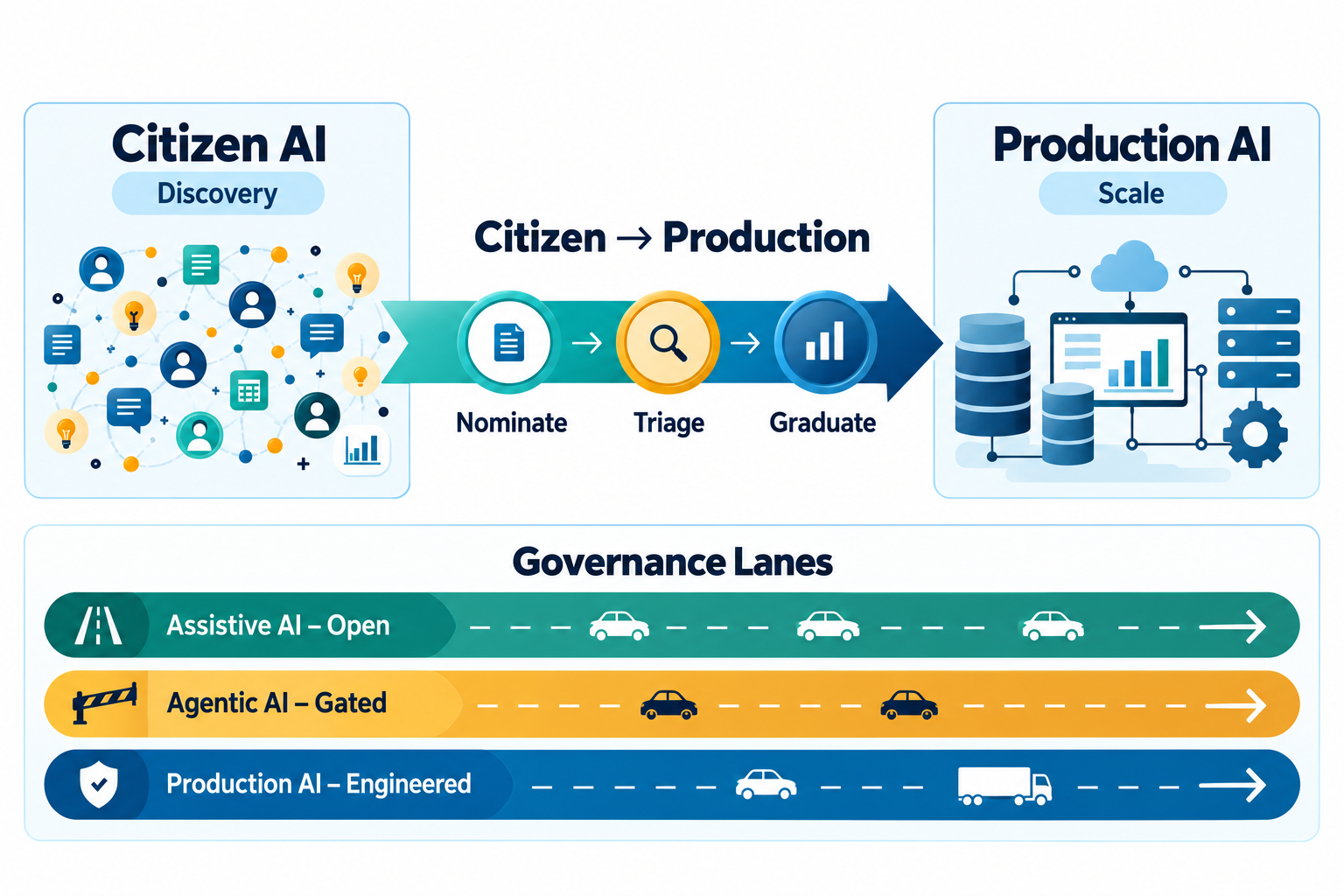
AI governance at your size is a small set of standing decisions: which AI you rely on, who is accountable for it, and how you find out when it goes wrong. We call our approach the Governance Freeway. Guardrails are what let traffic move fast. A company with no rules for AI does not move faster; it stops at every intersection because nobody knows who has the right of way.

Our "Highway" Model for Governance

Governance You Can Run on Two Pages

  • A clear view of every AI in use. A short inventory of what your people built, what your vendors switched on, and what your projects shipped, each with a risk class, so nothing that touches customers or money runs unseen.
  • A name on every AI that matters. An accountable owner for each production system and for any tool that does more than assist; when a builder leaves, nothing is orphaned.
  • One answer when two AIs disagree. A written system of record for each decision AI touches, with authority limits for agents that write into your ERP or CRM.
  • A plan for the Friday afternoon. A one-page AI incident path: who turns it off, who tells the customer, and who decides when it comes back on.
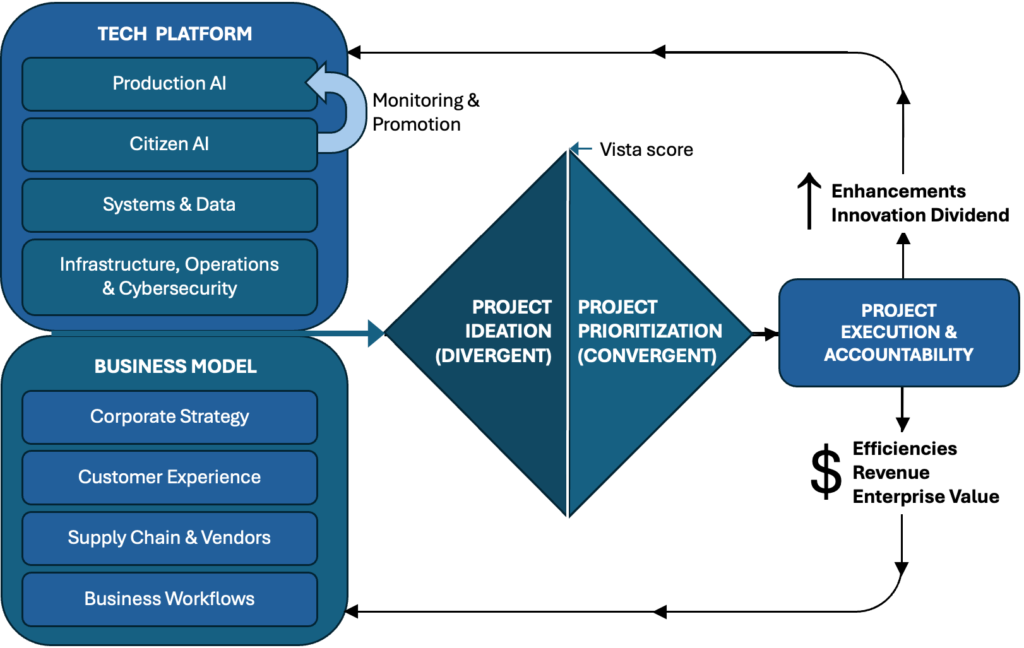
  • AI investments that earn their place. Project Vista, our triage method, ranks proposed AI projects on what each must prove in dollars before it is funded and put into production.
  • Answers ready for customers, auditors, and your board. Most of what a large customer’s AI questionnaire asks for, kept current in a few hours a quarter.

The sixty-page policy can wait, and often never needs to arrive at all.

How the Approach Works

From Citizen AI to Production AI

A pipeline, not a wall. Citizen AI, what others call shadow AI, is what your people build on their own: fast, cheap, close to the work, and invisible to leadership. Production AI is what the company has decided to stand behind, with a named owner, a record of what it did, a test before changes go live, a fallback, and a date to decide whether to keep it. Governance sets that bar. Nothing in it stops your people from building; it gives what they build somewhere to go.

Paced by readiness. AI is only as trustworthy as the data it reads and the platform it runs on. Assessments establish where both stand, and our maturity phases, Stabilize, Optimize, and Monetize, set how far to open the gate: tightly while core systems are still settling, wider once the platform is stable. Governance and Project Vista then run as a cycle, each new production system feeding the next review.

Independent by design. Vendors are embedding AI in software you already own, often at renewal and often with new terms for your data. We sell no software and support none, so we review those features, and every AI investment, with nothing to protect.

With or Without a CIO

Who Leads Your AI Governance

A person, not a committee, and not your IT vendor; a vendor cannot govern the AI it sells or supports. The role needs someone who has run technology inside a company like yours, can read a vendor contract, and answers to you.

  • No CIO? Governance is the first job of the CIO you don’t have yet, and it is where most Contract CIO+® engagements now begin: a sector-matched former CIO, month to month.
  • A CIO without room for AI? A virtual CAIO works alongside them. Your CIO keeps the platform; the vCAIO owns the inventory, the standing decisions, and the Project Vista queue, and both answer to you.

We use AI to monitor AI in our own engagements, and the monitoring still reports to a person. AI can’t lead itself. If you are early, start with our AI Maturity self-assessment; if AI is already in front of your customers or inside your ledger, start with a conversation and we will begin with the inventory.

learn more

Latest !nsights on Governance