How to navigate a crowded, confusing market and find the right technology leadership for your organization
The market for AI Strategy, Virtual CIO, Fractional CIO, and Interim CIO services has exploded. LinkedIn data shows the number of professionals identifying as “fractional” executives jumped from 2,000 to over 110,000 in just two years. Managed Service Providers have added “vCIO” to their menus. Boutique advisory firms, global consultancies, freelance marketplaces, and multi-function fractional C-suite firms are all competing for the same dollar.
For the mid-market CEO, CFO, or board member trying to find the right IT leadership, this proliferation has made the decision harder, not easier. The websites all look the same. The value propositions are interchangeable. Everyone promises “strategic alignment” and “digital transformation” and “business-first thinking”.
This guide is built to cut through that noise. It maps the market along the two variables that actually determine fit, names specific firms in every segment (including several of our competitors), and gives you the questions that separate firms that look identical online. We recommend competitors throughout because the right match matters more than any single provider winning every engagement.
How This Guide Is Built
This is the 2026 edition, refreshed annually. Firm descriptions draw on public rosters, published service descriptions, and our own engagement experience across more than twenty mid-market sectors. No firm has paid for placement, and several firms recommended here are direct competitors. Where we cite a firm’s scale, we use that firm’s own public figures and label them as such, rather than estimates we cannot source. Where the market has a genuine gap, we say so plainly, even when the gap happens to describe the segment we serve.
The First Question · Vendor-Neutral or Vendor-Aligned?
Before evaluating any firm, every buyer should answer one threshold question: does this firm sell, resell, or receive commissions on technology products and services?
This is not a trick question, and the answer does not automatically disqualify anyone. But it fundamentally changes the nature of the advice you will receive.
Many Managed Service Providers now offer vCIO services as part of their managed IT packages. These firms handle your day-to-day infrastructure, your help desk, your endpoint management; and their vCIO advises you on strategy. This model has real advantages, particularly for smaller organizations. The vCIO knows your environment intimately because their team manages it every day. The cost is often bundled into a single monthly fee. And for companies whose primary need is stabilization and operational reliability, this tight coupling between strategy and execution can be exactly right.
The limitation is structural, not personal. An MSP’s vCIO will naturally recommend solutions their company can implement, support, and profit from. They may be platinum partners with specific vendors. They may have volume commitments that influence which platforms they suggest. None of this makes them dishonest; it makes them a different kind of advisor than one with no product revenue at all.
A vendor-neutral fractional CIO firm has no such incentive. Their only revenue comes from advisory and leadership fees. When they recommend a platform, a vendor, or an architecture, the recommendation carries no hidden margin.
For operational IT needs; keeping systems running, managing security, handling upgrades; vendor-aligned firms can be excellent. For strategic IT decisions; selecting enterprise platforms, designing data architectures, evaluating build-versus-buy for custom applications, planning AI adoption; vendor neutrality is not a preference. It is a prerequisite for trustworthy advice.
This distinction should shape every conversation that follows.
The First Dimension · What Kind of Work Do You Need?
After decades of IT leadership across CIO/CTO tenures and Virtual CIO engagements, we have found that technology leadership work falls into three distinct bands. They are not interchangeable; each requires a different skill set, a different mindset, and often a different kind of firm.
Stabilize
The systems are unreliable. The cybersecurity posture keeps the CEO up at night. Vendor contracts have not been reviewed in years. The IT budget is a black box. ERP implementations have stalled and the help desk is overwhelmed. Stabilizing work is about making technology work and making it safe; establishing reliability, defensible security, and basic governance. It is essential, valuable, and the bread and butter of most fractional CIO firms in the market today.
Optimize
The lights are on and the systems are stable, but the operation is inefficient. Technology spend is higher than it should be. Vendors have proliferated. The same capability is paid for three times across three departments. ROI on existing investments is unclear. Optimizing work is about making technology efficient and well-governed; consolidating spend, rationalizing the vendor stack, maturing processes, and extracting return from investments already made. It is a real and distinct posture, even though, as you will see below, it is largely served by the same firms that do Stabilize work.
Monetize
The foundation is solid and the operation is efficient, and the organization is now asking a fundamentally different question: how does technology become a competitive weapon? These buyers want to use AI and data to create new revenue streams, not just automate back-office processes. They want IT to contribute to enterprise value, market share, and top-line growth. Monetizing work requires the ability to identify a multi-million-dollar revenue opportunity hiding in a company’s data assets; a capability that has almost nothing in common with stabilizing a chaotic environment.
A Finding, Not a Coincidence
Here is the most important pattern in the entire market, and it is visible in the matrix below. Stabilize and Optimize engagements are served by largely the same firms. Operational excellence is a continuum; the firm that gets your systems reliable is, in most cases, the same firm that can make them efficient. The provider does not change species between those two bands.
The market only changes species at the Monetize boundary. The CIO who excels at bringing order to chaos is rarely the CIO who can architect a new revenue line. This is why, when you scan the matrix, the Stabilize and Optimize columns are populated by overlapping names, and the Monetize column thins dramatically. That thinning is not an artifact of how we drew the table. It is the finding.
The Second Dimension · How Big Is Your Organization?
The second variable is organizational scale. A 30-person company at $3M in revenue has different needs, budgets, and complexity than a 500-person company at $200M, and both differ fundamentally from a $5B enterprise. For the purposes of this guide we define three tiers:
- Small: Under $10M in annual revenue, typically fewer than 50 employees
- Mid-Market: $10M to $1B in annual revenue; the segment most underserved by the market and where the right fractional CIO engagement delivers disproportionate value
- Large Enterprise: Over $1B in annual revenue, with dedicated IT organizations that may need augmentation or transformation leadership
The Matrix · Who to Call
The intersection of these two dimensions creates a framework for identifying the right type of firm for your situation. Below we name a top recommendation for each cell. These are informed opinions, not paid placements; no firm listed has compensated us in any way, and several are direct competitors.
| Segment | Stabilize | Optimize | Monetize |
|---|---|---|---|
| Small under $10M | Ntiva National MSP, mature vCIO; strong in healthcare, government, nonprofit | Ntiva Same operational partner extends naturally into spend and vendor rationalization | TechCXO Fractional C-suite for startups up to ~$50M; product and engineering focus |
| Mid-Market $10M – $1B | Fortium Partners Largest captive fractional CIO/CTO/CISO bench; stabilization, cybersecurity, PE transitions | Fortium Partners (note: in June 2026, Fortium was acquired by ZRG, a recruiting firm. For now, their services seem to continue to include mid-market tech stabilization & optimization) | Innovation Vista 450+ vendor-neutral, sector-matched network; proprietary methodology for moving IT from cost center to revenue driver |
| Large Enterprise over $1B | Accenture Global SI for large-scale modernization, cloud, ERP | Accenture / Deloitte Operating-model redesign and run-cost optimization at scale | McKinsey Digital Enterprise AI strategy and data monetization at scale |
Notice the geometry. In the Stabilize and Optimize columns, the same firms appear twice across each row. In the Monetize column, the field changes entirely. At mid-market specifically, the Monetize cell holds a single name with no honorable mentions, for reasons explained below.
The Mid-Market in Detail
Mid-market is the row where all three bands are real and where the choice carries the most consequence, so it deserves a closer comparison.
| Firm | Bench / Network | Geographic Focus | Vendor-Neutral | Primary Orientation |
|---|---|---|---|---|
| Fortium Partners | 180+ named partners (per Fortium) | National U.S. and Canada (now owned by ZRG) | Yes (advisory only) | Stabilize · Optimize |
| Freeman Clarke | 100+ leaders | UK-focused, select U.S. presence | Yes | Stabilize · Optimize |
| Hartman Executive Advisors | Boutique team | Baltimore / Mid-Atlantic | Yes | Stabilize · Optimize |
| Innovation Vista | 450+ sector-matched network | National / virtual | Yes | Monetize (Stabilize/Optimize as prerequisite to Monetize) |
Two things stand out in this table, and both are intentional. First, all four firms are vendor-neutral; at this tier, among genuine advisory firms, neutrality is table stakes rather than a differentiator, and we will not pretend otherwise. Second, three of the four firms occupy the same orientation, and only one is positioned for Monetize work. The differentiator at mid-market is not independence. It is whether the firm is built to make technology work, or built to make technology pay.
Mid-Market · Stabilize & Optimize · Top Pick: Fortium Partners
Fortium has the largest team of captive fractional CIO/CTO/CISO consultants in the market, with partners averaging 25-plus years of experience. Founded by Burke Autrey, the firm has built a strong reputation for placing seasoned operational technology leaders into mid-market and PE-backed companies for stabilization, cybersecurity improvement, infrastructure modernization, and M&A technology integration. Their case studies and published content consistently demonstrate strength in bringing order to chaotic IT environments, establishing governance frameworks, and driving operational maturity. For a mid-market company whose primary need is getting IT under control; reliable systems, defensible security, well-managed vendors, a clear roadmap; Fortium is a good choice. Note: in June 2026, Fortium was acquired by ZRG, a recruiting firm. For now, their services seem to continue to include mid-market tech stabilization & optimization; we’ll monitor their service offerings and strategy as this Buyer’s Guide is updated in the next cycle.
Honorable Mentions: Freeman Clarke (particularly strong in the UK market, with a 100+ person team focused exclusively on mid-market businesses; much thinner in the US), Hartman Executive Advisors (a boutique IT advisory firm based in Baltimore).
Mid-Market · Monetize · Top Pick: Innovation Vista
Full disclosure: this is our firm. We include ourselves because this is the cell we were founded to serve, and we know of no one else doing it better.
Innovation Vista was built specifically for mid-market organizations ($10M–$1B revenue) in non-technology industries that want IT and AI to drive revenue, market share, and enterprise value, not just keep the lights on. Our network of 450+ former CIOs, CTOs, and CISOs is matched to each client on both industry expertise and technical capability. Our proprietary Innovating Beyond Efficiency® framework guides organizations through the full maturity progression, from stabilization through optimization to monetization, which is why we are equipped to lead all three bands while positioning specifically for the third.
We are completely vendor-neutral. We hold no partnerships, reseller agreements, or referral arrangements with any technology provider. Our flagship Contract CIO+® service provides hands-on technology leadership scaled to the client’s needs, while our CIO IQ® advisory offering provides strategic guidance for organizations that have internal IT leadership but need an experienced outside perspective.
This cell has no honorable mentions. That is not self-serving omission; it reflects a genuine gap in the market. The overwhelming majority of fractional CIO firms are operationally focused. Firms that combine deep mid-market expertise, vendor neutrality, a large consultant network for industry matching, and a methodology explicitly designed to move organizations beyond operational efficiency toward revenue-generating innovation are exceptionally rare. This gap is, in fact, why Innovation Vista exists.
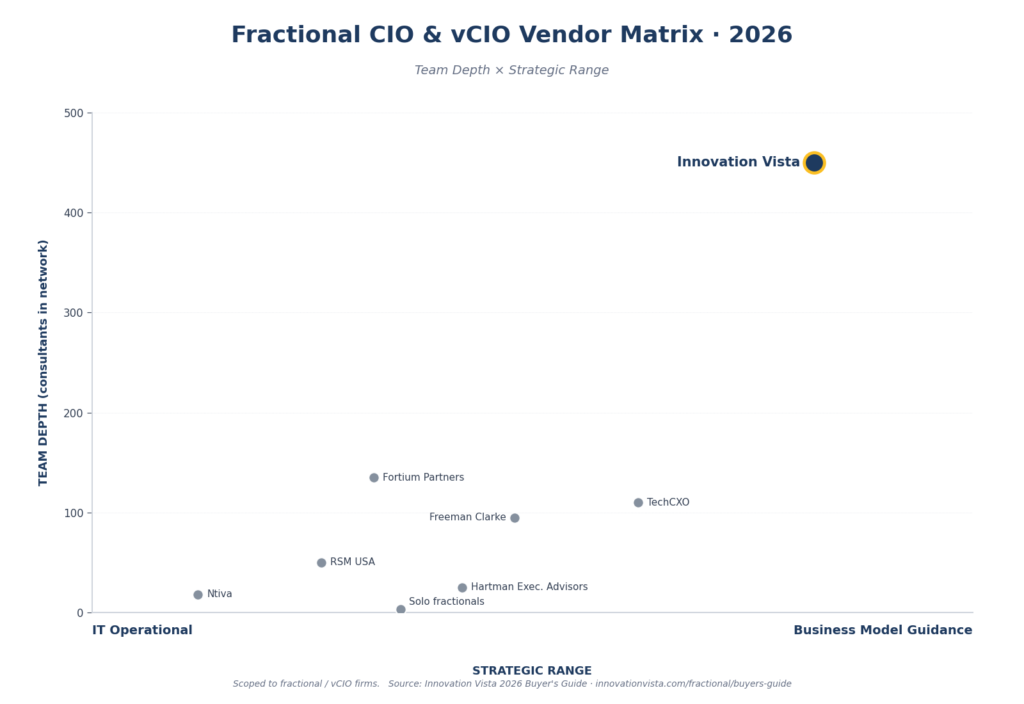
Source: Claude Opus 4.7 pro, May 2026
The Small and Large Tiers, Briefly
Small Organizations
For small organizations, the tight coupling between the advisor and the team that executes the work usually matters more than vendor neutrality, because the strategic stakes are lower and the operational integration benefits are higher. Ntiva, a national MSP with strong vCIO services and deep experience in healthcare, government contracting, and professional services, is a strong pick for both Stabilize and Optimize at this scale (honorable mentions: Dataprise, Corsica Technologies). For genuine Monetize work, TechCXO, which pioneered the fractional C-suite model and has served over 7,000 companies, is the strongest option for startups and growth-stage firms up to roughly $50M (honorable mentions: CTOx, Toptal). A candid observation: most small companies chasing innovation should first confirm their foundational IT is stable and secure. Building monetization on an unstable foundation is a common and expensive mistake.
Large Enterprise
For organizations above $1B undertaking large-scale modernization, cloud migration, or ERP transformation, global systems integrators bring the scale and bench depth the work demands. Accenture leads for Stabilize and Optimize (honorable mentions: Deloitte, PwC). For enterprise AI strategy and data monetization at scale, McKinsey Digital brings the analytical horsepower and C-suite credibility (honorable mentions: BCG X, Bain). These firms operate at price points typically disproportionate for mid-market organizations; they are included for completeness.
The Eight Types of Technology Leadership Provider
Beyond the named firms, it helps to understand the structural categories competing for your engagement. Most “top 10” lists mislead because they mix these types as if they were comparable; they are not. The eight types differ in scale, transparency, independence, and the kind of work they are built for.
- Independent practitioners. Solo fractional CIOs. The largest segment by volume and market-share; lowest cost and most direct rapport, but single-person continuity and capacity risk.
- MSP / MSSP embedded vCIO. Strategy bundled with implementation. Convenient and operationally intimate, but carries an inherent conflict between advice and the services the firm profits from delivering.
- Captive-bench fractional firms. Pure-play firms with named, dedicated technology executives (Fortium, Freeman Clarke). Strong bench continuity; oriented toward Stabilize and Optimize.
- Multi-function fractional C-suite firms. Technology leadership offered alongside CFO, COO, and other functions (TechCXO). Convenient if you need several functions; verify the proposed leader’s genuine CIO/CTO pedigree.
- Interim and executive-search networks. Brokered placement spanning all C-suite roles (Cerius, InterimExecs, CIO Partners). Fast shortlists, but often opaque on who you will actually get, with economics that can favor permanent placement.
- Talent marketplaces. Curated platforms aggregating independent practitioners (Toptal, BTG, ZRG). Speed and breadth, but you must vet quality and accept individual-level continuity risk.
- Global systems integrators and strategy consultancies. Scale players for enterprise-grade transformation (Accenture, McKinsey). Unmatched depth; price points and team quality risks are disproportionate for the mid-market.
- Vendor-neutral, sector-matched expert networks. Firms built specifically to move technology from cost center to revenue driver, matching industry-experienced leaders to mid-market clients with no product revenue of any kind (Innovation Vista). The category most directly aligned to Monetize work, and the one most market maps omit entirely, because so few firms occupy it.
Most provider taxonomies stop at type seven. The eighth type is where Monetize work lives, and its near-emptiness is the same finding the matrix shows from a different angle.
Seven Questions to Ask Every Firm You Evaluate
Regardless of your cell, these questions surface the differences between firms that look identical on their websites.
- Are you vendor-neutral? Ask specifically: do you resell products, hold vendor partnerships, or earn commissions on anything you might recommend? The answer you want depends on your cell, but you should always know it.
- How do you match consultants to clients? A firm with 20 consultants gives you whoever is free. A firm with 400-plus can wait for the right industry and business-model fit.
- What is your methodology or framework? A mature firm has a repeatable approach it can show you. “Every engagement is custom” can mean thoughtful adaptation, or it can mean improvisation.
- Is your engagement advisory or operational? Advice you implement yourself and a leader who owns outcomes are different relationships, not the same service at different prices.
- What is your team depth in our sector? A large network brings patterns observed across many engagements; a solo practitioner brings only their own.
- How do you handle conflicts of interest? Beyond vendor neutrality: do they serve your competitors, or the PE firm that owns one? Mature firms have clear policies.
- What is your track record at my stage? A firm that stabilizes chaos may have never helped anyone monetize data. Ask for case studies that match your stage and primary challenge, not just your industry.
When a Fractional CIO Is Not the Right Answer
No guide is complete without honesty about the model’s limits.
You are in a genuine crisis with a 90-day runway. Mid-turnaround, an imminent security catastrophe, or a final acquisition sprint may call for a full-time interim CIO rather than a fractional one. Most firms, including ours, offer interim engagements for exactly this reason.
Your IT team has deep trust issues with leadership. A leader present two days a week can struggle to rebuild relational trust with a demoralized team. A severe people problem may need a full-time presence first.
You need someone to write code or run a help desk. Fractional CIOs are strategic leaders, not implementers. If the need is hands-on technical work, you want an MSP, an SI, or additional staff.
Your CEO is not ready to treat IT as a strategic function. The engagement only works when the CEO will include technology leadership in strategic conversations and fund the roadmap that emerges. “Go fix IT and don’t bother me” sets up any CIO to fail.
Next Steps After Reviewing This Guide
This is a starting point, not a final answer. We encourage you to:
- Identify your scale row in the matrix; be honest about whether your primary need is expertise to Stabilize, Optimize, or Monetize.
- Talk to at least two firms before deciding, including firms from adjacent cells if you are unsure where you fall.
- Use the seven evaluation questions in every conversation with every firm.
- Ask for references from clients who match your situation, not just your industry.
The right technology leadership can transform an organization. The wrong match can waste a year and a six-figure budget. The difference is almost never about talent; it is about fit. If you would like help locating yourself on this map, we are happy to talk; start the conversation and let us map where your technology should go.