
Somewhere in your organization right now, a mid-level analyst is quietly doing the most valuable AI research your company will fund this year. She is not on the AI steering committee. She has no budget line. She has simply figured out, through a few dozen hours of trial and error, that a general-purpose AI assistant can cut a painful weekly reporting process from four hours to forty minutes. She has not told anyone, because she is not sure she is allowed to, or would be safe if she did.
Meanwhile, in a conference room several floors up, the leadership team is debating a question we hear in nearly every boardroom we advise: should we accelerate by training everyone on “Citizen AI,” or is that still too Wild West? Shouldn’t we channel our investment into a few serious, production-grade AI initiatives instead?
It is a reasonable question, asked by responsible leaders. It is also the wrong question. Citizen AI and Production AI are not two ends of a dial that leadership must set. They are two different organs in the same body, doing two different jobs, and the organizations winning with AI are not the ones that chose correctly between them. They are the ones that built the connective tissue linking one to the other.
Two Different Organs, NOT Two Ends of a Spectrum
Citizen AI is a discovery engine. When you put capable AI tools in the hands of hundreds of employees who understand their own work intimately, you are running hundreds of cheap, parallel experiments in where AI actually creates value in your business. No steering committee, however talented, can match that search capacity. The committee is guessing from the outside; the workforce is testing from the inside.
Production AI is industrialization. Once you know where the value lives, you invest with rigor: governed data, security review, integration into core systems, monitoring, accountability, and a business case with a named owner. Production AI is how a discovered opportunity becomes a durable capability instead of one person’s private productivity trick.
Seen clearly in this lens, the Citizen “versus” Production debate dissolves, and we realize that they are complementary. Discovery without industrialization evaporates; a thousand personal workflow hacks that never compound into anything the enterprise owns. Industrialization without discovery is guesswork; capital deployed into the use cases that sounded best in a conference room, which is how companies end up with expensive, capable platforms that nobody adopts. You do not choose between the organs. You make sure the bloodstream connects them.
What “Wild West” Gets Right, and What It Misses
The instinct behind the Wild West worry deserves to be taken seriously, because it is half right. But it is aimed at the wrong target, and the delta between the two matters a lot more now than it did two years ago.
Most Citizen AI activity is assistive: drafting, summarizing, analyzing, brainstorming. The blast radius of assistive AI is small. The worst realistic outcome is a weak paragraph or a flawed analysis, and both of those failure modes already exist in every organization that employs humans. Treating assistive AI as dangerous frontier territory, locking it behind restrictive policy, does not eliminate the risk. It relocates it.
Lockdown does not stop the behavior; it just stops the visibility.
Employees who find these tools genuinely useful will use them anyway, on personal devices and personal accounts, outside every control you own. We have watched security postures designed to prevent AI sprawl manufacture it instead. Lockdown does not stop the behavior; it just stops the visibility. Regulators have already priced this pattern: when major banks banned consumer messaging apps rather than governing them, usage simply went dark, and the industry ultimately paid billions in fines – not so much for anything said in the messages, but for the absence of records and supervision that the bans themselves guaranteed.
What has changed, and where the Wild West concern is now legitimate, is the arrival of agentic AI in citizen hands. An agent does not merely suggest; it acts. It touches systems, moves data, sends messages, executes multi-step work with credentials attached. A citizen-built agent with access to your CRM or your email is a categorically different risk than a chat window, and most AI policies written in 2023 and 2024 are silent on the distinction because the capability barely existed when they were drafted. Courts have already signaled that “the AI said it, not us” is no defense; an airline was held to a discount policy its own chatbot invented. And that was a sanctioned tool; an unsanctioned agent makes representations on your behalf that you will not learn about until the claim arrives.
So to honestly answer “is Citizen AI too Wild West?” we must bifurcate the question: Be liberal on assistive AI, because the risk is modest and the discovery value is enormous. Be gated on agentic AI, requiring registration, a named accountable owner, and scoped permissions before anything autonomous touches systems of record. The good news is that the major enterprise platforms have matured rapidly on exactly this point; agent identity, sponsorship, and lifecycle controls are now buildable with mainstream tooling rather than aspiration. The gate can be a fast lane with a checkpoint, not a review board that kills momentum.
The Missing Organ · A Promotion Pipeline
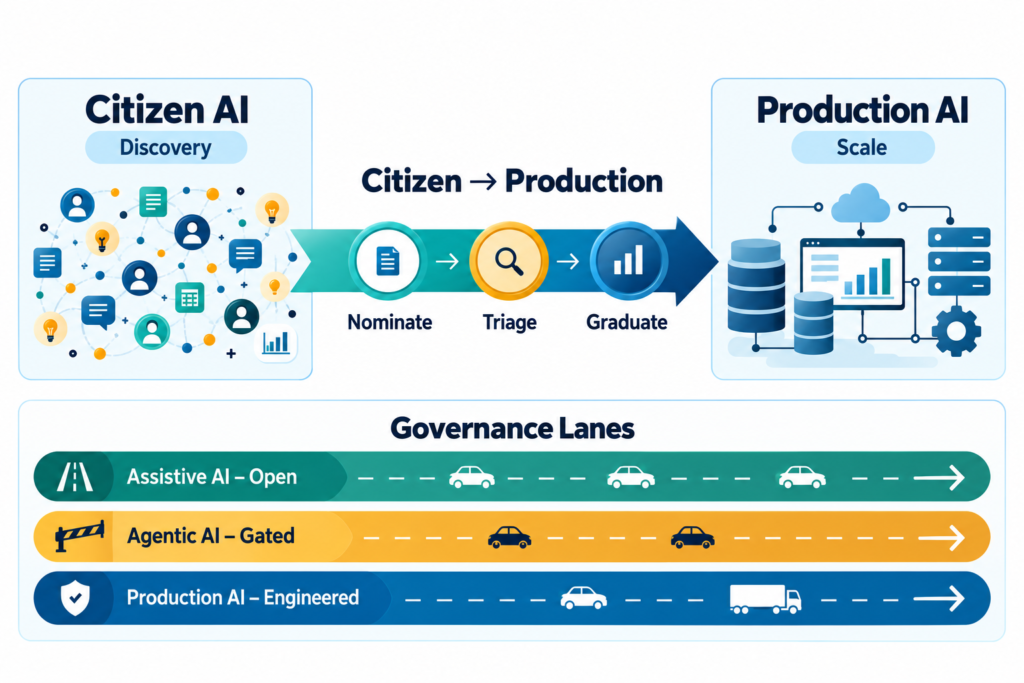
Here is the element we find missing in nearly every mid-market organization we assess, and it is the crux of this entire article. Almost nobody has a mechanism for noticing when a citizen user has invented something valuable which becomes a component of his department’s ongoing operations, and enabling a conversation about harvesting the model as a prototype for something grander, or even just putting the operation of the model on full autopilot by graduating it into a governed production capability.
The cruel irony is that the organization is already paying for the research; it is simply declining to read the results.
Think about what its absence costs. The analyst from our opening never surfaces her discovery, so it remains her personal advantage rather than a capability the enterprise owns, and it walks out the door when she does. Multiply her by every experimenter in the company and you are leaving your best-validated AI opportunities unfunded while the steering committee debates initiatives validated by nothing but intuition. The cruel irony is that the organization is already paying for the research; it is simply declining to read the results.
A promotion pipeline does not need to be elaborate. It needs a front door where employees can nominate what they’d like to propose for auto-pilot or expansion, an incentive to ensure they’ll want to walk through it, a lightweight triage that meets on a regular rhythm, and clear criteria for what graduates: how many people share this pain, what data does it touch, what would it take to harden, what is it worth at scale. The output is a production AI investment portfolio built from demonstrated demand rather than committee guesswork. In our experience this single mechanism does more to de-risk AI capital allocation than any amount of upfront strategy work, because it replaces prediction with evidence.
Follow the Unsanctioned Spend
If you want to know where that evidence hides, follow the money your employees are spending out of their own pockets. Across our client work we keep encountering the same striking pattern: the value employees derive from AI tools is often inversely correlated with how sanctioned those tools are. The officially licensed, centrally procured platform sits underused, while your most productive people quietly pay personal subscription fees for tools and custom agents the organization has never heard of.
Leadership teams tend to read this as a compliance failure. Read it instead as market research. When a top producer spends her own money on an unsanctioned tool, she is casting the most credible vote possible on where AI value lives in your business. She has skin in the game; the steering committee does not. An organization that responds to this signal with only enforcement is shooting the messenger. The right response is dual: yes, bring the activity into governed visibility, and simultaneously treat every instance of personal spend as a flashing arrow pointing at your next production AI candidate.
The Freeway, Not the Roadblock
None of this argues against the governance of AI. It argues for a particular kind of governance, which we describe to clients as a freeway rather than a roadblock. Roadblock governance stops every vehicle for inspection and is why so many AI programs stall: the review process costs more than the experiments it reviews, so experimentation goes underground. Freeway governance invests in infrastructure that lets traffic move fast precisely because the guardrails, lanes, and signage are engineered in advance.
In practice the freeway has three lanes. Assistive Citizen AI travels the open lane: broad access to approved tools, data loss prevention running quietly underneath, prompt libraries and communities of practice to spread skill. Agentic AI travels the gated lane: registration, a named human sponsor, scoped credentials, and monitoring, a checkpoint measured in minutes rather than committees. Production AI travels the engineered lane: full rigor, because these systems carry the enterprise’s weight. The freeway metaphor also clarifies what governance is for. Its job is not to minimize AI usage. Its job is to maximize safe throughput.
The Dividend Only Pays If Someone Redesigns the Work
Suppose you do all of the above and AI adoption flourishes. A warning from the field: adoption is not the same as return. When AI is bolted onto an unchanged workflow, the time it saves tends to be absorbed as slack, intercepted before it ever reaches the P&L or the customer. The gains become real only when a manager redesigns the process around the new capability: fewer handoffs, collapsed review stages, redeployed hours pointed at revenue-producing activity. This is the difference between an efficiency and a dividend, and it is why we train managers to redesign workflows with at least as much energy as we train employees to prompt.
There is a second bottleneck that’s more subtle: AI moves the constraint in knowledge work from producing output to verifying it. An organization that multiplies its draft output without expanding its capacity to review, validate, and take accountability for that output has not gotten faster; it has built a longer queue in front of its senior people. Evaluator skill, the ability to quality-check machine work quickly and know when to trust it, is a genuinely new competency, and almost no training budget currently acknowledges it.
And underneath both sits a question of trust. Employees hide their AI wins when they believe the surplus will be harvested against them. If the unspoken policy is that discovered efficiency becomes a headcount reduction, your promotion pipeline will receive nothing, no matter how elegantly you build it. Leaders who want honest signal must answer the dividend question out loud: when AI frees your time, where does that time go? The organizations getting the best telemetry are the ones that share the dividend visibly, some to the employee, some to the firm, and celebrate the people who surface discoveries rather than quietly restructuring around them.
The Best of Both Worlds
So, back to the boardroom question: do we train people on Citizen AI, or push investment toward Production AI? The answer is a sequence, not a selection. Open the assistive lane wide, because fluency is cheap and discovery is priceless. Gate the agentic lane now, before your first citizen-built agent quietly acquires credentials nobody is tracking. Then let production investment be driven by citizen signal: fund the two or three use cases your own workforce has already proven, and hold the rest of the portfolio lightly until the evidence arrives.
The failure mode of production-first is building cathedrals for congregations that do not yet exist. The failure mode of citizen-only is a thousand private miracles that never accrue to the bottom line. The best of both worlds was never a compromise between exploration and rigor. It is a pipeline that turns one into the other, on purpose, over and over. Efficiency gains are where that pipeline starts. What comes out the other end, capabilities your competitors do not have and cannot easily copy, is what it looks like to innovate beyond efficiency.
Why “Citizen”?
The alternative to a citizen is not a subject; it is an outlaw.
The term “citizen” was not chosen by accident. Citizenship has never meant unlimited license; it promises freedom conditioned on a rule of law, rights that exist because a framework of obligations surrounds them. Both halves of that bargain apply here. The rights: the curiosity your AI explorers are demonstrating is precisely the trait you screened for in recruiting them; and an organization that hires optimizers and then prohibits optimizing is at war with its own hiring criteria in worship of laziness. And there is an obligations half: that license to explore exists only because governance bounds it. And note that the alternative to a citizen is not a subject; it is an outlaw. Outlaw AI (unregistered, invisible, running on personal accounts) is exactly what blunt prohibition manufactures.