
We’re proud to present another unveiling of our proprietary approach to innovation, from our CEO’s “Innovation is a Process” series…
Picture the next ninety days of your AI program. Is this something you can do?
The reason you cannot picture a successful AI quarter is that nobody has ever shown you one.
Most CEOs cannot, and not because they lack imagination. It is because every version of “doing AI” they have ever been sold arrives shaped like a project: a kickoff, a scope document, a go-live date, a number at the end that either lands or it doesn’t. That shape has served you well for thirty years of enterprise software, and trusting it was never a mistake. It is simply the wrong shape for this. The reason you cannot picture a successful AI quarter is that nobody has ever shown you one.
That is the gap this piece is meant to close. Not the case for acting; you have read that case here a dozen times, and the board has made it to you in person. This is the thing underneath the case: a plain, unromantic view of what the work actually looks like when it is going well. What gets done in Month 1. What exists at the end of Month 2 that did not exist before. What your board sees on day 90, and why that thing is more valuable than the finished “AI transformation” you have been told to want.
Why the project shape fails, and what replaces it
Start with why the instinct misfires, because the failure is expensive and well-documented. RAND Corporation puts the AI project failure rate north of 80%; that is roughly twice the failure rate of conventional IT projects. MIT’s 2025 research landed in the same neighborhood, finding that the overwhelming majority of corporate AI pilots never produce measurable financial impact. The reflexive read on those numbers is that the technology is too immature to deliver results. But that is not dynamic we see failing. The technology is the most capable it has ever been and getting cheaper by the quarter. What fails is the operating posture around it.
A project has a beginning and an end. You scope it, you build it, you ship it, you are done. That works when the ground holds still long enough for the plan to stay true; for a payroll migration or an ERP rollout, it mostly does. The AI revolution does not give you stable ground. The models improve underneath you; your own people discover new uses faster than any roadmap can absorb them. A capability that was science fiction in March is a line item by September. Run that against a twelve-month project plan and the plan is obsolete before the second steering-committee meeting; you will spend the back half of the year executing decisions that the world already invalidated.
So the unit of production AI is not the project. It is the quarter. Ninety days is long enough to put something real into production and short enough to course-correct before the spend compounds into sunk cost. It matches the rhythm your board already runs on, and it matches the rate at which both the tools and your own discovery actually move. A company that is good at AI is not a company that finished an AI project. It is a company that has a quarterly cadence and runs it on repeat. The cadence is the asset. Everything below is one turn of it.
Month 1 · Mapping the field before building anything
The first surprise, for a CEO expecting a project, is that nobody builds anything in the first month. The work is cartographic. Before you can decide what to harden, you have to see what is already running, and in nearly every mid-market company more is running than leadership knows.
Your employees did not wait for your strategy. They have been quietly wiring AI into their own workflows for two years; the analyst with a prompt library that does half her reconciliation, the ops lead whose “spreadsheet” is now three tools in a trench coat. We have called this the rack of reinvented wheels running your company: dozens of unsanctioned, undocumented, often genuinely clever experiments holding up real work. This is Citizen AI, and it is not a problem to be stamped out. It is unsponsored R&D, and it is the richest source of production candidates you have.
Month 1 surfaces it and triages it. This is exactly the divergent-then-convergent rhythm at the center of how disciplined innovation actually works; you cast wide to see everything that is alive in the field, then you narrow hard to the few bets worth real investment. The divergent half is an honest inventory: what people are running, what it touches, where it would be catastrophic if it quietly went wrong. The convergent half is a ranking. Most of what surfaces is a toy and gets left alone. A few items are dangerous, touching customer data or regulated decisions with no controls, and those get flagged immediately. And two or three are real: high-leverage, repeatable, close to a number that matters.
The artifact at the end of Month 1 is not code. It is a ranked portfolio of production candidates, and attached to each one is the question that decides whether it can ever pay off: not “can the model do this” but “does our operating model let the answer change anything.” That distinction is the whole game, and it is why the AI ROI problem is almost never the model; it is the operating model around it. A flawless forecast that nobody is empowered to act on returns zero.
What your board sees at the end of Month 1 is a map: here is what is actually happening inside the company, here is the short list of what is worth hardening, here is the reason each one made the cut. For most boards it is the first time AI has been presented as something legible rather than something to be anxious about.
Month 2 · Building the freeway, hardening one real thing
Now you build, and you build narrowly. The discipline of Month 2 is restraint: you take the one or two top-ranked bets and you move them across the line from Citizen AI to Production AI. Everything else waits its turn. A quarter that tries to harden eight things finishes none.
The crossing has a name. We have written for years that tech governance should be designed as a freeway, not a roadblock; that the right guardrails are the things that let you go faster, not the things that slow you down. The Governance Freeway is the on-ramp from experiment to production, and “hardening” is the concrete work of driving a capability up it. It is unglamorous and it is the entire difference between a clever demo and a system you can bet revenue on.
In practice, hardening a bet means a handful of specific things, none of them exotic:
- An evaluation harness, so you can tell whether the thing is right and not merely fluent. A demo that impresses in a meeting and a system that holds up against real volume are different objects; the harness is how you know which one you have.
- The data plumbing, so the model is reading your actual source of truth rather than guessing. Most failed pilots fail here; you asked a genius to answer without letting it read the textbook.
- Human-in-the-Loop (HitL) checkpoints, deliberately placed. This may be a human reviewing every output, if that offers efficiencies and if the risk & complexity of the work product demand it; or it may be an overssight/quality control sampling function, equipped with KPI monitoring and a feedback loop to improve the models. Either way a human is positioned in a cost-effective role in places where the cost of being wrong is highest.
- Mapped failure modes, so you know in advance how the system breaks and what happens when it does, before a customer finds out for you.
- Integration into a real workflow, not a sandbox. The capability has to live where the work lives or it changes nothing.
Of course the architecture and decisions vary by sector, which is the point of putting an industry-matched leader at its head, rather than a generalist. For a logistics firm, the Month 2 bet is often a middle-office forecasting or exception-handling agent running against live shipment data. For a professional-services firm, it is a proposal- or document-drafting workflow wired into the real engagement history. For an insurer, it is claims triage instrumented so a human owns the high-stakes edge cases. Same cadence, same hardening discipline, different terrain; and the terrain is where most generic AI advice quietly dies.
The artifact at the end of Month 2 is one capability running in production, against real volume, instrumented so you can actually see whether it is working. Your board does not see a roadmap of intentions. It sees the first real thing live, and an early read on whether it is moving the number you told them it would.
Month 3 · Proving the number and earning the next quarter
The third month is where production AI separates itself from theater, because the third month is about measurement and a decision, not activity.
You return to the thesis you wrote down in Month 1; this bet was supposed to move a specific number by a specific amount. Did it? You now have weeks of real production data to answer honestly, and the answer falls into one of three buckets:
- It worked. The number moved, the mechanism is understood, and the path to scaling it is clear. You pour resources in and you widen the freeway.
- It half-worked. The model performs, but the gain is trapped because the operating model around it has not changed; the answer improved and nothing downstream is allowed to act on it. The fix is organizational, not technical, and naming that precisely is worth more than another model.
- It did not work. Then you kill it cleanly, on purpose, in week ten, having spent one quarter’s controlled budget instead of a year’s committed one. You harvest what the failure taught you and you fold it into the next portfolio. A clean kill is a successful outcome of a well-run quarter, not a failure of one; the failure is the company that cannot tell the difference and lets a dead bet limp along for a year because someone’s reputation is attached to it.
This is also where the firm’s incentives ought to be visible. When an advisor only gets paid on the calendar and only the client carries the downside, the honest “kill it” conversation is the one that never happens. For clients willing to truly “partner” with us on this journey, we think the right model puts the firm’s own chips on the table alongside the client’s, because the willingness to share not just the upside, but also the downside, is what makes the Month 3 verdict trustworthy. There are a few different ways a similar dynamic can be activated in situations where the clients prefer to keep traditional engagement economics and retain all of the upside potential for themselves.
The artifact at the end of Month 3 is twofold. First, a decision: scale, rework, or kill, backed by a real number rather than a vibe. Second, the next quarter’s portfolio, already ranked, because the field map from Month 1 has been refreshed by everything the quarter taught you. The board gets a clean board-meeting story; here is what we bet, here is what it returned, here is what we are doing about it, here is what is next. That narrative, repeated quarter over quarter, is what eventually lets you talk about AI in the only language the board ultimately cares about, which is its effect on earnings.
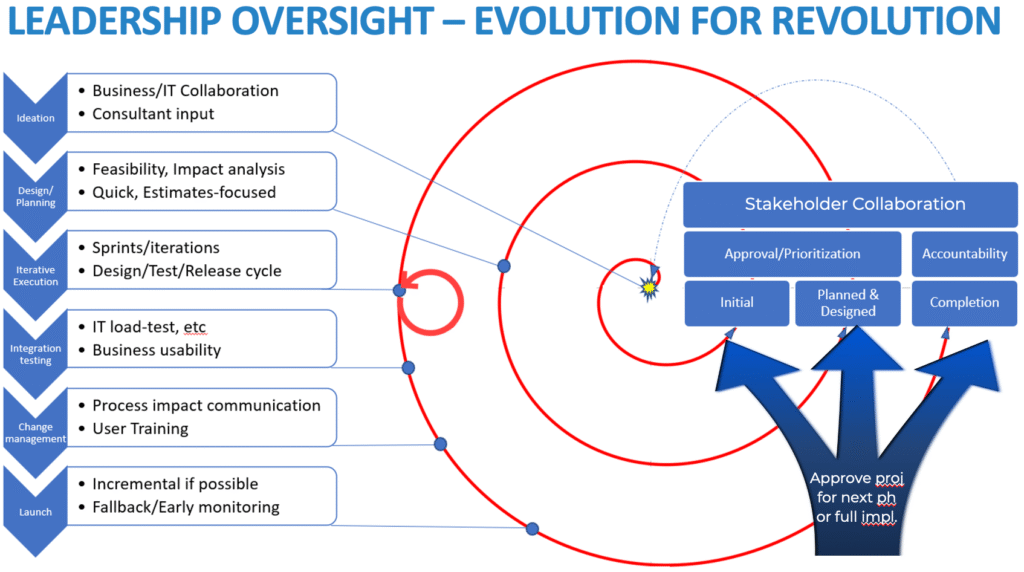
The Evolution Cadence Yields Revolution Over Time
Here is the part that reframes everything above. The thing you are looking at across these ninety days is not a finished AI transformation. There is no ribbon to cut, no go-live to celebrate, no project that closes. What you have at day 90 is one completed turn of a wheel: discover, prioritize, invest, measure, re-evaluate. And then it turns again.
That is the view into success; it looks almost anticlimactic from the outside, which is precisely why nobody sells it to you. There is no moment of “arrival”. What there is, instead, is a company that has stopped treating AI as an event and started running it as a disciplined process; one that surfaces its own discovery on a schedule, hardens the best of it deliberately, proves or kills each bet against a real number, and compounds the learning into the next quarter. The companies pulling away right now are not the ones that ran the biggest AI project. They are the ones whose third quarter is better than their first because the cadence has been running long enough to compound.
A project gives you a thing. A cadence gives you a capability that keeps producing things, and improves at producing them.
A project gives you a thing. A cadence gives you a capability that keeps producing things, and improves at producing them. The first is what most of the market is still trying to buy. The second is what actually moves enterprise value, and it is buildable in ninety days because ninety days is not the finish line; it is the first full revolution of the flywheel.
If you want to know what your own first quarter would surface, the honest place to start is a map of what is already running and which of it is worth hardening. That is what our IT & AI assessment is built to produce, and it is the same Month 1 cartography described above, run before you commit to a quarter. From there, an industry-matched Contract CIO+® leader runs the cadence with you, not at you. The technology has never been more ready. The only question left is whether your company is running a process or still waiting on a project. Let’s talk about what your first quarter would look like.