
by John Bentley II, CTO Consultant
The first version of my AI workflow looked like one assistant doing one job.
A potential client opportunity came in. The AI evaluated the request, identified risks, helped clarify the likely need, and drafted a proposal when the opportunity was worth pursuing.
That was useful because the workflow was still small.
When One Assistant Stops Being Enough
Then the system started answering more business questions.
Was the opportunity captured correctly? Was it strategically valuable? Had a proposal already been submitted? Did the client respond? Did the opportunity become a contract? Were acquisition costs producing a return? Did the outcome suggest that the evaluation criteria needed to change?
At first, it was tempting to keep expanding the original assistant. Add more instructions. Add more context. Ask it to handle another responsibility.
That eventually became the wrong design.
The Trust Problem With Large Instruction Sets
A large AI instruction set can look capable because it covers many scenarios. Operationally, however, it becomes difficult to understand which responsibility failed, which input was missing, and whether the output can be trusted. Improving one part of the workflow can also introduce inconsistency somewhere else.
The better answer was specialization.
The better answer was specialization.
Specialization as an Operating Principle
Different responsibilities naturally became different AI jobs. One captured incoming opportunities. Another evaluated fit, risk, and economic value. Another prepared proposals. Others reconciled messages, tracked contracts and transactions, monitored acquisition spend, and notified me when a decision required attention.
This did not mean pretending the AI workers were employees. It meant applying a familiar operating principle: responsibilities become easier to manage when they are clearly defined.
Each AI worker needed a purpose. It needed known inputs, an expected output, and a clear handoff to the next part of the system. Some ran on a schedule. Others responded to changes in the pipeline. Some interpreted messy information. Others performed structured reconciliation and quality checks.
That distinction matters.
Non-Deterministic Work Still Needs Deterministic Structure
AI is particularly useful when the work is non-deterministic. It can interpret incomplete requests, recognize patterns, surface risk, and recommend a course of action. But the surrounding business process still needs deterministic structure.
An opportunity should not disappear because one AI response was incomplete. A contract should not be recorded twice. A proposal should not be treated as successful simply because it was generated. The system needs state, history, handoffs, validation, and feedback.
That is the role of orchestration.
What Orchestration Actually Does
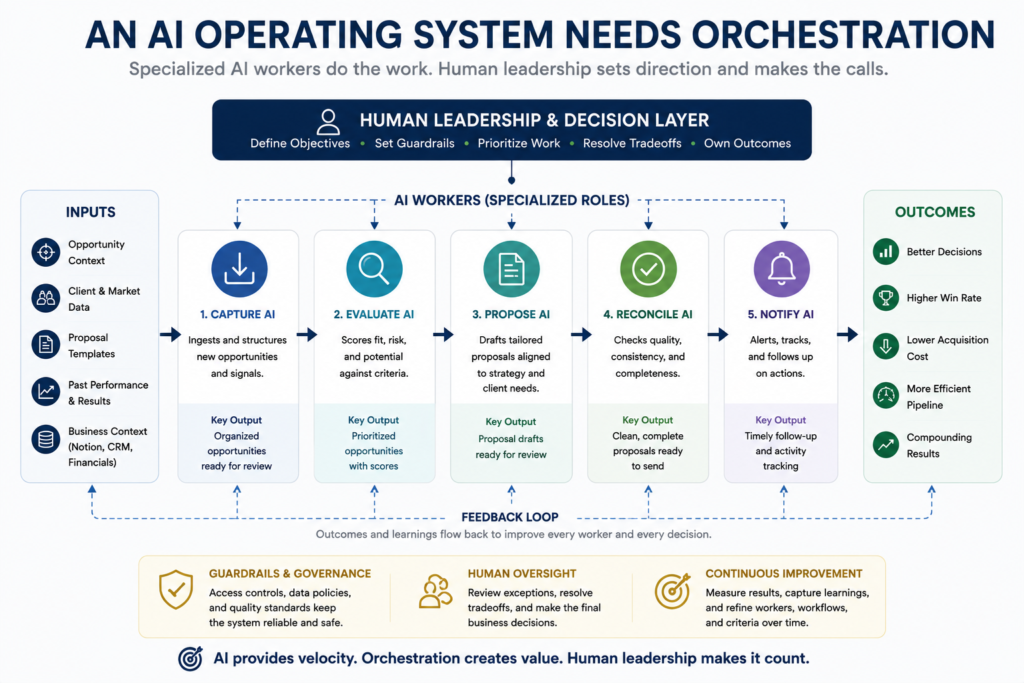
Orchestration determines which AI capability acts, what context it receives, where its output goes, and what happens next. It also creates the controls that make the overall system reliable: intermediate data capture, quality checks, escalation rules, and measurable outcomes.
The more specialized the AI workers become, the more important the decision layer becomes.
The Decision Layer Does Not Move
AI cannot lead itself. It can support the analysis, but it cannot own the business tradeoff.
Someone still has to decide what the system is optimizing for. Is the objective more proposals, better clients, higher-value contracts, faster response time, or lower acquisition cost? Those goals can conflict. AI can support the analysis, but it cannot own the business tradeoff.
Human leadership also remains necessary for exceptions. A borderline opportunity may be worth pursuing because it opens a strategic market. A seemingly attractive request may be wrong because it pulls the business away from its positioning. A workflow can identify the decision, but judgment still determines the answer.
This is why AI does not eliminate leadership.
It changes the work of leadership.
What Leadership Looks Like in an Orchestrated System
Instead of supervising every task, the operator designs the system: defining responsibilities, establishing decision rights, setting quality standards, reviewing performance, and deciding where human judgment must remain in the loop.
That lesson applies beyond a client pipeline. Sales intake, customer support, financial reconciliation, vendor management, compliance review, and internal reporting can all benefit from specialized AI capabilities. But each system still needs orchestration around the AI and accountability above it.
The future is not one autonomous assistant running the business.
It is an orchestrated AI team operating within a business system designed for measurable outcomes.
AI workers may perform more of the work.
Leadership still decides what good work means.
Leadership still decides what good work means.