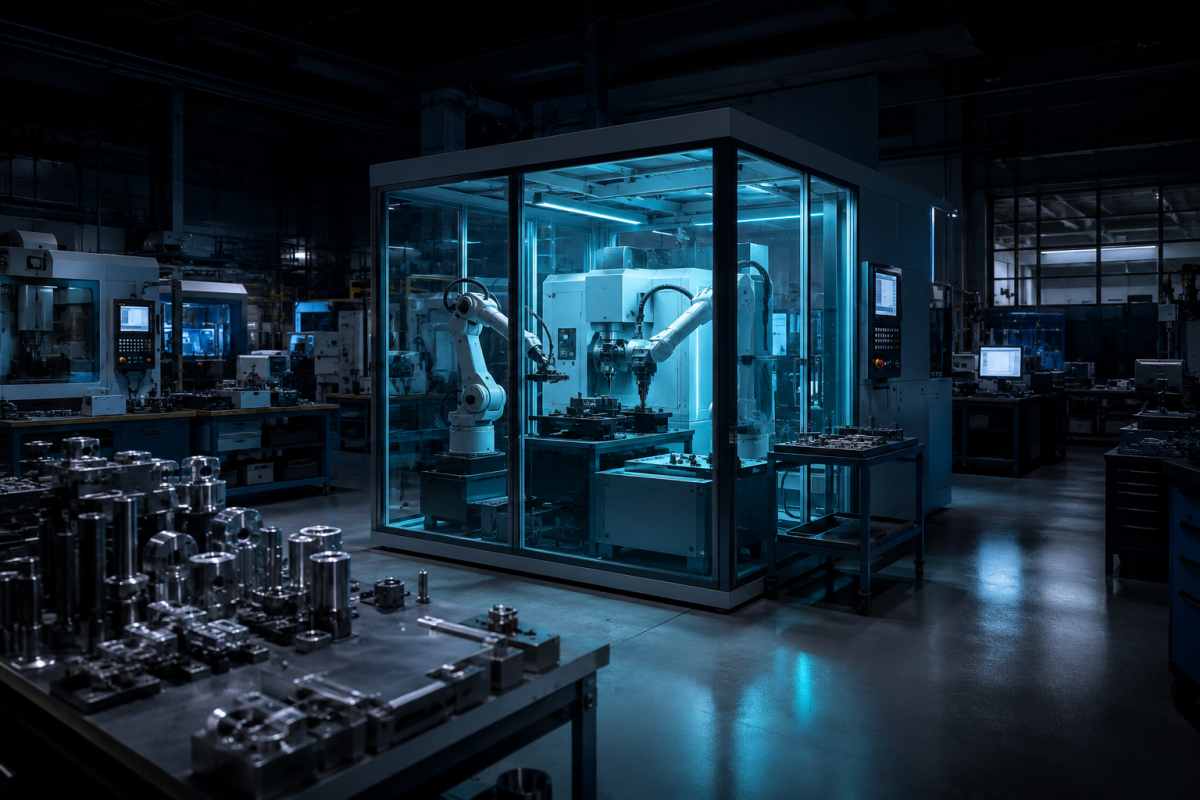
Five scenarios for mid-market manufacturing, the probabilities behind each, and the indicators that will tell you which future is arriving
Bottom-line first: mid-market manufacturing is not going to disappear, and neither is the factory job; at least not the ones that matter. We are asked from time to time whether the “dark factory” (a plant so automated it runs with the lights off) will finally arrive, and whether it ends the mid-market manufacturer when it does. That is the wrong fear, and manufacturers who spend the next decade debating it will miss what actually happens. The more likely outcome is harder to plan for.
WE PREDICT that the dark factory does arrive by 2040, but not where forty years of predictions have placed it. It does not arrive first as a billion-dollar greenfield giga-plant, and it does not arrive first in low-wage countries. It arrives inside the mid-market, one AI-flexible cell at a time, in high-mix shops in Ohio and Ontario and Bavaria. The reason is structural: once AI-driven robotics collapse labor to a rounding error in unit cost, the entire logic of manufacturing geography inverts. Location decisions stop being about wages and start being about energy cost, logistics, and proximity to demand. That inversion is the best structural news the Western mid-market has received in fifty years, and it will be captured by far fewer firms than are profitable today.
That conclusion comes from looking at what a manufacturer actually sells, function by function, and asking which functions AI and robotics absorb and which they structurally cannot. It also comes from watching sectors that sit eighteen to thirty-six months ahead of discrete manufacturing on the automation curve; warehousing and logistics and semiconductor fabrication have already run this experiment, and the pattern is consistent: the work consolidates around a smaller layer of institutionalized process knowledge, and the firms that captured that knowledge in systems before their experts retired are the ones left standing.
The Components of Manufacturing Success
Strip a mid-market manufacturer down, and it sells six things:
- precision and repeatability (holding tolerance, part after part),
- capacity and scheduling flexibility (absorbing an OEM’s demand volatility),
- process knowledge (how to hold ±0.0005″ on this alloy, on this machine, on a humid Tuesday),
- certification and blame absorption (the AS9100 stamp, the PPAP package, a named quality engineer whose signature stands behind a flight-critical or implantable part),
- supply assurance (being the vendor who has never shut a customer’s line down), and
- responsiveness and proximity (the engineering change accommodated in days, not quarters).
AI and robotics absorb the first two almost completely by 2040. Vision-guided, AI-programmed cells already handle changeovers that once made high-mix work “un-automatable”; that capability only improves, and it quietly ends the era in which flexibility was a defensible human moat. Scheduling is a pure optimization target, and agentic MES systems will run the calendar better than any production manager.
The middle item, process knowledge, is where the industry splits in two. In most mid-market shops, that knowledge lives in the heads of machinists and process engineers whose median age is climbing toward sixty. Every retirement is an uncompensated write-down of the firm’s core asset. The manufacturers that survive to 2040 are the ones that treat process knowledge as institutional data to be captured, structured, and encoded into their automation, not tribal lore that walks out the door at 4:30.
The last three functions resist automation for structural rather than technical reasons. An aerospace prime accepting a fracture-critical component needs an institution whose certification and reputation are collateral; liability does not automate. Supply assurance and responsiveness actually strengthen as differentiators in an automated world. Proximity, the mid-market’s oldest advantage, appreciates dramatically once wage arbitrage stops paying for ocean freight and eight-week lead times.
The Lights-Out Question
Every few years someone predicts the fully dark factory. The prediction is now over forty years old. General Motors bet billions on it in the 1980s and got robots painting each other. FANUC has famously run robots building robots since 2001, and Philips ran a nearly unmanned razor plant in the Netherlands; yet lights-out never scaled across Western manufacturing, and the reason is instructive. Automation was rigid, and most manufacturing is not. High-mix, low-volume work, the mid-market’s home turf, punished fixed automation; and labor was cheap enough, or offshorable enough, that full autonomy never penciled.
Both protections are now failing at once. AI-driven robotics solve the flexibility problem that killed every previous lights-out attempt; a cell that reprograms itself for the next job eliminates the changeover economics that protected human-run shops. And the labor that made “cheap enough” true is aging out faster than it is being replaced. The skilled-trades retirement wave means the choice for many shops is not “automate or keep our people” but “automate or decline the work”. Meanwhile China’s genuinely dark factories are no longer speculative; they are operating, and they are a preview of the cost structure your customers will benchmark you against.
Here is the twist the forty-year-old prediction always missed: when the dark factory finally becomes economical, it destroys the very labor arbitrage that sent manufacturing offshore. A lights-out cell costs roughly the same to run in Indiana as in Shenzhen, and Indiana wins on logistics, IP security, energy stability, and proximity to the customer’s engineers. The dark factory does not arrive as a threat to Western manufacturing. It arrives as the mechanism of its reshoring, captured by whichever firms are architecturally ready to deploy it.
Five Futures, with Probabilities
Scenario 1: The Consolidated Process-Knowledge Layer (~32%)
The base case, and the winnable one. Mid-market manufacturing survives as an industry, but the number of firms falls substantially. Progressive automation, cell by cell rather than big-bang, hollows out direct labor while a smaller senior layer of process engineers, quality leaders, and customer-facing talent operates on top of AI-driven production platforms. Margins improve materially for the survivors: less labor volatility, higher machine utilization, faster quoting, and pricing power that comes from being one of the few qualified sources left in a niche.
The dividing line in this scenario is not equipment, capital, or even customer relationships. It is whether a firm’s process knowledge lives in institutional systems or in retiring employees’ heads. Firms in the second category dissolve when those employees leave; their tolerances, tricks, and tribal fixes are unrecoverable, and firms in the first category absorb their book of business. This scenario requires no platform monopoly and no coordination problem to be solved. It is simply every firm optimizing independently, which is why it carries the highest probability.
Scenario 2: Platform Capture · Manufacturing-as-a-Service (~20%)
The marketplace logic that transformed retail arrives on the shop floor. Manufacturing-as-a-service platforms, today mostly instant-quoting brokers, climb from quoting into owning the customer relationship and, eventually, the transaction economics. Job shops become licensed capacity nodes: work arrives algorithmically, prices are set by the platform, and the shop’s brand disappears behind the platform’s. Commodity work (simple machining, sheet metal, standard molding) trades in transparent auction formats first, and the platform’s take-rate climbs the value stack until it hits certified, design-intensive work. Manufacturers persist upmarket, but the intermediary economics migrate to the platform even where the manufacturer survives; the industrial version of the hotel that fills its rooms through someone else’s app.
Scenario 3: OEM Reintegration (~15%)
Displacement arrives not from a platform but from the customers themselves. Once dark micro-factories make small-footprint, high-flexibility production economical, the largest OEMs begin reversing the great outsourcing of the 1990s; insourcing fabrication into automated cells adjacent to their assembly lines, cutting suppliers not for cost but for control, IP security, and lead time. The supplier base retreats to specialty processes, surge capacity, and work below the OEM’s automation threshold. The tell for this scenario is the first major OEM announcing an in-house, AI-native fabrication network and a corresponding cut to its qualified-supplier list.
Scenario 4: Full Agentic-Autonomous Production (~13%)
The science-fiction version: OEM procurement agents negotiate directly with supplier production agents; orders flow into dark factories, schedule themselves, produce, inspect, and ship with humans reduced to exception handling and final quality sign-off. Technically plausible for commodity parts by 2040, but it requires customers to trust autonomous agents with production commitments, fully standardized part data and quality records across every industry, and the disappearance of the certification and blame-absorption function. That last requirement is the binding constraint; nobody has yet designed the insurance policy for an uncertified autonomous line producing fracture-critical parts. Meaningful probability in commodity segments, near zero for regulated and safety-critical work.
Scenario 5: Muddle-Through (~20%)
Efficiency gains everywhere, structural change nowhere. Capital constraints, the sheer heterogeneity of mid-market equipment and processes, integration debt across ERP/MES/QMS systems that don’t speak to each other, and the industry’s justified skepticism after decades of overhyped automation slow every transformation. Manufacturing in 2040 looks like manufacturing today with better tools, more cobots, and a somewhat thinner labor force. History gives this outcome more credit than technologists like to admit; the industry has already survived several “factory of the future” waves without structural displacement. But muddle-through is a probability, not a plan, and it is the only scenario in which doing nothing works.
The Land Is Being Claimed Now
Read the scenarios together and one pattern dominates. In four of the five futures, mid-market manufacturing still exists and can be more profitable than it has ever been; in every one of those four, the profits accrue to a much smaller set of firms than are profitable today. The reshoring wave that the dark factory triggers is real, but reshored volume does not distribute itself evenly across the existing supplier base. It flows to the firms that can quote in hours, prove their process capability with data, and run automated cells their competitors cannot capitalize or staff.
The commodity tier of the market migrates to platforms and autonomous production in nearly every scenario; the only real question is how far up the value stack that logic climbs before it hits the trust ceiling of certification, liability, and safety-critical work. The firms that survive above that line share a common architecture: process knowledge that belongs to the institution rather than the individual, production data disciplined enough to feed AI systems, and a deliberate migration of their people from touching parts to owning judgment in quality, customer engineering, and exception handling. That architecture takes years to build, and the monetizable advantages go to the firms that start while their most knowledgeable people are still on the payroll.
What to Watch
Scenario probabilities are only useful if you can tell which future is arriving. Five leading indicators are worth tracking:
- The robot-labor cost crossover in your region. When the fully-loaded hourly cost of an AI-flexible robotic cell drops below fully-loaded regional labor cost for your work mix, the economics of every scenario accelerate at once. Track it like you track material prices.
- The first certified dark line in a regulated industry. One aerospace or medical production line achieving AS9100/FDA-equivalent certification while running lights-out moves autonomous production from theoretical to priced-in, and starts the clock on the trust ceiling rising.
- Platforms taking per-part economics. The first move by a dominant manufacturing marketplace from quoting fees into owning capacity or taking a percentage of production value is the opening act of the platform capture scenario.
- OEM insourcing announcements. Watch for a major OEM pairing a micro-factory investment with a public reduction of its supplier count; that is the reintegration scenario arriving, and it will be framed as “supply chain resilience”.
- The retirement cliff in your own building. The most local indicator is the average age of the people who hold your process knowledge. Every year that number rises without a capture program, your firm’s terminal value transfers to whichever competitor built one.
The Strategic Question
The question for a manufacturing leadership team in 2026 is not whether the dark factory is coming; that debate is finished everywhere except the trade-show floor. The question is which scenario your firm is positioned for, and whether your current investments are building toward a seat in the consolidated, reshored future or merely making the present more efficient. A cobot here and a dashboard there improve this quarter; capturing thirty years of process knowledge before it retires, and re-architecting your data so AI systems can run on it, decides whether there is a firm left to improve. Those are different projects with different architectures, and the manufacturers that conflate them will discover the difference at the worst possible moment.
Innovation Vista works with mid-market manufacturers to answer exactly that question: translating what sectors eighteen to thirty-six months ahead on the automation curve have already learned, and turning it into a positioning strategy for the consolidation, and the reshoring, ahead. If you want to pressure-test which side of 2040 your firm is building toward, that conversation is where we start.