
Innovating Beyond Efficiency ®
Driving Top-Line Results When AI and IT Align with Business Strategy
Most IT strategies stop at stability and efficiency. We believe technology’s highest purpose is not cost reduction but growth. In the AI era, that conviction matters more than ever: organizations are spending billions on AI initiatives that target efficiency alone, while the real opportunity – using AI integrated with a strong IT and data platform to drive revenue, expand markets, and win share – goes uncaptured.
From IT & AI strategy advisory to month-to-month Tech leadership – even AI strategy & vCAIO services for organizations that already have their IT strategy & leadership in place – Innovation Vista’s services have been built with this mindset from day one.
The Mindset of Your Tech Advisor Scales Your Horizon of Innovation
Most organizations today are hiring AI strategists and IT leaders separately, then wondering why neither delivers transformative results. The problem is not the people; it is the separation. AI initiatives built without deep IT integration stall on weak data pipelines, security gaps, and infrastructure that cannot support production workloads. Innovation Vista’s focus on integrated AI and IT leadership is what makes top-line impact achievable rather than aspirational.
This isn’t theory. Our clients have realized more than $1.5B in new top-line impact through strategies we’ve designed and overseen. That success proves that using technology as a growth engine is not a pipe dream – it’s a repeatable, achievable outcome when guided by the right mindset and the right advisors. With Innovation Vista, your horizon of innovation need no longer be limited to uptime and efficiency gains. It expands into the realm of transformation and industry disruption to drive real growth for your entire enterprise.
A Framework for Real Innovation
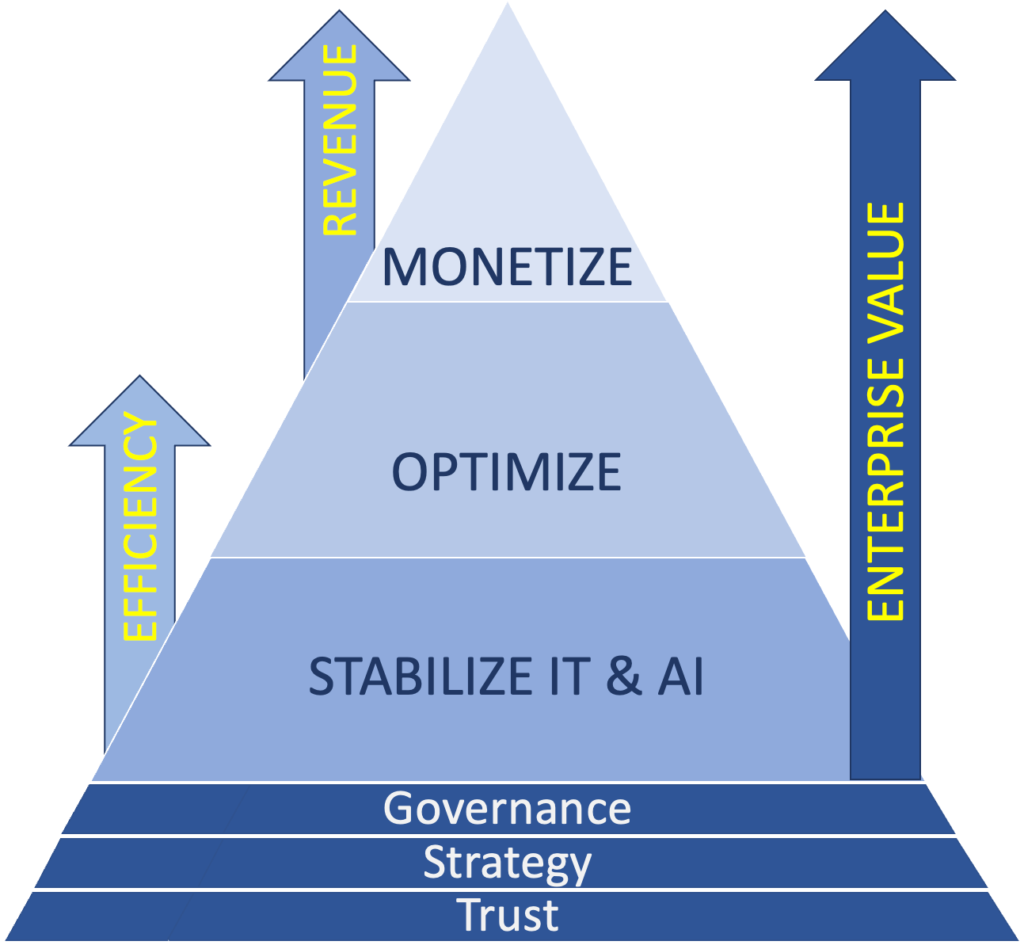
Our award-winning approach ensures the prerequisites are achieved in order – Trust, Strategy, and Efficiency are achieved before leaping into Monetization & Revenue.
This discipline is especially critical in the AI era, where organizations that leap to AI deployment before stabilizing their data architecture and optimizing their integration layer join the 80%+ of AI projects that fail.
Stabilizing IT & AI: ensuring platforms are reliable, secure, and ready for growth
Optimizing IT & AI: aligning systems, vendors, and budgets with maximum ROI
Monetizing IT & AI: turning technology and data into new or accelerated revenue streams
Digital Disruption: reshaping industries with innovations competitors can’t match
Strategy is developed early and continually refined, in collaboration with the organization’s leadership team. All of the prep work strengthening the foundation is done with an eye toward the real strategic goals. Once those foundations are ready, the door to tech-driven revenue and market-share are thrown wide open, sometimes enabling clients to disrupt their industries with unique pricing &/or delivery capabilities their competitors can’t match.
We would love to have a conversation with you about driving business results with our unique approach to Innovation…

Innovating Beyond Efficiency
Most technology consulting sells one result: efficiency. Cut costs, consolidate vendors, automate the back office, repeat. We have a different conviction, and it is the reason our clients’ measurable results skew toward top-line growth rather than savings. Efficiency isn’t bad; it’s just not enough. The reason is structural, not rhetorical: cost savings are bounded and revenue is not. You cannot cut your way below zero, you cannot save your way to growth, and every competitor eventually converges on the same savings from the same vendors. Differentiation and top-line growth face no such ceiling, and they compound. Treated as the finish line, efficiency leaves the most valuable work undone, because IT isn’t a cost center to be minimized; it’s an undeveloped asset waiting for a strategy worthy of it. The organizations that grasp this truth in their project ideation & prioritization earn what we call the innovation dividend: the right projects pay you twice, once in efficiency and again in revenue, market share, and enterprise value.
The Efficiency Trap
History is unsentimental about companies that stopped at efficiency. TiVo owned its moment and settled for making television more convenient, while others monetized the future it had glimpsed. 3M nearly optimized away the innovation engine that made it great by applying Six Sigma discipline to the one place it didn’t belong. The lesson generalizes: just keeping the lights on is simply awaiting disruption, and the deeper problem is that most leadership teams set the IT bar too low to notice what they’re missing.
The costs of that low bar are rarely visible on a budget line. They show up as invisible tech friction quietly capping your revenue potential, and in five red flags that your IT may be costing you growth long before anything “breaks”. The antidote is a fixed reference point: business impact as the true north for every technology decision. Comfort is the enemy here; the status quo is a lotus flower, and eating it feels wonderful right up until it kills your company.
Here is the part most analyses miss: companies rarely stop at efficiency for lack of ambition. They stop because they once reached for more, on a foundation that couldn’t hold it, and the failure taught the wrong lesson. A transformation attempted out of sequence collapses, and burned leadership retreats to what is safely measurable; the efficiency trap is, more often than not, a failure of confidence wearing the costume of patience. That is why the cure is not more ambition. It is order.
Our framework supplies that order. Three stages, deliberately sequenced: Stabilize, Optimize, Monetize. Each stage earns the right to attempt the next; skipping ahead is how transformations fail, and how leaders get burned into settling.
Stabilize · Earning the Right to Innovate
No one monetizes technology that doesn’t work. The first stage is the journey from crisis to stability: reliable operations, resilient infrastructure, and risk brought under management. This is less obvious than it sounds. Obsolete technology is often worse than broken technology, precisely because it still runs; and technical debt operates as a hidden innovation tax that belongs on the boardroom agenda, not buried in sprint retrospectives. Stability also means confronting concentration risk, like the single developer whose departure would orphan software your business depends on, and it means security posture strong enough that a CEO can run our plain-language checklist and sleep at night.
One caution before moving on: stability is a state you maintain, not a summit you conquer. Camping in Stabilize indefinitely is the mirror-image failure of skipping it; risk aversion dressed up as diligence costs you the same market windows that recklessness does. The exit criteria are not perfection. They are reliability sufficient to build on, and the discipline to keep it while you climb.
Optimize · Turning Reliability into Leverage
If Stabilize is about making technology dependable, Optimize is about making it deliberate. This stage has a one-line definition: optimization is the discipline of strategic trade-offs, which mostly means deciding what not to do. Every dollar and every architecture choice gets aligned to the business model it serves; spend that doesn’t map to strategy is either redeployed or retired. That framing is what unifies the work of this stage. The journey from stability to optimization is where technology starts pulling its strategic weight, and it is typically where growing companies discover they have outgrown their MSPs, because maintenance vendors are structurally unable to make trade-off decisions on your behalf.
Governance is trade-off discipline made durable. Done right, governance is a freeway, not a roadblock; done brilliantly, it becomes an unlock, as Spotify proved with the most copied governance architecture in tech. Even compliance can be converted into competitive advantage when you raise the bar your industry buys against. The big platform decisions are trade-offs too; our consultants bring hard-won guidelines for selecting and implementing enterprise systems, including new thinking on how much data history to migrate in the age of BI and AI, because yesterday’s throwaway records are tomorrow’s training data.
Monetize · Where Technology Starts Paying You
The third stage is the one most consultancies never reach, and it is our namesake. Monetizing means technology that drives revenue, market share, and valuation; it is how strategic IT grows enterprise value, and it is why boards have stopped asking for AI strategy and started asking for AI EBITDA.
Revenue, though, does not come from technology. It comes from customers, which means monetization almost always routes through customer experience; your data is the raw material, and the customer relationship is the refinery. The bar keeps rising, because customer expectations are no longer set by your industry but by the best digital experience your customer had anywhere. The raw material is usually already in the building: most organizations are holding a treasure chest of data, starting with CRM data that can be turned into deep customer insights. When a company commits to refining it, the results compound; Progressive turned personalization into market-share dominance, and disciplined digital investment produces a flywheel effect that accelerates ROI with each turn. For owners with an exit in view, this stage has a direct multiple attached: five non-negotiable IT upgrades before a PE or M&A exit routinely change the valuation conversation.
The AI Stress Test · Why the Sequence Matters More Than Ever
AI has not replaced this framework; it has run the hardest test in its history against it, and the framework has held. In fact, AI maps directly onto the three stages: Stabilize is your data architecture and security posture, the foundation whose absence explains most AI failures; Optimize is where AI governance and workflow integration live; Monetize is where AI EBITDA is earned. Nearly every failed AI initiative we are asked to rescue is a stage-skipping failure, an attempt to Monetize on a foundation that was never Stabilized.
The convergence is structural: “stronger together” has moved from slogan to strategy requirement, because AI, technology, and business strategy can no longer be planned separately. The evidence is brutal for those who try. Most AI projects fail, at more than twice the rate of ordinary IT projects, and the root cause is almost always foundational: AI strategy IS IT strategy, and neither works without the symbiosis of data strategy and AI strategy underneath.
The efficiency trap has an AI-era sequel. Maximizing your AI investment means escaping efficiency traps for hybrid intelligence, and it means using AI strategy as a lens to separate traction from distraction amid weekly waves of hype. Waiting is not the safe harbor it appears to be; patience-flavored AI paralysis may kill your company while an order-of-magnitude leap sits for sale in your sector at roughly the price of electricity. Even adopters are leaking value: the AI dividend is flowing to the wrong bank account when vendors capture gains their customers generated, and the last tech wave rewarded waiting for vendors; this one won’t.
Getting AI to scale requires the same staged discipline as everything else: balancing citizen AI exploration with production AI rigor, and taming the agentic AI genie with governance built for the mid-market rather than for regulators or research labs.
Innovation Is a Process, Not a Personality
The final piece of the framework is method. Breakthroughs are engineered, not awaited; stop waiting for a flash of insight and run the process instead. Ours begins with green-field gap analysis to reconnect an organization to its best possible future, then applies Vista Score triage to choose the right projects when every department is asking, all while nurturing a culture where innovation can actually happen.
That last point matters more now than ever. In an era when any executive can generate a competent strategy deck in an afternoon, the answer is cheap; adoption is what costs you. Real transformation is led by people who put on your colors, injecting high-power strategy without disrupting the culture you spent decades building; that is why we build trust first on every engagement, and why our results outlast our engagements.
The Framework Needs an Owner
One thing remains, and it is the thing AI cannot supply. A process without an accountable owner is shelfware; a sequence no one is responsible for driving is a diagram, not a strategy. AI can generate the plan, but it cannot own the outcome, and ownership is precisely what a framework requires to leave the page. That is the through-line of everything we do: AI can’t lead itself, and neither can Stabilize → Optimize → Monetize. Every stage of this framework is delivered by a sector-matched former CIO or CTO who owns the result end to end, because the framework’s power was never in the diagram. It was always in the hands holding it.
Put the Framework to Work
Innovating Beyond Efficiency® is delivered through every Innovation Vista engagement: embedded leadership via Contract CIO+, strategic advisory via CIO IQ, and dedicated AI leadership via vCAIO. Most clients begin with an IT & AI Assessment that locates them on the Stabilize → Optimize → Monetize path and prioritizes the moves that pay twice.n
Most IT strategy firms focus on Offerings. And most AI consultancies do the same, optimizing the product without examining whether the business model, customer journey, or internal configuration should change first. We review the entire spectrum of potential innovation to find maximum ROI beyond efficiency.
Latest Articles

Including Tech in the Weekly Meeting · 5 Metrics for Companies with an Operating System
Your weekly scorecard probably has no technology line, and that is a design gap, not neglect. Add five technology numbers to the meeting, starting with baselines and thresholds. If the count is still zero by Monday, that is your first item on the Issues List.

The Control Group Is Gone · How to Prove AI Works When Nobody Will Work Without It
Once a team won’t work without an AI tool, you’ve lost the group you’d compare it against. Prove the value while you still can. Stagger the rollout, count work at intake, check what people say against your system records, and decide up front what result would change the plan.

The 9% Problem · What Your Board Actually Wants to See on AI
Your board is about to ask who is accountable for what your AI does, and how you would prove it. Nine percent of your peers could answer today. Build governance in the right order, and get an independent look at which stage you are in.