
Why complex technology initiatives require leadership, not just project management
by Jose Solera, CIO Consultant
In many organizations, technology is viewed as magic. Spread a bit of that technology pixie dust around, and all your problems go away! Just let the techies handle it.
But major technology initiatives rarely work that way. The CIO may be accountable for the outcome while much of what determines success sits outside the technology organization.
Technology teams can do a lot, but they cannot transform a business alone. They need active participation from the business.
Technology teams can do a lot, but they cannot transform a business alone. They need active participation from the business.
At Intel, we had a practice that any mid-size to major technology initiative required a business partner to co-lead the effort. The amount of time that person devoted varied, but the accountability did not. Someone from the business was explicitly accountable for the initiative’s success alongside technology.
I saw the value of this approach on initiatives such as the Intel Inside® Program system development. Years later, as a CIO, I experienced what happened when that business partnership was missing. I was asked to implement a CRM for the organization. There was no co-leader from the business side. The CEO had a lot on her plate and expected her other direct reports, my peers, to provide the business leadership. No one stepped up.
As I dug into the business problem, I discovered that the CRM, while important, was not the most critical need. The more immediate problem was the mountain of insurance applications that arrived during the fourth quarter. Volume went from almost nothing during the first three quarters to thousands of applications in the fourth. I assigned one of my business analysts to document the operational process, which had never been documented. Then I had to convince the CEO and my peers that we needed to change priorities.
We succeeded, eventually. Guess what? Technology figured it out. But it was painful and less effective and efficient than it would have been with an engaged business leader.
When Authority Ends, Leadership Begins
Project management could help us organize the work. It couldn’t make my peers participate, set business priorities, document their processes, make decisions, or provide the expertise we needed. That required leadership.
I had to rely on leadership rather than authority.
And, of course, I as the CIO had no authority over them. I had to rely on leadership rather than authority. I was new, so first I had to establish credibility and trust. Then I had to help people understand what we were trying to accomplish, create a sense of shared responsibility, support the people doing the work, and make decisions based on what was best for the organization.
We made the work visible using a Kanban board to show more than 60 projects already in flight. The goal was to establish the discipline that every new request had to be visible, reviewed, and prioritized. “If it’s going to get done, it has to be in the backlog. Just because it’s in the backlog, though, doesn’t mean it will get done” was the line I used with my peers. And I told my team not to take on additional work. Instead, they should direct the requester to me for discussion.
We also built a product backlog for our new operational and CRM system. We sized the effort. We showed it to our business partners. We told them where we were and where we were going and asked for their support. This visibility helped everyone see the effort in flight and how they could best support it. Not that they engaged to the desired level, but at least they understood that other work would have to wait.
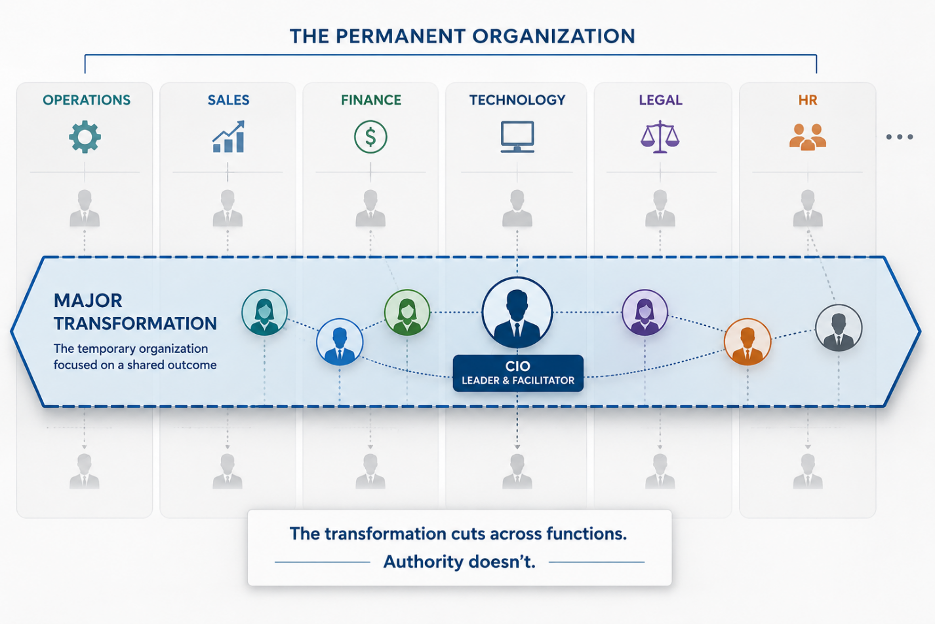
My role as CIO had become as much cross-organizational leader and facilitator as technology leader. I had to educate my peers about priorities: “not everything can be priority one.” I had to elicit their support, help them understand the work already underway, and show them where their participation was needed. And sometimes I had to say no.
The lesson wasn’t that the CIO should take over the business. Quite the opposite. Technology leaders cannot substitute for the knowledge and accountability of business leaders. But when that leadership is missing, the CIO cannot simply retreat to the technology organization either. Someone has to create the shared understanding, priorities, visibility, and commitments needed to move the initiative forward.
Leading the Temporary Organization
The CIO may be accountable for leading it without owning most of it.
This is a role CIOs and other technology leaders play repeatedly. Major initiatives cut across the boundaries of the permanent organization. People who normally work in different functions suddenly depend on one another to produce a shared outcome. The CIO may have little formal authority over many of them but still has to help them work as an organization.A major transformation creates a temporary organization inside the permanent one. The CIO may be accountable for leading it without owning most of it.