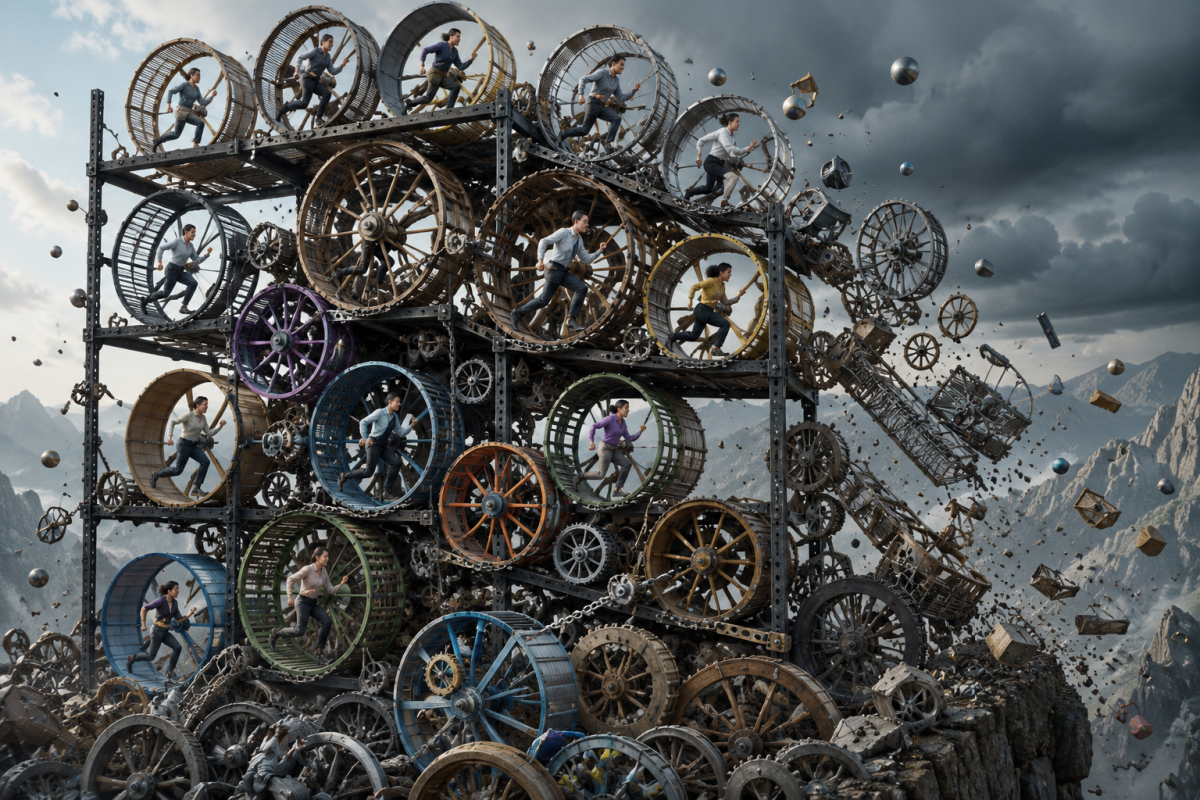
Imagine walking into your server room and finding a rack of forty mismatched units, each built by a different employee, each running a critical workflow, none of them documented, none version-controlled, none speaking to each other, and none on a backup schedule. You would not tolerate this for thirty minutes. You would shut it down by Friday.
This is precisely what most companies have built with AI in the last twenty-four months. We just cannot see the rack.
The wheels were reinvented inside ChatGPT accounts, Claude Projects, Copilot threads, and Custom GPTs scattered across personal browsers. The CFO has a spreadsheet she runs through ChatGPT every Friday to flag variance anomalies. The head of sales has a prompt that drafts customer proposals. A marketing manager has a Custom GPT trained on the brand voice. A controller built a reconciliation workflow in three afternoons that quietly closes the books faster than the legacy process. Each of these is a wheel. Each one rolls. None of them was engineered. All of them are running your company.
The Phenomenon: Why Citizen AI Exploded
Shadow IT took twenty years to become a board-level concern, and most CIOs caught it before it metastasized. Citizen AI happened in eighteen months, and most leadership teams are still treating it as a productivity win without ledger entries on the other side.
The acceleration was inevitable. The cost of building a workflow used to be measured in IT tickets, project sponsors, vendor selections, and procurement cycles. The cost today is the time it takes to type a prompt. When the construction cost collapses by four orders of magnitude, you do not get a slightly larger volume of workflows; you get an inversion of who builds them. The center of gravity moves from IT to anyone with a keyboard.
This is, on balance, a good thing. Employees are closer to the workflow than IT will ever be. They notice friction faster, iterate faster, and abandon what does not work. The same forces that made spreadsheets the most successful enterprise software in history are now operating on AI, at higher velocity.
Citizen development at least had IT to mop up after it. Citizen AI has no mop.
The problem is not that employees are building. The problem is that nothing about the surrounding infrastructure has caught up. Citizen development at least had IT to mop up after it. Citizen AI has no mop.
The Hidden Failure Modes
Most failure modes of Citizen AI are silent. They do not crash anything. They do not generate help-desk tickets. They surface as quiet erosion, eventually, in places far from where the wheels were built.
Duplication and Inconsistency
In a company of two hundred people, you can reliably bet that between eight and fifteen employees have built variants of the same email drafter, proposal generator, or meeting-notes summarizer. They each have different prompts, different examples, different few-shot anchors, and therefore different outputs. The “company voice” is now a probability distribution rather than a standard, and the spread is widest precisely where it matters most: customer-facing communication.
The waste is real but mostly invisible. Fifteen people each spending an hour refining “their” prompt is a payroll cost that never gets surfaced, because no one knew the other fourteen were doing the same thing.
Data Leakage and Compliance Exposure
The financial controller who pastes a vendor contract into a consumer-grade LLM account has just sent that contract through a different terms-of-service agreement than the one your legal team signed. The salesperson who uploads a customer list to seed a Custom GPT has just created a data flow that does not appear in any data map. The HR business partner who asks a chatbot to summarize an employee performance review has potentially crossed three statutes depending on jurisdiction.
The compliance posture you certified to your auditors last quarter is not the compliance posture you have today. You have not been told because the people doing it do not know they are violating anything.
Silent Model Drift
The prompt that worked perfectly in March may produce different outputs in November. Underlying models are updated continuously, sometimes with announcement and sometimes without. Retrieval behavior changes. Tone shifts. Reasoning depth fluctuates with provider economics. Citizen AI has no regression tests, so the drift is detected, when it is detected, by a customer reading something off-brand or a regulator noticing an inconsistency.
The wheel did not break. It just started rolling differently, and nobody was watching the odometer.
Knowledge Concentration Risk
The best prompt in your company is currently locked in someone’s Notes app. When that person leaves, takes a sabbatical, or simply forgets to mention it during a transition, the workflow dies and the institutional knowledge of how it worked dies with it. You will not notice for weeks; you will only notice because the output it used to produce stops appearing in the inputs to downstream processes.
This is the same single-point-of-failure problem that has plagued spreadsheet-based finance functions for thirty years, with one difference: spreadsheets are at least visible on shared drives. Prompts often are not.
The Cost-Center Mirage
Most leadership teams currently track AI spend through SaaS line items: how much we pay OpenAI, how much we pay Anthropic, how much we pay Microsoft for Copilot seats. This number is wrong by an order of magnitude in both directions. It understates the true cost because it ignores the payroll hours sunk into prompt engineering, the duplicate workflows, and the cleanup labor when outputs go sideways. It overstates the value because no one is measuring which workflows actually move a business metric and which are theater.
You cannot manage what you have not inventoried. Most companies have not inventoried, and the ones who have tried often discover that the inventory is harder to build honestly from inside the organization than it first appears.
Why Banning It Does Not Work, and Should Not
Some risk-averse organizations have responded by trying to lock down AI usage: blocking consumer accounts at the firewall, requiring approval for every Custom GPT, restricting access to a single sanctioned platform. This nearly always fails, and on the rare occasions it succeeds, it fails worse.
It fails when employees route around it: personal phones, personal accounts, BYOD. You have not eliminated the wheels; you have just moved them off your monitoring stack entirely.
Suppression is not a strategy; it is surrender dressed as caution.
It succeeds, sometimes, in highly regulated environments where compliance discipline holds. In those cases you have traded Citizen AI for no AI, and your competitors who handled it better are now operating with a margin advantage you cannot match. The companies that win the next decade will be the ones that absorb Citizen AI’s energy without absorbing its chaos. Suppression is not a strategy; it is surrender dressed as caution.
The correct response is graduated triage. Some Citizen AI workflows should be left alone. Some should be deprecated. A specific subset should be promoted into Production AI with the engineering discipline that designation implies.
Diagnosing What Should Graduate to Production
Not every workflow belongs in the Production pipeline. Promoting a one-off prompt that an analyst uses twice a quarter is a waste of engineering capacity. The diagnostic question is which wheels are doing structural work in the organization.
Four tests, applied in combination, separate the candidates from the noise.
The Frequency Test
A workflow that runs more than a handful of times per week is doing structural work, whether or not anyone has acknowledged it. A workflow that runs ad hoc, twice a month, probably does not justify the engineering overhead of productionization. Frequency is a first filter, not a final one; it tells you where to look closer.
The Stakes Test
What is downstream of this workflow’s output? If the answer is a customer email, a regulator submission, a board deck, a financial statement, or a hiring decision, the stakes test triggers. High-stakes outputs require human review at minimum and tested infrastructure when they scale.
Conversely, a prompt that helps someone brainstorm internally, where every output is reviewed by the person who requested it and the cost of error is rounding-error small, can stay in the Citizen tier indefinitely.
The Repeatability Test
Is this the same workflow with different inputs, or is each invocation genuinely different? Drafting customer onboarding emails from a template is repeatable. Asking the model to think through a one-off strategic question is not. Repeatability is the precondition for testing, and without testing there is no production.
If you can write down the steps the workflow performs in a way that would not surprise the person doing it, the workflow is repeatable enough to productionize.
The Shared-Need Test
If more than one person in the organization needs this workflow, even with minor variations, it belongs in Production. The decision is not “do we standardize”; the decision is “do we standardize deliberately, or by accident through the most opinionated employee”.
A workflow that exactly one person uses, that nobody else would benefit from, and that depends heavily on that person’s expertise, may legitimately belong in Citizen AI. The expertise is doing most of the work; the AI is just an accelerant.
When all four tests trigger, the workflow is unambiguously a Production AI candidate. When two or three trigger, it deserves a closer look. When zero or one trigger, leave it alone and revisit in six months.
What Production AI Actually Requires
Promoting a workflow to Production AI is not a re-labeling exercise. It is an engineering commitment with five non-negotiable components. Skip any of them and you have not built Production AI; you have built Citizen AI with a more impressive job title.
Version Control for Prompts and Workflows
Prompts are code. The same forces that made source control mandatory for software apply to prompts: you need to know what version is running in production, you need to be able to roll back, you need a diff when something changes, and you need an audit trail for compliance.
If your AI infrastructure cannot tell you which prompt version produced a specific output, you do not have Production AI; you have a slot machine.
The mechanics are not exotic. Prompts live in a repository. Changes go through pull-request review. Releases are tagged. The prompt that ran last Tuesday is recoverable next Tuesday. If your AI infrastructure cannot tell you which prompt version produced a specific output, you do not have Production AI; you have a slot machine.
Output Testing and Evaluation Suites
Every Production AI workflow has a golden dataset: a curated set of representative inputs paired with the outputs they should produce, or the qualitative properties those outputs should have. Before a prompt change ships, it runs against the golden set, and the results are compared against the prior version. Regression in critical dimensions blocks the deployment.
For workflows where exact-match testing is impossible, which is most of them, evaluation suites use scoring rubrics, classifier-based judges, or LLM-as-judge architectures with careful guardrails. The point is not perfection; the point is that someone notices when output quality degrades, before the customer does.
This single discipline, applied consistently, separates serious AI organizations from the rest.
Data Quality Protocols
Production AI workflows that retrieve data from internal sources require the same data quality discipline as any other analytics infrastructure. Source freshness is monitored. Schemas are versioned. Permissions are enforced at the data layer, not the prompt layer. PII is handled according to the same policy that governs every other system that touches it.
The temptation in early AI projects is to skip this step because the model “figures it out anyway”. This is true until it is not, and the moment it is not usually arrives in front of a regulator or a customer.
Model Abstraction and Monitoring
Production AI workflows should not be hardcoded to a specific model. The model layer should be abstracted so that swapping providers, upgrading versions, or routing to a different model for a specific task is a configuration change, not a rewrite.
Monitoring tracks token usage, latency, cost per invocation, output quality scores, and drift signals over time. The same dashboards that have governed software systems for two decades apply to AI workflows; the metrics just have different names.
Human-in-the-Loop Where It Matters
For high-stakes outputs, human review is a feature, not a bug. The goal is not to replace humans with AI; the goal is to amplify humans with AI in workflows that would be infeasible at human-only throughput. Production AI architectures explicitly designate review checkpoints, route work to qualified reviewers, and capture reviewer decisions as additional training and evaluation data over time.
The companies treating human review as a temporary measure to be eliminated as soon as the model “gets good enough” are misreading the long-term equilibrium. In any consequential workflow, the value of human judgment compounds, even as the marginal task it performs shrinks.
The Pipeline: From Citizen AI to Production AI
The transition is not a one-time project; it is an ongoing capability. Three phases recur indefinitely.
The first phase is discovery. Most organizations have no inventory of their Citizen AI footprint, and building one is harder than it looks from the inside. Employees who suspect their workflows might be shut down will not fully disclose them to an internal survey. IT teams have their own blind spots, both about what they themselves use and about workflows they have implicitly sanctioned. Pattern recognition across companies, which is the difference between a list and a useful inventory, is difficult to acquire from a sample size of one. Most organizations that get this right bring in a neutral outside team for the initial cataloging pass, where independence and cross-industry context do most of the work, then transition to internal stewardship once the catalog and the operating model are established. The deliverable is a living catalog: who uses what, for what, how often, with what data, and producing what outputs.
The second phase is triage. Apply the four tests. Categorize each workflow as Promote, Maintain, or Deprecate. Promotion candidates enter the engineering backlog. Maintenance candidates remain in the Citizen tier with light governance. Deprecation candidates are sunset, often with replacement workflows offered.
The third phase is productionization. The promoted workflows enter a structured build cycle: requirements gathering, prompt engineering, eval suite construction, data integration, monitoring setup, rollout, and post-deployment review. The cycle time matters. If productionizing a workflow takes nine months, the underlying need will have evolved and your engineering team will have built something the business no longer wants. Aim for weeks, not quarters.
This is where the Stabilize → Optimize → Monetize framework applies cleanly. Stabilizing AI means reining in Citizen chaos and building the production foundation. Optimizing means rolling promoted workflows into the catalog, measuring their impact, and refining them. Monetizing means using the stable foundation to build differentiating capabilities that competitors without the foundation cannot match.
Companies that try to skip stabilization and jump straight to monetization, which is most of them, are building skyscrapers on sand. The early returns look good. The collapse is always quieter than it should be.
What Leadership Should Do Monday Morning
Three actions, in order.
First, commission an honest inventory. Not a survey that asks employees whether they use AI tools, because the answers will be politically shaped. A structured assessment that looks at the workflows themselves: what does the work actually require, where is AI showing up, who is the de facto owner. The argument for an outside lens on this first pass is not capacity; it is that neutrality and cross-company pattern recognition produce a different inventory than internal teams can generate, even with the best intentions. Expect to be surprised by the volume.
Second, identify three to five high-stakes workflows that have already drifted into Citizen AI and triage them first. The customer-facing communications, the financial close support, the contract review acceleration. These are the wheels most likely to throw a tread, and they are the ones where the cost of doing so is highest.
Third, commit to the production discipline before promoting anything. Version control infrastructure, evaluation framework, monitoring stack, and the operating model that governs them. Promoting a workflow into “Production” without the infrastructure to support that designation is theater, and theater in AI governance ages badly.
The rack is already running. The question is whether you are going to keep ignoring it, or open the door, take inventory, and start running it like infrastructure.
The companies that do the second thing will not have a sudden AI breakthrough. They will have, two years from now, a quiet structural advantage that the companies still tolerating the rack cannot identify, much less close.