Five scenarios for restaurants and food service, the probabilities behind each, and the indicators that will tell you which future is arriving
Bottom-line first: restaurants are not going to be replaced by robots. We are asked that question from time to time, usually right after a video of a robotic fry station makes the rounds, or whether the entire industry collapses into delivery apps and vending machines. That is the wrong fear, and operators who spend the next decade debating it will miss what actually happens. The more likely outcome is harder to plan for, because it does not happen to the industry uniformly; it happens to the industry unevenly, and the unevenness is the story.
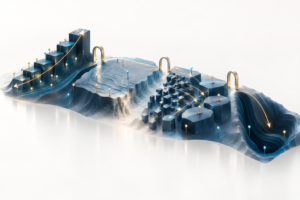
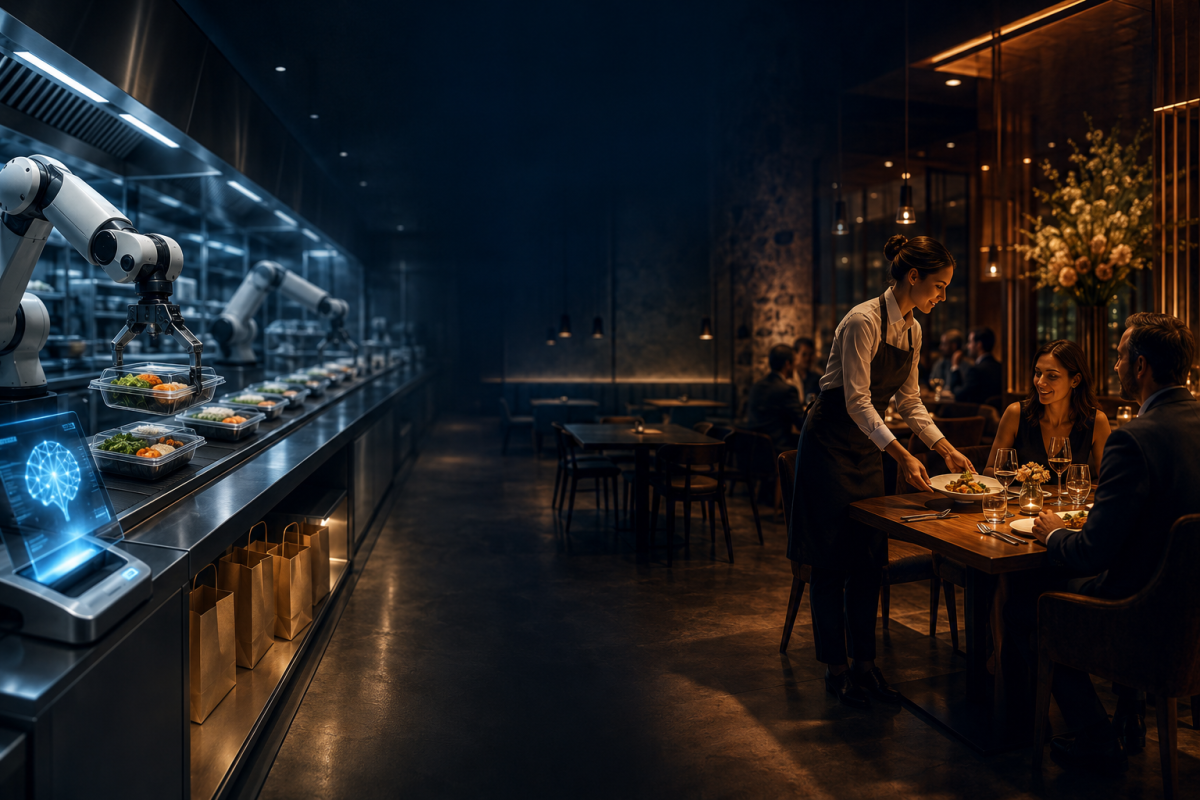
WE PREDICT that food service in 2040 will be two genuinely good businesses instead of one mediocre one. At one end, an automated calorie-delivery tier with software-grade margins that today’s operators would not recognize. At the other, a human hospitality tier where service is the explicit product and priced accordingly. Both ends will be more profitable than the industry average today. The casual middle, too expensive to compete as fuel and too ordinary to command an occasion, is where the seats disappear, and the claims on both ends of the barbell are being staked in the next thirty-six months, not in 2039.
That conclusion comes from looking at what food service actually sells, function by function, and asking which functions AI and robotics absorb and which they structurally cannot. It also comes from watching industries that sit ahead of full-service dining on the automation curve; retail checkout, logistics fulfillment, and the contact center have already run this experiment, and the pattern is consistent: the transactional layer automates almost completely, the human layer gets smaller and more premium, and the operators who knew which layer they were in before the wave arrived are the ones left standing.
What Food Service Actually Sells
Strip the industry down, and it’s clear food service sells six things:
- calories and convenience (fuel, fast, predictable)
- labor arbitrage (someone else shops, cooks, and cleans)
- consistency (the brand as a trust shortcut in an unfamiliar city or a rushed weeknight)
- logistics (food where you are, when you want it)
- the third place (social space that is neither home nor work)
- hospitality and occasion (being hosted, remembered, celebrated)
AI and robotics absorb the first four almost completely by 2040. Voice AI already takes drive-thru orders with fewer errors than a headset-wearing teenager at peak hour; robotic make-lines already assemble bowls and fry baskets at chains that publish the throughput numbers; demand forecasting already writes prep sheets and purchase orders more accurately than a twenty-year GM. Consistency, the function that built the great franchise empires, turns out to be the single most automatable thing a restaurant does; a robot’s thousandth burger is identical to its first. Logistics was the first function to leave the building, and it never came back.
The last two resist automation for structural rather than technical reasons. A couple celebrating an anniversary is not buying calories; they are buying the experience of being received, and a machine that remembers your name performs recognition without conferring it. The third place and the occasion are the industry’s judgment layer: the part of the product that exists precisely because a human is doing it. The 2040 restaurant that thrives above the automation line sells hospitality as the product and food as the medium, and the economics of that business favor fewer, better-paid, genuinely skilled service professionals.
The Ghost Kitchen Question
Every few years someone predicts the end of the dining room. The most confident recent version was the ghost kitchen wave, which announced that restaurants were really just kitchens with expensive seating attached, and that stripping the real estate would liberate the economics. Billions of dollars later, the largest ghost kitchen ventures had retrenched, sold, or shut down, and the reason is instructive: the model optimized the fuel and logistics functions while amputating consistency, trust, and experience. Customers discovered they were ordering from brands that did not exist, prepared in facilities they could not picture, and the trust shortcut that makes a restaurant brand valuable evaporated on contact.
But the logic protecting the dine-in status quo is weakening in a way the ghost kitchen prophets got directionally right and mechanically wrong. They removed the human from the supply side while the demand side still belonged to humans browsing apps. The next wave inverts that: when a consumer’s AI agent orders dinner based on budget, macros, and past preferences, the human is removed from the demand side, and the restaurant is no longer competing for appetite; it is competing for algorithm placement. When that infrastructure matures, it will not be built by a restaurant cooperative; it will come from the delivery platforms climbing further into the demand layer, or from the AI assistants that already own the consumer relationship, and the concepts it commoditizes first will be the ones whose value proposition was convenience rather than experience.
Five Futures, with Probabilities
Scenario 1: The Barbell (~35%)
The base case, and the winnable one. The fuel tier automates end to end: AI ordering at every channel, robotic production lines, dynamic supply chains, labor per unit down by well over half, margins up accordingly. The hospitality tier grows in the opposite direction, with human service as the advertised premium and menus, wages, and prices all reflecting it. Total industry employment falls substantially, but the jobs that remain at the top of the barbell are better paid and genuinely skilled, while the automated tier delivers cheaper, faster, more consistent food than the fast food of today.
The dividing line in this scenario is not cuisine, capital, or brand heritage. It is whether a concept knows which end of the barbell it is building toward, and whether its operational intelligence lives in institutional systems or in the heads of a few irreplaceable GMs. Concepts in the second category dissolve when those people leave; concepts in the first category absorb their traffic. This scenario requires no platform monopoly and no coordination problem to be solved; it is every operator optimizing independently, which is why it carries the highest probability.
Scenario 2: Platform & Agent Capture (~22%)
The demand layer consolidates before the barbell fully forms. Delivery aggregators and consumer AI assistants come to own the ordering decision; the majority of off-premise orders are placed by or through an agent rather than a browsing human, and restaurants become licensed kitchen capacity paying rent on demand infrastructure they do not control. Take rates become the new occupancy cost, brand equity migrates to whoever owns the recommendation, and the fuel tier’s newly automated margins are captured by the platform rather than the operator. Hospitality persists upmarket, because agents do not book anniversaries, but the transactional economics move decisively off-premise and off-brand.
Scenario 3: Home Displacement (~12%)
The disruption arrives from outside the industry entirely. Kitchen robotics and automated meal systems make home preparation nearly effortless, grocery and CPG players converge on restaurant-quality prepared food, and GLP-1 medications structurally compress appetite across a meaningful share of the population. Food service loses share of stomach to an automated home, and the industry shrinks rather than restructures. The addressable market for fuel-tier restaurants contracts hardest; the occasion tier is the most insulated, because nobody celebrates a promotion with their countertop robot.
Scenario 4: Automation Up the Stack (~8%)
Robotics climb past the fuel tier into full-service dining: robotic runners, automated kitchens behind mid-tier menus, humans reduced to a greeter and a manager. Technically plausible by 2040, and pieces of it will exist in specific formats. But it requires customers to accept automation in a setting they chose partly to be served in, and that is the binding constraint; in the hospitality tier, the human is not a cost of delivering the product, the human is the product. Meaningful probability in mid-scale and institutional dining, near zero at the occasion end.
Scenario 5: Muddle-Through (~23%)
Efficiency gains everywhere, structural change nowhere. Franchise agreements that make unit-level automation someone else’s capex decision, thin margins that slow every investment, immigration and labor dynamics that keep wages tolerable, and the sheer fragmentation of an industry with hundreds of thousands of independent operators all slow the transformation, and food service in 2040 looks like food service today with better scheduling software and a few robotic fry stations. History gives this outcome more credit than technologists like to admit; the industry absorbed the ghost kitchen wave, the delivery wave, and the kiosk wave without restructuring. But muddle-through is a probability, not a plan, and it is the only scenario in which doing nothing works.
The Middle Is Emptying Now
Read the scenarios together and one pattern dominates. In four of the five futures, both ends of the barbell are good businesses; in every one of them, the casual middle is squeezed from both directions at once, undercut on price and speed by the automated tier and outclassed on experience by the hospitality tier. GLP-1 adoption accelerates the squeeze, because compressed appetites cut the marginal visit first, and the marginal visit lives in the middle. The franchise model comes under a strain it has never faced, because when the operating playbook becomes software, the question of what a franchisee actually provides beyond capital gets asked out loud. And because food service is the largest first-job employer in the economy, the disappearance of the entry tier carries a societal echo that restructuring in brokerage or law never will.
The concepts that survive above the automation line share a common architecture: operational intelligence that belongs to the institution rather than a few veteran managers, a deliberate answer to which end of the barbell they occupy, and data discipline across ordering, labor, and supply systems that most operators today cannot honestly claim.
What to Watch
Scenario probabilities are only useful if you can tell which future is arriving. Five leading indicators are worth tracking:
- Published unit economics of a fully automated location. The first national chain to disclose labor-per-unit and margin figures for an end-to-end automated store moves the barbell from thesis to arithmetic.
- Agentic share of digital orders. Watch what percentage of delivery and pickup orders are placed by AI assistants rather than browsing humans; this is the leading edge of demand-layer capture.
- Aggregator moves up the demand stack. The first major platform to launch a consumer AI that chooses the restaurant, not just lists it, is the opening act of the platform capture scenario.
- Traffic and check divergence. Sustained industry data showing visit counts falling while average check rises signals GLP-1 and home displacement compressing the marginal occasion.
- The hospitality wage premium. When the pay gap between fuel-tier and experience-tier service jobs widens sharply, and casual-dining net closures accelerate alongside it, the middle is emptying on schedule.
The Strategic Question
The question for a food service leadership team in 2026 is not whether AI and automation will change the industry; that debate is finished everywhere except the trade show floor. The question is which end of the barbell your concept is building toward, and whether your current technology investments are constructing that position or merely making the present slightly cheaper to operate. Those are different projects with different architectures, and the operators who conflate them will discover the difference at the worst possible moment, most likely somewhere in the middle of the menu.
Innovation Vista works with food service companies to answer exactly that question: translating what industries further along the automation curve have already learned, and turning it into a positioning strategy for the bifurcation ahead. If you want to pressure-test which side of 2040 your concept is building toward, that conversation is where we start.