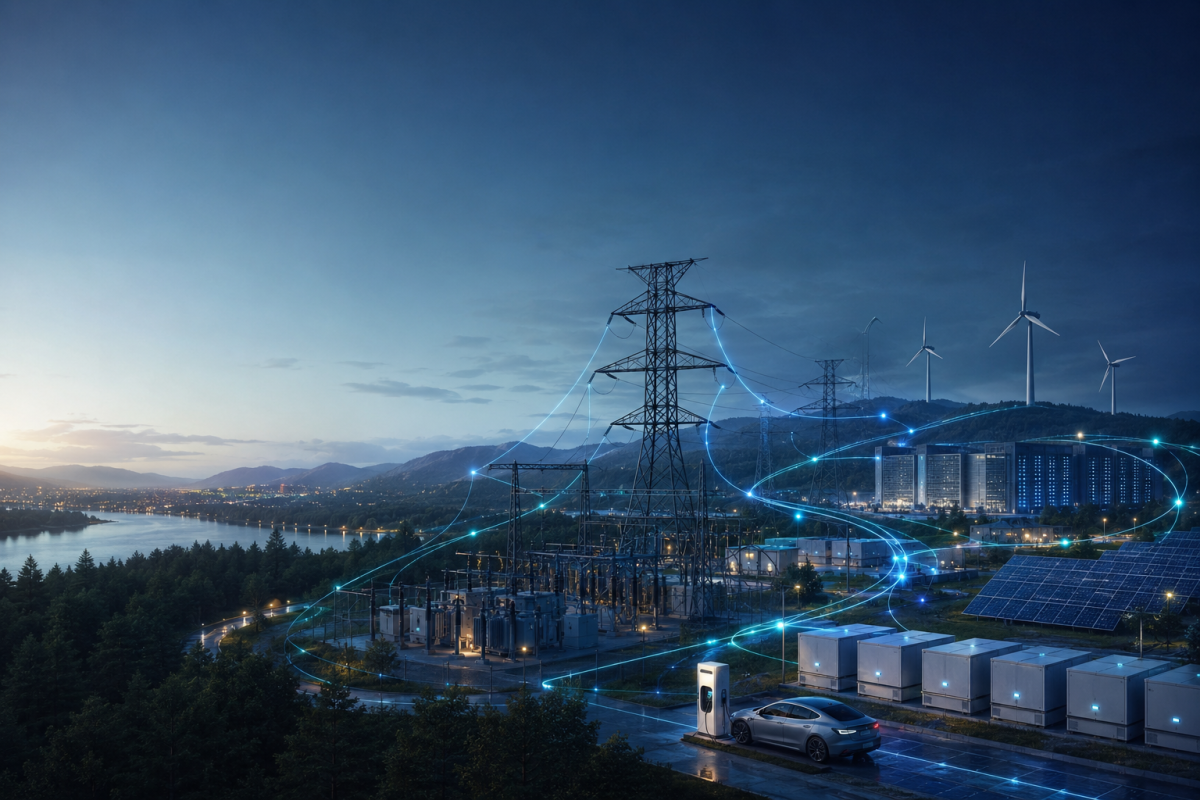
Five scenarios for electric utilities, the probabilities behind each, and the indicators that will tell you which future is arriving
Bottom-line first: Utilities are not going to be disrupted out of existence. We are asked that question from time to time; whether rooftop solar and batteries will finally trigger the grid-defection death spiral the industry has been warned about since 2013. That is the wrong fear, and utilities that spend the next decade debating it will miss what actually happens. The more likely outcome is harder to plan for, because it arrives while revenue is growing.
WE PREDICT that the electric utility of 2040 will be a bigger business than it is today. The first sustained load growth in a generation, driven by AI datacenters, electrification, and reindustrialization, guarantees that. The wires monopoly survives in every plausible scenario; nobody is going to overbuild the distribution grid. What is genuinely contested is everything that sits on top of the wires: forecasting, dispatch, orchestration of grid-edge assets, the customer relationship, and the trading and optimization layers where the margin actually lives. Those layers are being claimed right now by software platforms, by aggregators, and by the utilities’ own largest customers; the utilities that end up owning them will look nothing like the ones that end up renting them.
That conclusion comes from looking at what a utility actually sells, function by function, and asking which functions AI absorbs and which it structurally cannot. It also comes from watching industries that already ran this experiment. Telecom carriers kept their networks and lost the margin to platforms that built on top of them; banks kept their charters and watched fintechs capture origination, payments, and the customer interface. In both cases the regulated core survived and the economics migrated. Utilities are the last great regulated network business to face that pattern, and they are facing it with less software capability than either predecessor had.
What a Utility Actually Sells
Strip the industry down, and it’s clear a utility sells six things:
- delivered energy over physical infrastructure (the wires, the rights-of-way, the transformers),
- capacity assurance (the guarantee that power is there at peak, which customers pay for whether or not they use it),
- balancing and dispatch (the second-by-second orchestration that keeps the grid stable),
- the customer relationship (the meter, the bill, the call center, the brand on the truck),
- regulatory accountability (a named, franchised entity that answers to the commission when the lights go out), and
- the social compact (universal service, storm restoration, the implicit promise that the grid serves everyone).
AI absorbs the middle of that list almost completely by 2040. Load forecasting, generation dispatch, congestion management, outage prediction, vegetation management prioritization, storm damage assessment, and first-line customer service are all pattern-recognition and optimization problems; that is precisely what machine intelligence does best, and precisely where utilities’ decades of operational data become raw material for someone’s model. The strategic question is whose model. Balancing a grid with millions of solar inverters, batteries, EV chargers, and smart loads is beyond human dispatchers regardless of preference; some AI orchestration platform will run it. Whether the utility owns that platform or licenses it from a software company is the difference between the two dominant scenarios below.
The first and last items on the list resist automation for structural rather than technical reasons. Nobody digitizes a right-of-way, and a public utility commission cannot fine an algorithm. When a hurricane takes out a substation, a regulator needs a franchised entity with crews, capital, and a CEO who can be summoned to a hearing. That accountability function does not disappear when AI runs the control room; it becomes the core of what the utility is. The risk is that accountability without the intelligence layer is exactly the telecom carrier position: essential, regulated, capital-intensive, and earning a regulated return while someone else’s platform earns the margin.
The Death Spiral Question
Every few years someone predicts utility grid defection: customers pairing solar with batteries and cutting the cord, leaving a shrinking customer base to carry fixed costs in a self-reinforcing spiral. The industry’s own trade association published the canonical warning in 2013. It has never happened, and the reason is instructive: full defection never penciled economically, and the grid’s value as backup and balancing infrastructure grew as intermittent resources multiplied. The customers most capable of leaving were the ones who benefited most from staying connected.
But the logic protecting that status quo is weakening, and from the opposite direction than predicted. The death spiral was forecast from the bottom of the customer base; the real secession pressure is coming from the top. Hyperscalers facing multi-year interconnection queues are building behind-the-fence gas generation and contracting for small modular reactors; the largest new loads in a century are deciding whether the grid is a supplier or merely a backup. And the residential base isn’t defecting; it’s being aggregated, as virtual power plant operators and retail platforms enroll millions of batteries, EVs, and thermostats into portfolios they orchestrate and monetize. In both cases the customer stays physically connected while the economic relationship migrates to someone else. The wires keep every customer; the margin doesn’t.
Five Futures, with Probabilities
Scenario 1: The Orchestrator Utility (~30%)
The base case, and the winnable one. The utility becomes the platform that orchestrates millions of grid-edge assets: owning the AI dispatch layer, running the virtual power plant programs, monetizing flexibility, and using its data estate as the moat it always should have been. Load grows, rate base grows, and the utility captures the intelligence margin on top of the regulated wires return. Regulators cooperate because performance-based frameworks let them share the gains.
The dividing line in this scenario is not size, territory, or generation mix. It is whether a utility’s operational intelligence lives in institutional systems or in the heads of a control-room workforce that is retiring this decade. Utilities in the second category will license their orchestration layer from someone else within ten years, because they will have no alternative; utilities in the first category become the platform their neighbors license. This scenario requires no regulatory revolution and no technology that doesn’t already exist, which is why it carries the highest probability; it also requires software execution that most utilities have never demonstrated.
Scenario 2: Platform Capture (~24%)
The orchestration layer arrives, but owned by software companies rather than utilities. A handful of grid-intelligence platforms (the pattern is already visible in retail-energy software licensing across continents) become the operating system for dozens of utilities each, the way core processors became the operating system for community banks. The utility keeps the wires, the crews, the regulatory relationship, and a regulated return; the platform takes a per-meter or per-megawatt fee and, more importantly, owns the data flywheel and the pace of innovation. Aggregators simultaneously capture the customer-facing flexibility economics under frameworks that give distributed resources direct wholesale market access. Nothing about this scenario looks like disruption from the outside; reliability improves and rates stay reasonable. But the utility has quietly become a licensed operator on infrastructure it does not control, and its enterprise value reflects it by the mid-2030s.
Scenario 3: Big-Load Secession (~18%)
The growth story inverts. Hyperscalers, AI campuses, and reindustrializing manufacturers, the very loads that were supposed to fund the next generation of grid investment, conclude that interconnection queues, ratepayer politics, and grid congestion make self-supply the rational default. Co-located gas, SMRs at industrial parks, and private microgrids serve the majority of new large load by the mid-2030s, with the grid relegated to backup service that regulators struggle to price. The remaining customer base carries the fixed-cost burden the datacenters were supposed to share, reviving the death-spiral arithmetic from an unexpected direction. The tell for this scenario is regulatory: the first major stranded-cost fight over transmission built for datacenter load that subsequently went behind the fence.
Scenario 4: The Full Agentic Grid (~6%)
Machine-speed markets end-to-end: autonomous agents bidding flexibility, negotiating interconnection, settling transactions between grid-edge devices, with the distribution system operating as a self-healing mesh and humans reduced to exception handling and compliance sign-off. Technically plausible by 2040 at the wholesale and device layers. But it requires regulators to certify autonomous systems for decisions where the failure mode is measured in lives, full interoperability across a fleet of grid hardware with forty-year asset lives, and a resolution of the accountability question that no commission has yet been willing to touch. Liability does not automate, and in no industry is that constraint more binding than the one where the product is measured in nines of reliability. Meaningful probability at the market and trading layers, near zero for full grid autonomy.
Scenario 5: Muddle-Through (~22%)
Efficiency gains everywhere, structural change nowhere. Cost-of-service regulation rewards capital deployment rather than intelligence, commissions move at the speed of rate cases, and the utility of 2040 looks like the utility of today with better forecasting, fewer truck rolls, and a modestly smarter control room. History gives this outcome real credit; utilities have absorbed smart meters, deregulation waves, and the solar boom without structural displacement, and regulation is a powerful preservative. But muddle-through in a growth era is more dangerous than it looks: the load arrives whether or not the utility modernizes, and every year of muddling is a year in which platforms and aggregators build the layers the utility will eventually need to buy back at a premium. It is the only scenario in which doing nothing works, and even here it only works for a while.
The Margin Is Being Claimed Now
Read the scenarios together and one pattern dominates. In every future, the wires survive and the utility exists; in four of the five, the intelligence and orchestration margin ends up owned by whoever built the platform layer first, and in only one of those four is that the utility itself. This is not a fight over whether utilities have a future. It is a fight over whether that future resembles the orchestrator or the telecom carrier, and the outcome is being determined by investments made in the next thirty-six months, not in 2039.
The utilities that end up on the right side of that line share a common architecture: operational intelligence that belongs to the institution rather than a retiring workforce, a data estate treated as a strategic asset rather than a compliance byproduct, cybersecurity posture worthy of running critical infrastructure on software, and a regulatory strategy that gets performance-based frameworks in place before the platform economics harden. None of that is a technology purchase. All of it is an operating-model decision, and the window for making it deliberately rather than defensively is closing.
What to Watch
Scenario probabilities are only useful if you can tell which future is arriving. Five leading indicators are worth tracking:
- Behind-the-fence share of new large load. Watch what fraction of announced datacenter and industrial capacity is served by self-supply rather than grid interconnection; this is the leading edge of the secession scenario.
- Platform licensing deals. Each major utility that licenses its customer or orchestration stack from a third-party software platform is a data point for platform capture, and each one makes the platform stronger for the next negotiation.
- VPP enrolled capacity. When aggregator-controlled flexible capacity in a region rivals a mid-sized power plant, the orchestration layer has a second owner whether the utility acknowledges it or not.
- Performance-based regulation adoption. Commissions shifting utilities from pure cost-of-service to performance frameworks are building the regulatory rails the orchestrator scenario requires; states that don’t are quietly voting for muddle-through or capture.
- The first autonomous grid segment. One regulator certifying a substantially self-operating distribution area will move the agentic scenario from theoretical to priced-in, and reset every utility’s technology roadmap the following quarter.
The Strategic Question
The question for a utility leadership team in 2026 is not whether AI will change the industry; the interconnection queue answered that question before the control room did. The question is which scenario your organization is positioned for, and whether your current investments are building the orchestration layer or merely making the wires business more efficient while someone else builds it. Those are different projects with different architectures, and the utilities that conflate them will discover the difference when the platform terms arrive.
Innovation Vista works with utilities to answer exactly that question: translating what industries that already ran the network-versus-platform experiment have learned, and turning it into a positioning strategy for the layer contest ahead. If you want to pressure-test which side of 2040 your organization is building toward, that conversation is where we start.