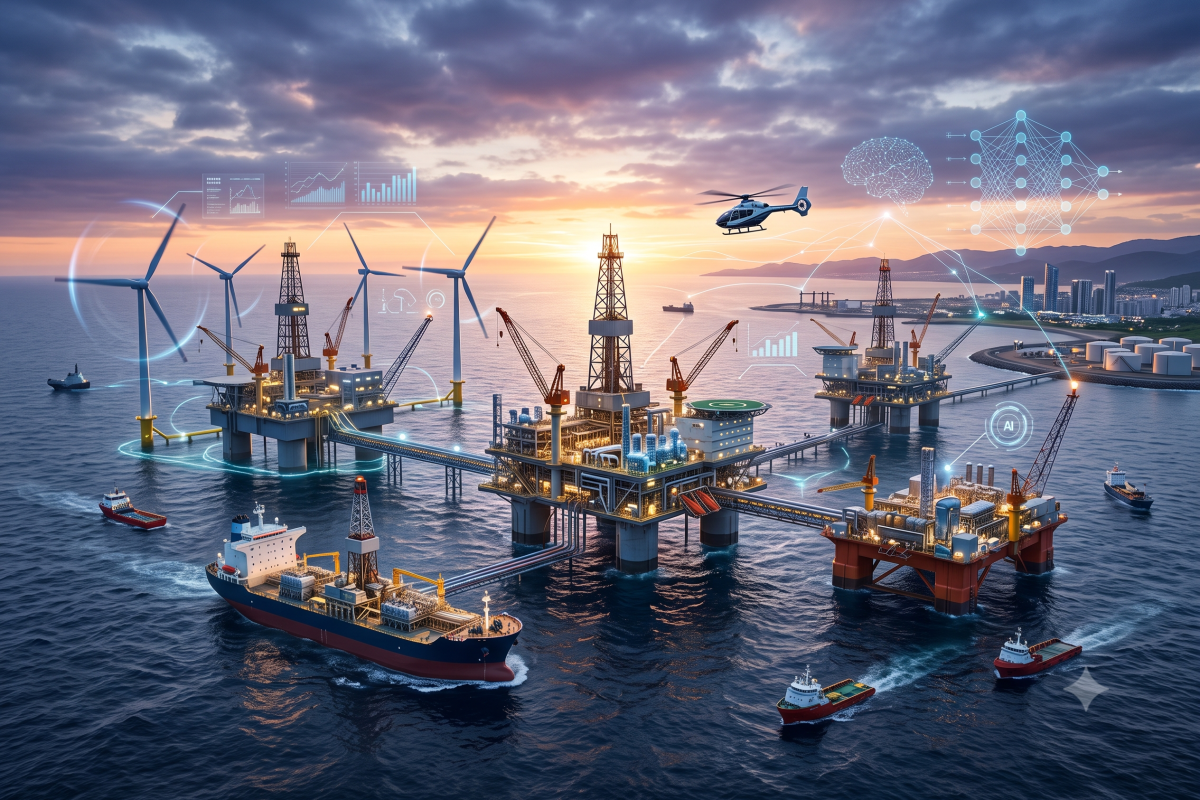
Five scenarios for the oil & gas industry, the probabilities behind each, and the indicators that will tell you which future is arriving
Bottom-line first: the oil & gas industry is not going to disappear by 2040, and neither is it going to be rescued by the transition quietly failing. Both stories, the stranded-asset apocalypse and the business-as-usual reprieve, are the wrong frame; companies that spend the next decade arguing between them will miss the change that is actually underway. For the first time in a generation, the demand side of energy is moving faster than the supply side, and it is moving in two directions at once. AI data centers have broken twenty years of flat electricity demand and turned natural gas into the most strategically important fuel on the grid; electrification of transport is simultaneously eroding oil’s largest market, barrel by barrel. One industry, two demand curves, pointed opposite ways. That divergence, not any single technology, is what rewrites the supply stack: which molecules get produced, by whom, at what margin, and for how long.
WE PREDICT that oil & gas in 2040 will be a better business per barrel and a smaller club of producers. Lifting costs fall, field headcount per BOE collapses, and margins improve for those still operating; but the number of consequential companies shrinks dramatically, and the dividing line runs straight through the demand shock. Gas-weighted producers get pulled toward the power sector, repriced as suppliers to the fastest-growing demand source in the economy. Oil-weighted producers face a plateau in their core transport market and a repricing toward harvest economics, where cost-curve position is the entire investment case. Oil retreats toward the uses where its energy density is irreplaceable: petrochemicals, aviation, and marine. Natural gas becomes the swing asset of the entire energy system, the fuel that firms intermittent renewables and the bridge that nuclear’s construction timeline forces everyone to keep crossing. The industry does not die; it splits, and the companies that recognize which side of the split they are on, early, are the ones still standing.
There is an irony at the center of this forecast worth naming. The same AI revolution hollowing out oil & gas org charts by automating the geoscience, the trading, the drilling optimization, and the production surveillance is simultaneously the demand source rescuing gas economics. AI is both the actor and the audience of this story. That conclusion comes from looking at what the industry actually sells, function by function, and asking which functions AI absorbs and which it structurally cannot. It is the same analysis we ran for CRE brokerage, and the same uncomfortable pattern emerges: the work consolidates around a smaller judgment layer, and the firms that institutionalize their intelligence early absorb the market share of those that don’t.
What Oil & Gas Actually Sells
Strip an exploration and production company down to its functions, and it sells six things:
- subsurface judgment (deciding where capital goes into the ground, under irreducible geological ambiguity)
- execution efficiency (drilling and completing wells faster and cheaper than the basin average)
- land and mineral relationships (the negotiated access that no dataset can substitute for)
- capital access and risk-bearing (absorbing commodity-price risk that most investors will not hold directly)
- midstream and market access (the physical right to move molecules to a price), and
- operatorship itself: blame absorption for well control, process safety, and environmental compliance, where a named human’s license and reputation stand behind every well.
AI absorbs an enormous amount of the work underneath those functions by 2040. Seismic interpretation, drilling optimization, completion design, production surveillance, and predictive maintenance are all pattern-recognition problems on rich data, and they are being automated in roughly that order. The crew count per rig and the field headcount per BOE both fall relentlessly; the remote operations center replaces the rotation the way it already has on the most advanced offshore platforms, and drilling completes its long transformation from craft to manufacturing.
What resists automation resists it for structural rather than technical reasons. Capital allocation under geological ambiguity does not automate, because the ambiguity is the job. Land and regulatory relationships run on trust with mineral owners, county officials, and state regulators; these are constituencies that do not take meetings with software. And operatorship is the industry’s version of blame absorption: when someone certifies well control or signs an emissions attestation, a human reputation is the collateral. The 2040 producer is a judgment layer sitting on autonomous operations, and the economics of a judgment layer favor fewer, more senior people at far fewer companies. This arrives at the worst possible moment for the industry’s knowledge base: the Great Crew Change and the AI revolution are hitting simultaneously, and the companies whose subsurface judgment lives in retiring engineers’ heads rather than in institutional systems will discover that only one of those two waves can be postponed.
The Meter Question
Every industry has a structural boundary that everyone accepts and no one questions, because the players with power built their businesses around it. In CRE it is the absence of a commercial MLS. In oil & gas it is the meter: producers sell molecules at the hub, take the benchmark price, and let the power sector capture everything that happens after combustion. That boundary made sense when electricity demand was flat and utilities held all the negotiating leverage. It is starting to crack, because the largest energy buyers in history are now bypassing the grid entirely and showing up at the wellhead.
Data-center developers facing multi-year interconnection delays are contracting directly for behind-the-meter generation, and the most interesting deals pair gas supply with on-site power in a single arrangement. Every one of those contracts is a producer escaping benchmark pricing for the first time in the industry’s modern history, selling reliability instead of molecules and capturing margin that used to belong to someone else’s side of the meter. The question for the next decade is how far upstream that logic climbs: whether producers remain price-taking suppliers at the hub, or whether the gas-weighted independents of 2026 become the power-adjacent energy companies of 2040. The boundary will not be erased from within the utility sector; it is being made porous from outside, by buyers who care about delivered electrons and are indifferent to who owns the turbine.
Five Futures, with Probabilities
Scenario 1: The Gas Highway (~30%)
The base case. The “bridge fuel” turns out to be a fifteen-year highway. AI-driven load growth outpaces nuclear construction throughout the 2030s; storage improves but cannot carry seasonal firming alone; and natural gas remains the energy system’s swing asset through 2040. Gas turbine order books stay backlogged for years, gas-weighted upstream and midstream assets are repriced upward, and the mid-market independents that thrive are the ones that reoriented from selling molecules into oil markets toward feeding power demand, whether at the hub, through firm supply contracts, or behind the meter. Oil-weighted operators without a gas story consolidate on ordinary timelines. This scenario requires nothing exotic to happen; it is simply every current constraint persisting, which is why it carries the highest probability.
Scenario 2: The Two Industries (~20%)
The demand divergence completes, and oil & gas stops being one industry. Gas becomes a growth business attached to the power sector, with growth multiples, growth capital, and a talent pipeline to match. Oil becomes a harvest business: enormously profitable for low-cost producers, starved of new equity, and managed for distributions rather than expansion. The two attract different investors, different balance sheets, and eventually different companies, as diversified producers split themselves the way utilities once separated generation from wires. In this future the most important strategic decision a mid-market producer makes this decade is portfolio weighting, and the most dangerous position is the middle: too oil-weighted for growth capital, too gas-light to matter to the power sector.
Scenario 3: The Early Peak (~18%)
Electrification of transport accelerates past forecasts, and the oil demand plateau arrives visibly before 2032. The equity story for oil-weighted producers ends years ahead of the industry’s planning assumptions; capital exits, multiples compress, and the consolidation endgame arrives early. The barrels still flow for decades, but only the lowest-cost, lowest-carbon barrels earn a return worth having, and cost-curve position becomes the entire investment case. The companies that survive this future are the ones that treated operational efficiency and data discipline as existential rather than incremental while the cycle still forgave mediocrity.
Scenario 4: Wellhead to Watts (~12%)
The Meter Question resolves in the producers’ favor. Behind-the-meter deals scale from novelty to business model, and a cohort of gas producers integrates forward into generation: co-located turbines, firm-power contracts with hyperscalers, and eventually merchant positions in the markets they once merely supplied. The E&P becomes an energy company in fact rather than in slogan, selling delivered reliability at power-sector margins instead of molecules at hub prices. This is the highest-upside future for the mid-market and the most demanding; it requires project delivery and commercial capabilities most producers have never built, which is precisely why the ones that build them early will not stay mid-market for long.
Scenario 5: Policy Whipsaw (~20%)
The muddle-through of the energy world, with a distinctly political flavor. Election-cycle reversals (subsidies enacted and repealed, permits granted and litigated, emissions rules imposed and withdrawn) keep capital cautious in every direction at once. Everything advances; nothing resolves. Gas grows some, oil plateaus slowly, and 2040 looks like 2026 with better tools, fewer people, and the same arguments. History gives this outcome more credit than technologists admit; this industry has absorbed multiple predicted revolutions without structural displacement. But whipsaw is a probability, not a plan, and the only companies it rewards are those engineered to stay profitable under permanent uncertainty, which is itself a strategy, and a demanding one.
The Land Is Being Claimed Now
Read the five scenarios together and one pattern dominates. In every future, the number of consequential producers shrinks and the per-barrel economics improve for the survivors. In four of the five, natural gas’s connection to power demand is the industry’s growth engine; the scenarios differ mainly on how long the bridge runs and who collects the tolls. And in all five, the dividing line between the consolidators and the consolidated is the same: whether a company’s operational intelligence (its subsurface judgment, its asset performance data, its land and regulatory relationships) lives in institutional systems or in the heads of a workforce that is retiring right now.
For a mid-market leadership team, the strategic questions are no longer whether the transition happens or whether AI changes the business. They are which side of the demand divergence your portfolio sits on, which side of the meter your future revenue sits on, and whether your data architecture positions you to hold value across at least three of the five scenarios rather than betting the company on one. The commodity tier of the business (undifferentiated molecules sold at benchmark prices by average-cost operators) migrates to thin-margin, AI-optimized trade in nearly every future; the durable economics sit with cost-curve leadership, power-market access, and the judgment layer above the automation.
What to Watch
Scenario probabilities are only useful if you can tell which future is arriving. Five leading indicators are worth tracking:
- The first gigawatt-scale wellhead-to-data-center deal signed by an independent. The majors will do these first; the signal is when a mid-market producer lands one, because that marks the Meter Question opening to the whole industry.
- Gas turbine order backlogs. Order books are the honest demand forecast. Backlogs stretching further into the 2030s confirm the Gas Highway; a sudden thinning signals gas’s bridge shortening.
- The multiple divergence. Watch the valuation spread between gas-weighted and oil-weighted producers of comparable quality; a widening gap is capital markets voting for the Two Industries future in real time.
- The first on-budget SMR fleet order. Nuclear delivered on schedule at a committed repeat-build price starts the countdown clock on gas’s power-sector growth; until then, the bridge holds.
- The oil demand plateau. The first three consecutive years of flat-to-declining global crude demand outside a recession ends the growth-equity story for oil-weighted independents, whether or not anyone announces it.
The Strategic Question
The question for an oil & gas leadership team in 2026 is not whether the demand shock is real; the interconnection queues, the turbine backlogs, and the data-center announcements have already answered it. The question is which scenario your capital program is silently assuming; every capital program assumes one. The follow-on question is whether your technology and data investments are building optionality across the futures above or merely making your current position more efficient. Those are different projects with different architectures, and the companies that conflate them will discover the difference at the worst possible moment, most likely at the bottom of a commodity cycle with a retirement wave in progress.
Innovation Vista works with oil & gas leadership teams to answer exactly that question: identifying which of these futures your company is actually positioned for, and turning that analysis into an AI and technology strategy built for the consolidation ahead. If you want to pressure-test which side of 2040 your company is building toward, that conversation is where we start.