
The managed services business has always been a relationship business dressed in technical clothing. Tickets, response times, and patch cadences are the daily currency; renewal decisions, however, get made in boardrooms by executives who increasingly want to talk about something other than uptime. They want to talk about AI. They want to talk about modernization, M&A readiness, cybersecurity posture beyond the EDR dashboard, and what their technology investment is actually buying them three years out.
For most MSPs, that conversation is awkward. The lead engineer who built the relationship can speak fluently about the stack, but goes quiet when the CEO asks whether the company’s AI strategy is competitive. The vCIO badge on the website turns out, on closer inspection, to be a senior systems administrator with a nicer title. Clients can tell.
That gap is where white-labeled vCIO services quietly change the math. Innovation Vista’s model lets MSPs deploy genuine C-level IT and AI leadership under their own brand, on demand, without adding a single full-time strategist to payroll. The MSP keeps the relationship and the revenue; we stay behind the curtain.
From Stack Operator to Boardroom Voice
MSPs are already in the room. They see the spend, the systems, the gaps, and often the politics. What they typically lack is the seat at the strategy conversation, because the value proposition the client has internalized is operational, not advisory. The result is predictable: when the CEO needs strategic IT or AI guidance, they don’t ask their MSP. They hire a Big Four consultant, or they bring in a boutique advisory firm, or they post for a fractional CIO. The MSP gets to keep the helpdesk contract and watches someone else shape the roadmap that will define the next three years of spend.
White-labeling flips this. The next QBR isn’t just an SLA review; it’s a strategy session with a former Fortune 500 CIO who happens to wear the MSP’s badge for the day. Suddenly the MSP is the firm that brought the AI readiness assessment, scoped the modernization plan, and presented the board-ready roadmap. The strategic conversation stays in the MSP’s account, where it belongs.
A Competitive Edge at the Right Price
Managed services margins are compressing. Differentiation is increasingly hard when every competitor in the local market sells the same 24/7 monitoring, the same EDR, the same backup SKU, and pitches the same logos on the same capabilities slide. The firms that escape the commodity trap are the ones that move up the stack, into advisory and strategy work where price comparisons stop being apples to apples.
White-labeled vCIO services hit exactly that nerve. They allow an MSP to say to a prospect or existing client: We don’t just run your IT, we help you lead it. For a CEO deciding whether to renew, that extra dimension shifts the calculus. The MSP is no longer interchangeable with three others on a spreadsheet; it’s the firm that brings genuine boardroom-grade leadership when the moment calls for it.
The pricing makes it accessible. Innovation Vista’s network of 450+ proven C-level IT leaders deploys at engagement levels starting under $1,000 per week, well below the cost of even a junior internal analyst. For the MSP, there is no overhead, no recruiting risk, no bench to carry. For the client, there is instant expertise delivered through a partner they already trust.
Reactive Today, Strategic Tomorrow
There are two ways MSPs put this model to work, and the best operators do both.
The first is reactive. In the normal flow of account management, a client mentions a problem the MSP isn’t built to solve: an AI pilot that has stalled, a board pushing for a digital strategy, a cybersecurity posture that needs a defensible narrative for the audit committee, an acquisition with no real tech diligence behind it. Rather than shrugging or referring out (which often ends the conversation), the MSP can respond, “We can have a CIO-level strategist on this within two weeks.” The problem stays inside the account.
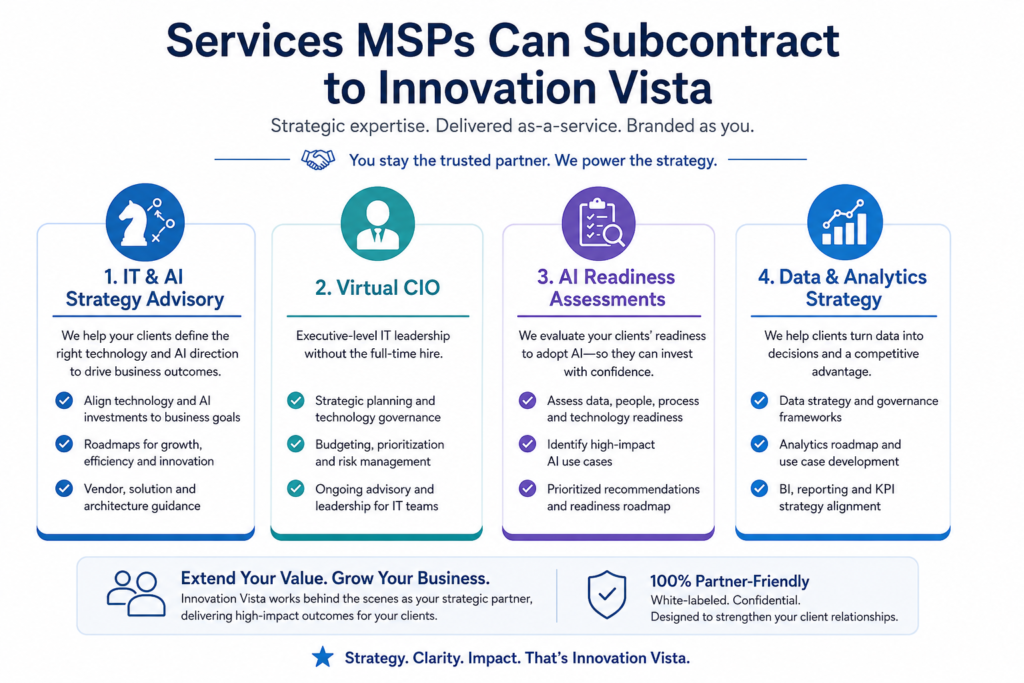
The second is strategic. MSPs can package white-labeled vCIO as a premium tier of their managed services offering, sold proactively into key accounts and built into the annual engagement. Quarterly strategy reviews, AI readiness assessments, modernization roadmaps, vendor-neutral solution architecture, M&A tech diligence, board-level IT reporting; each becomes a billable advisory touchpoint that the MSP can deliver credibly because the talent behind it is genuine.
That second approach is where competitive advantage compounds. Very few MSPs in any local market can credibly claim a real C-level advisory bench. The ones that can will win the larger engagements, hold their pricing, and convert tactical accounts into strategic ones.
The Trust Equation
The MSP-client bond is built on years of operational reliability and personal relationships. Clients trust their MSP to know their environment, protect their data, and answer the phone at 2 a.m. Extending that trust into strategy work is a smaller leap than it appears, provided the experience feels continuous.
White-labeling protects that continuity. The strategist works under the MSP’s banner, attends meetings as part of the MSP’s team, and writes deliverables on the MSP’s letterhead. Innovation Vista remains invisible to the client. That subtlety matters. Clients prefer a single accountable partner over a daisy chain of vendors; the MSP stays the one throat to choke, the one name on the contract, the one logo in the relationship.
Expanding the MSP’s Story
Every MSP sales conversation is a narrative. Here is how we understand your environment. Here is how we keep it running. Here is what we have done for companies like yours. Adding vCIO advisory enriches that story considerably. It changes the pitch from operational stewardship to strategic partnership, which is a different conversation with a different buyer at a different price point.
The story plays especially well in industries where technology has become a competitive battlefield rather than a support function. Healthcare clients facing both HIPAA pressure and AI adoption questions. Manufacturers navigating OT/IT convergence and supply chain digitization. Financial services firms balancing cybersecurity, AI, and post-quantum readiness. Professional services firms trying to automate workflow without gutting their people model. For MSPs serving those sectors, walking in with credible C-level strategy capability isn’t a nice-to-have; it’s a door-opener.
Building Long-Term Stickiness
The MSP’s economic model lives and dies on MRR retention. Every advisory touchpoint added to the engagement is another reason for the client to stay, and another conversation that competitors can’t easily replicate. Quarterly IT strategy reviews. Annual AI readiness scorecards. Roadmap updates timed to the client’s budget cycle. M&A tech diligence when the client is acquisitive. Each of these embeds the MSP deeper into the client’s leadership fabric, well past the point where a cheaper competitor’s RFP can dislodge the relationship.
The strategic conversations also tend to surface additional in-stack work. A roadmap recommends a cloud migration; the MSP executes it. An AI readiness assessment identifies data infrastructure gaps; the MSP scopes the remediation. The vCIO layer doesn’t cannibalize the managed services revenue; it feeds it.
Risk-Free Expansion
The elegance of the white-label model is how little the MSP has to commit. There is no requirement to hire a $300K CIO who may or may not fit. No bench to carry between engagements. No new practice area to stand up, market, and grow. The capability appears when needed and recedes when it doesn’t, with the economics matching the engagement rather than fixed overhead.
That flexibility is particularly valuable in a market where client budgets are tightening and competitive pressure is intensifying. MSPs that can deliver both operational excellence and strategic advisory on demand are more resilient than those locked into a single value proposition, and they capture revenue streams that don’t exist in the commodity managed services market at all.
The Future of MSP Value
The managed services industry is approaching the same inflection point that hit accounting firms a decade ago and law firms before them. Commodity work is being automated, offshored, and compressed. The firms that thrive are the ones that move up-stack into advisory, where the value is judgment, not execution; where AI accelerates the practice rather than replacing it; where the conversation with the client is about strategy, not SLAs.
MSPs that remain narrowly defined as “the IT vendor” will continue to face margin compression, churn pressure, and roll-up risk. MSPs that broaden their scope without taking on the cost structure of a consulting firm have a genuinely different future available to them.
White-labeled C-level technology and AI advisory is one of the cleanest paths to that future. It lets the MSP wield world-class strategic leadership as a deployable capability, under its own brand, ready when the client needs it and invisible when they don’t. In an industry where the next five years will separate operators from strategic partners, that capability may be the line that decides which side of it the MSP ends up on.