
We met recently with a CEO who has stopped reading AI headlines. Not out of denial; out of arithmetic. The headlines describe an economy where algorithms take entire markets overnight, and then he looks out his window and sees nothing of the kind. His competitors are the ones he had five years ago. His clients still call, still negotiate, still renew. No machine has taken everything from anyone he knows. So he filed the whole subject under “Overblown” and got back to work.
If this is you, you are half right, and the arithmetic is on your side. Weight every American industry by its payroll and the headlines invert: roughly one in three jobs sits where AI is already table stakes, and fewer than one in twenty-five faces anything like winner-take-all. The 2026 edition of our AI Dividend Map shows the count. The urgency industry writes for the smallest shape on the map, and the majority can tell, which is exactly why so many capable executives have tuned the subject out.
The half you are wrong about will cost you more than panic ever would. The window was the wrong instrument. It shows you your competitors, and only their official capabilities. It cannot show you the floor dropping out from under a sector two doors down, or the platform overhead already pricing your ceiling, or what is happening inside your own margins right now. Because something is. It is quieter than the headlines, and it does not look like losing.
It looks like working harder every year to keep margins that used to keep themselves.
So read what follows as a forecast, not a territory. You did not choose your industry any more than you chose your weather, and no map lets you pick a different one. What a forecast does is tell you which system is over you, which way it is moving, and what to do before it arrives. In every market we serve, the AI dividend is taking one of four shapes. Three questions about your customers decide which one. This article explains the questions, what each shape does to the money, and what we would do in your seat under each.
Capturing the Dividend Is Not Keeping It
The AI dividend is the gap between what work used to cost and what it costs now that machine intelligence can carry part of the load. It is real, it is large, and it is growing in nearly every industry at once. Whether you capture it is the first question, and inside your own company it leaks in two directions before it ever reaches your bottom line: outward into vendor margins, and inward into an org chart built for the old cost of work. Recovering it is a discipline of its own.
This article is about the second question, the one your market answers for you. Capturing the dividend and keeping it are different achievements. Once captured, the structure of your market decides whether the dividend stays with you, gets competed away into your customers’ expectations, or flows upstream to platforms that were never your competitors at all. The dividend is real everywhere. Who banks it differs by industry, and it differs in a pattern you can learn to read.
The Three Customer Gates
Your shape is not set by your industry label. It is set by three questions about how your buyers choose and how far your market can concentrate. Picture each one as a gate that is also a dial: it stands more open or more closed by degree, and the shape your dividend takes depends on how far each is open today. All three must stand open before winner-take-all economics arrive.
Spec it. Can your buyer fully define the deliverable before the work starts and verify it afterward? Booking a flight is specifiable. Turning around a distressed division is not. Where output resists specification, buyers cannot comparison-shop on efficiency, because they cannot verify what they would be comparing.
Shop it. Does your buyer choose algorithmically, on measured criteria, or deliberatively, on trust and reputation? Freight rates are compared by machines in milliseconds. Auditors are chosen by committees over dinners. Efficiency advantage converts into market share only when the selection process can see it.
Sole-source it. Will this market concentrate its business on one or two dominant providers, or do its constraints keep it split? Flight booking, freight matching, and personal-lines insurance aggregation concentrated because nothing stopped them: delivery scales like code, and buyers collapse onto the cheapest qualified platform. Custom manufacturing, certified aerospace work, and licensed care stay fragmented, because capacity, geography, licenses, and durable differences in what buyers want hold the market in pieces no matter how efficient any one provider becomes. Concentration needs both a delivery model that scales and a market willing to collapse onto its winners.
Because the gates are dials, a market has a center of gravity rather than an address. Sectors sit nearer or farther from a boundary, and a whole industry can swing when one dial turns. Hold that thought; the last section before the playbook is about how fast the dials move.
The Four Shapes
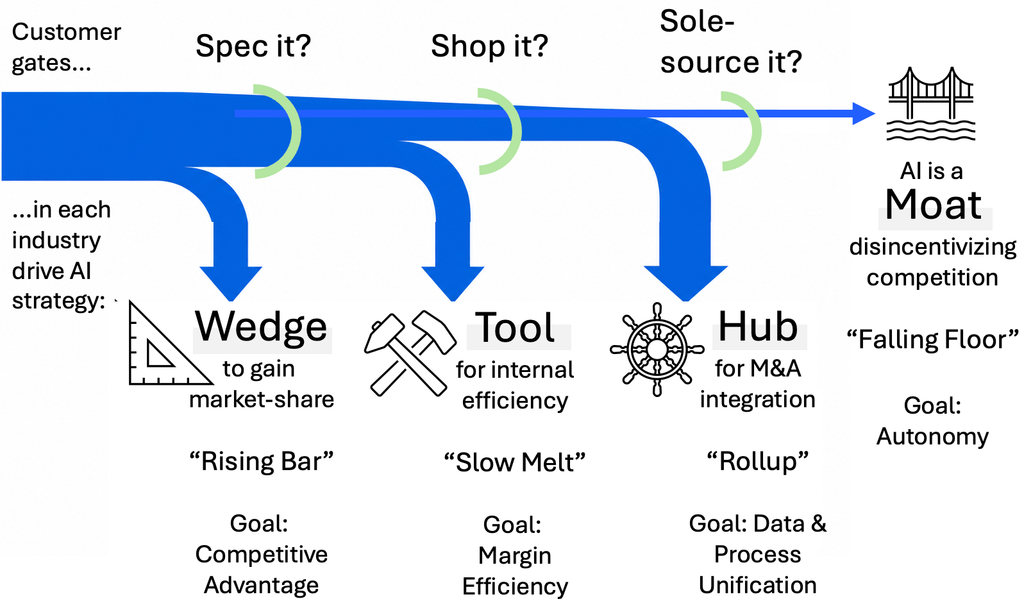
Run a market through the gates and its dividend comes out in one of four shapes. Two are the poles in this article’s title: a Rising Bar, where AI becomes the price of staying on the field, and a Falling Floor, where efficiency compounds until very few players remain. The other two are shelters between the poles, and neither shelter is permanent. Each shape hands AI a different identity and a different goal, which is what the graphic compresses. The table says the same thing in a form you can hold in your head.
| Shape | Gates | AI is your… | Goal | Who banks the dividend if you stand still | From the window it looks like |
|---|---|---|---|---|---|
| Rising Bar | Spec it closed | Wedge | Competitive advantage beyond table stakes | Your customers, as expectations | Working harder for the same margin |
| Slow Melt | Spec it open, Shop it closed | Tool | Margin efficiency, banked now | You, until your buyers start shopping | Nothing; loyalty is holding |
| Rollup | Spec it and Shop it open, Sole-source it closed | Hub | Data and process unification | Consolidation capital | Peers selling, multiples moving |
| Falling Floor | All three open | Moat | Autonomy | The single most efficient operator | Price pressure that never lets up |
The decision rule fits in three lines. If your buyers cannot fully specify your work, you are under a Rising Bar. If they can specify it but still choose you on trust, you are in a Slow Melt. If they specify it and shop it but the market cannot concentrate, you are in a Rollup. If all three gates stand open, your floor is falling.
One correction before you place yourself. Your industry predicts where your center of gravity sits. It does not describe your company, which is a portfolio of activities spread across all four shapes. The law firm holds rising-bar counsel and commoditized document review under one roof. The hospital delivers gated, licensed care on top of a revenue cycle that is industrializing by the quarter. Read your market’s shape once, then read the mix inside your own walls, because the second reading is where the strategy is.
Rising Bar (AI as your wedge). The Spec it gate is closed: buyers cannot fully define the work, so efficiency cannot be comparison-shopped. AI floods in anyway and becomes table stakes almost by definition, because any capability you can buy, your competitor can also buy, and the frontier models are for sale to everyone with a credit card. Clients absorb faster turnaround as the new normal, expect more scope for the same fee, and reset their standards without sending a memo. Every firm must clear the new height simply to stay on the field, and no firm wins the field by clearing it. Drawn over time, this is a ratchet: you capture the dividend, your customers absorb it into expectations, the bar rises, and you capture again.
This is the largest shape on the map, and its gains are real but governed by physical and human scale. The exceptions to “anyone can buy it” are narrow and they matter: integration, proprietary workflow data, and distribution cannot be bought off a shelf, and they decide who clears the bar comfortably rather than whether it rises. So AI is a wedge here, and the goal is competitive advantage, but only beyond table stakes. Share goes to the firms that spend the recovered dividend on new offerings, a deeper judgment layer, and speed and scope clients have not yet learned to demand.
Slow Melt (AI as your tool). Spec it is open but Shop it is not: the work is specifiable, yet buyers still choose on trust and reputation. Economics that would not survive algorithmic selection shelter here, the way audit relationships and deposit accounts have sheltered margins that arithmetic abandoned years ago. Drawn over time, the dividend holds flat for as long as the shelter does, then bends the day your buyers start shopping. AI is a tool for the engine room, and the goal is margin efficiency banked now, while selection still runs on trust. The melt has an expiry date you cannot read, and it is your buyer, not you, who sets it.
Rollup (AI as your hub). The first two gates are open but Sole-source it is not: buyers will shop specifiable work, yet capacity, geography, regulation, or preference keeps the market too fragmented to concentrate. Nobody takes all; consolidation capital takes most, buying fragmented firms and repricing the work behind the AI it brings along. Drawn over time, the independent’s dividend is a step function that moves at the transaction, up for the consolidator and down for the firm that waited. AI is a hub, and the goal is data and process unification. For the independent in its path, that hub is a valuation question long before it is a technology one.
Falling Floor (AI as your moat). All three gates stand open: specifiable work, algorithmic selection, and a market willing to collapse onto its winners. Here efficiency does not dissipate; it compounds. Every advantage converts into share, every unit of share lowers the leader’s costs further, and the market consolidates around one or two players, because only the leanest survive the pricing pressure created by the leader’s own success. Drawn over time, one line compounds while the rest fall away. AI is a moat, and the goal is autonomy: the operator who automates most completely runs beneath every rival’s cost floor and disincentivizes competition from forming at all. Your strategic menu shortens to three items: race for scale, partner with scale, or exit while multiples still assume a future.
Two poles, two shelters. At one pole AI is table stakes, and a wedge only for the firms that spend it beyond the bar. At the other it is a moat in the making, and the game has very few winners. The shelters between are comfortable, and each expires in its own way: the melt ends when your buyers’ agents start shopping, and the rollup ends when someone else’s capital arrives carrying the technology you were going to build next year.
Three Forces Off the Map
The gates describe your market. Three forces sit outside it and can decide your dividend anyway. The four shapes are incomplete without them, and most of the surprises in our sector work trace back to one of the three.
Your window shows you your competitors. It does not show you your ceiling.
The layer above. In sector after sector, the entity positioned to take all is not a rival firm. It is a layer: the booking platform above the hotel, the delivery app above the restaurant, the AI tutor above the school, the marketplace above the merchant. The layer runs the three gates on its own work, whether distribution, booking, or matching, and finds all three open, so it can operate a Falling Floor directly above a sector that remains a Rising Bar beneath it. That is how a sector keeps nearly all of its people and loses an outsized share of its margin. Your window shows you your competitors. It does not show you your ceiling.
The regulator. Where customers cannot leave, there is no selection gate at all. The regulator, not the market, decides who keeps the dividend, which turns AI investment into a rate-case argument as much as a technology decision. This is the exception that proves the gates: remove buyer choice entirely and the four shapes stop applying.
The capital. Consolidation capital is not a competitor in the ordinary sense. It is the buyer of Rollup markets. It uses AI economics as its thesis, purchases fragmented firms, and reprices the work behind the intelligence it brings. Wherever the first two gates are open and the third is closed, assume the capital is already reading the same map you are.
The Proof in One Profession
If you want proof that the gates are real, one profession already ran the experiment. Travel agents once handled both the booking and the advising. The booking opened all three gates: buyers could spec it, they shopped it on price, and they proved perfectly willing to sole-source it onto a handful of platforms, which took nearly all of it within a decade. The advising, for complex itineraries and high-end travel, opens none of the three, and it is alive and profitable today as a rising-bar trust business. One profession, split exactly along the three gates. And notice who took the booking side: not a rival agency. The layer above.
The Line Moves at Two Speeds
Every comfortable shape on the map comes with one warning: the dials turn, and they turn at two very different speeds.
The working line moves slowly, through capability. Each model generation converts some previously unspecifiable judgment work into specifiable work, opening the first gate another notch. Simple tax returns crossed that line decades ago while complex ones stayed behind, and the definition of complex has been creeping upward ever since. You can watch the working line move. It gives you years.
The buying line moves fast, through your customer. A market does not need its work to change for its shape to change. It only needs its buyers to stop selecting like humans. When procurement becomes agentic, when your customer’s AI evaluates vendors against structured criteria, trust gets quantified and the Shop it gate swings open in markets that relationship-based buying protected for generations. The buying line can flip a sector between one edition of the map and the next.
The line moves slowly when AI does the work, and fast when AI does the buying.
Remember that sentence if you remember nothing else here. No market protected only by how its customers choose should mistake that protection for a wall.
What to Do, Shape by Shape
A framework earns its keep only if it changes what you do on Monday. Here is what we would do in your seat under each shape, and where our practice fits. One note on posture first: we are vendor-neutral by design, we staff engagements with former CIOs, CTOs, and CISOs from your own sector, and every relationship starts with an exploratory conversation with our CEO rather than a sales rep. That is not a formality. Placing your business on this map, honestly, is exactly what that conversation is for.
Under a Rising Bar, stop waiting for the existential threat, because it is not coming, and start respecting the ratchet, because it already arrived. The wedge is not adoption itself; clearing the bar is the entry fee, and share goes to the firms that spend the recovered dividend beyond it. The play has two halves. First, capture the dividend deliberately: our AI and technology assessments find where it is leaking through vendors and org design, and our Capturing the AI Dividend engagement recovers it. Second, and this is the half most firms skip, redeploy the recovered dividend beyond efficiency before the rising bar absorbs it. Pure savings evaporate into client expectations; new offerings, new revenue, and a stronger judgment layer do not. That redeployment is the heart of our fractional CIO and virtual CAIO work, and it is why our track record shows more top-line impact than cost savings.
In a Slow Melt, your customer loyalty is real, your margins are real, and both have an expiration date you cannot read. Treat the protected years as a war chest and a window. The work is to industrialize behind the trust wall, rebuilding your specifiable operations to survive algorithmic selection before your buyers’ agents impose it, which is a two-to-three-year program that must start while the shelter still holds. A sector-matched technology leader from our bench, fractional or interim, exists for exactly this: someone who has run your kind of institution, building the engine room quietly while the franchise still commands its premium.
In a Rollup, understand that the buyer at your door is consolidation capital using AI economics, and your operational AI posture is already being priced into your multiple. That leaves a fork, and both tines are ours to help with. If you intend to remain independent or to sell well, an honest AI readiness assessment and a focused operational program can move your valuation more than a year of earnings. If you intend to be the consolidator, our M&A technology leadership builds the integration playbook that makes each acquisition accretive instead of chaotic. What we counsel against is the third path, drifting, because in consolidating markets the firms that fare worst are the ones that never chose.
On a Falling Floor, urgency is not marketing, it is arithmetic, and your menu is short: race, partner, or exit. The racing question is whether you can win on efficiency at scale, and it deserves a brutally honest technology answer before you bet the company on it. The partnering and exit questions turn on how your capabilities look through an acquirer’s diligence. We provide the honest answer, the roadmap for whichever play you choose, and the technology diligence posture that protects your value in a transaction. What we will not do is sell you a measured, comfortable adoption roadmap, because on a falling floor comfort is the one thing that is always mispriced.
Beneath a layer, your rivals are not your problem; your ceiling is. The platform above you has three plays available to it, and so do you. Own the layer where you still can: direct booking, direct ordering, first-party data, the customer relationship the platform is trying to rent back to you. Join it on terms you set rather than terms you accept, treating platform economics as a negotiated cost of distribution with a ceiling you defend. And build the layer the platform cannot: the judgment, curation, and experience that make a customer ask for you by name inside someone else’s interface. Most operators do a little of all three by accident. The work is to choose the mix deliberately, and to stop funding the ceiling with the dividend you just captured.
Under a regulator, your dividend is argued rather than competed, so your AI strategy must be a regulatory strategy: roadmaps built for prudency review, reliability improvements quantified the way commissions score them, and investment structured for recognition in rate design, all while planning for the load growth that AI itself is driving onto your grid. Our utility-sector executives have sat on your side of those proceedings, which is precisely the point of a bench built from industry insiders.
If you are the capital, you already know the Rollup shapes are the opportunity. The honest question is post-close: every fund screens with AI now, so returns have moved to the operating playbook that makes the dividend appear in EBITDA rather than on a board slide. Embedding sector-matched technology leadership inside portfolio companies, at the moment of the thesis rather than after it disappoints, is the version of that playbook we run. Use the map as a screen; the sectors drifting toward the buying line are where consolidation economics improve before the auction processes notice.
Reading the Forecast
The four shapes are the framework. The forecast itself is the AI Dividend Map, which we publish each year: every sector we serve in the mid-market, scored against the three gates, located by its center of gravity, with the split inside it, the force most likely to take its dividend, and which line is moving. The 2026 edition is the first. Some of what it says will be wrong by the third edition, which is what maps of moving weather are for.
Until you read it, the standing questions for your leadership team are the ones this framework was built to sharpen. What shape is the AI dividend taking in your market? Which of your activities sit in the other three? What is AI in each of them: your wedge, your tool, your hub, or someone else’s moat? Which of the three forces off the map is closest to your margin? And is the line moving toward you at working speed or at buying speed?
Answer those five and you will know more about your next three years than the headlines will ever tell you. Answer them out loud, with someone who has run a company in your shape, and you will know what to do on Monday.