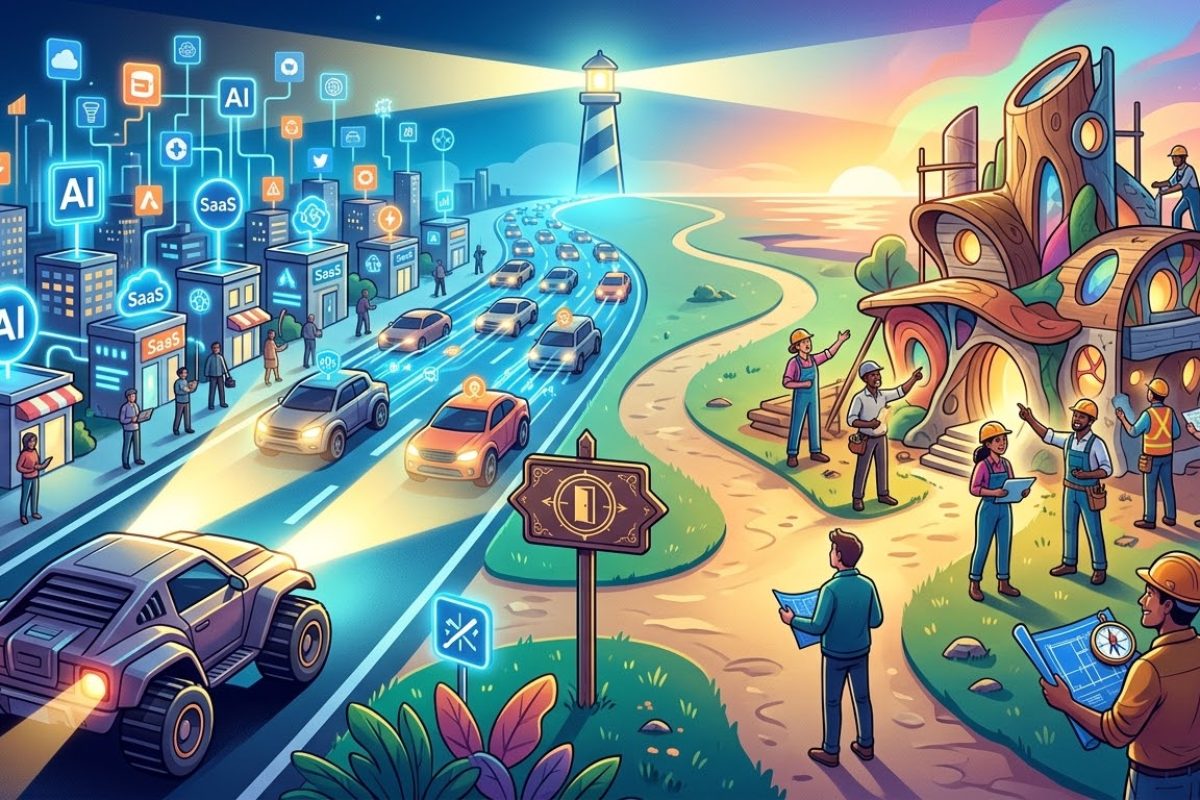
Every enterprise software vendor on the planet is racing to embed AI into their products. Salesforce has Einstein. Microsoft has Copilot. ServiceNow, Workday, Oracle, SAP, and dozens of others are all shipping AI features as fast as they can build them. For the mid-market CEO trying to figure out where to invest in AI, this creates a genuinely confusing landscape. You are being told from every direction that AI is essential, that you need to be building capabilities now, that the window is closing. And much of that is true.
But here is what rarely gets said: most companies that are building custom AI capabilities right now are building in the wrong places. They are investing time, money, and scarce technical talent to create something their software vendors are going to hand them for free within the next 18 to 24 months.
The smarter play is to turn on your headlights. If you can see where the SaaS vendors are driving, you know where not to build. And more importantly, you can see where the road is dark; where no vendor is headed, and where your proprietary AI opportunity actually lives.
We have previously explored the strategic crossroads companies face when deciding whether to build, buy, or wait for AI capabilities. But that framework leaves a critical question unanswered: where should you build, where should you buy, and where should you wait? The answer depends on where your SaaS vendors’ headlights are pointed.
Zone 1: Inside the Platform (Stop Building Here)
The most common AI misstep we see in the mid-market is companies building analytics and prediction models on data that lives entirely within a single software platform. Think CRM-based lead scoring, ERP demand forecasting using only the ERP’s own historical data, or HRIS attrition prediction drawn solely from HR system records.
This is the zone where your vendors will always beat you. They have more training data than you do; they can learn from thousands of customers’ patterns, not just yours. They have deeper access to their own platform’s data architecture than any external model you build. And they have every financial incentive to ship these features, because AI capabilities are the primary competitive battleground in enterprise software right now.
If you are building a custom model that takes data from Salesforce and produces insights about that same Salesforce data, you are almost certainly wasting money. Salesforce is building that exact feature right now with better data, better engineers, and a bigger budget than you can bring to the problem. The same logic applies to virtually every major SaaS platform in your stack.
This is the “wait” zone. Save your budget.
Zone 2: Common System Pairings (Build Cautiously)
Here is where it gets nuanced. Your SaaS vendors are not just building AI for data within their own walls; they are also building integrations with the platforms most commonly paired alongside them. Salesforce knows that a huge percentage of its customers also use HubSpot for marketing, or Zendesk for support, or QuickBooks for billing. These high-frequency pairings are visible in the vendor’s install base data, and the vendors are building AI features that span those connections.
This is what I call the vendor’s “adjacent observable universe”. They can see which integrations get enabled most often, they can see the data flowing across those connections, and they will prioritize AI features for those combinations. CRM plus support tickets, ERP plus warehouse management, marketing automation plus CRM; if 40% of a vendor’s customer base runs a particular combination, you can bet that vendor is building AI for it.
The trap here is that companies often think any cross-platform analysis is inherently proprietary. “We are combining our CRM with our billing system and our support data” sounds unique, but if that is a combination tens of thousands of other companies are also running, it is not unique at all. The vendor sees it and is coming for it.
That said, there is a window. Vendors build on their own timelines, with generic business logic designed for the broadest possible customer base. If speed-to-insight is competitively critical for you, building in this zone can deliver real value for 18 to 36 months. But go in with your eyes open: this is rented advantage, not owned advantage. Build with the expectation that you will sunset the custom solution once the vendor catches up, and architect accordingly. Do not overinvest in infrastructure you are going to decommission.
Zone 3: Your Proprietary Data Topology (This is where Strategic Advantage Lives)
This is where the real opportunity lives, and it is where most companies are underinvesting because they have spent their AI budget in Zones 1 and 2.
Zone 3 is defined by data combinations no vendor can see and no vendor has the incentive to productize. These are the unusual system pairings, the proprietary data sources, and the unique business logic that make your company different from every other company in your industry. Your IoT sensor data married to your warranty claims data married to your dealer network performance. Your proprietary pricing models layered against real-time competitive intelligence and regional demand signals. The data sets that, when combined, tell a story only your company can read.
But the real insight is subtler than “use unusual data combinations”. Even when companies are working with common systems, the competitive moat often lives not in the data itself but in the business logic layer that interprets it.
Consider two manufacturers that both connect their ERP to their manufacturing execution system to their quality management platform. Same systems, same basic data flows. But one company’s competitive advantage lies in how they define an “at-risk batch” based on a specific interplay of supplier lead time variance, ambient humidity readings during production, and downstream customer complaint patterns. That definition; that interpretive logic sitting on top of common data; is what no SaaS vendor will ever build for them. The vendors will provide the plumbing. The recipe is yours to write.
This is the zone where AI investment creates genuine competitive separation. Not because you have fancier technology than your competitors, but because you are asking questions of your data that no one else has the context to ask.
The Headlights Keep Moving
One critical point that static frameworks miss: these zones shift over time. What was a Zone 3 opportunity two years ago may have migrated to Zone 2 as vendors expanded their integration ecosystems. What is in Zone 2 today will eventually slide into Zone 1 as platform AI matures. The SaaS vendors’ headlights are always advancing, and the road they illuminate grows longer every quarter.
This means your AI strategy cannot be a one-time decision. It requires ongoing awareness of your vendors’ roadmaps, their integration partnerships, and the direction of their AI development. Read the release notes. Attend the user conferences (or at least read the recaps). Watch which acquisitions your vendors make, because acquisitions signal where they are expanding their observable universe.
The companies that get the most value from AI are not necessarily the ones spending the most on it. They are the ones who know where to spend; who have mapped their own data topology, identified the intersections where their proprietary insight lives, and focused their investment there while letting their vendors handle the rest.
Darkness on the Road is the Signal
The instinct when you see brighter headlights on the road ahead is to follow them. In the AI landscape, that instinct leads companies to build where the vendors are already headed, which is precisely the wrong place to invest.
The better instinct is to look at where the headlights are not shining. The darkness on the road is not a risk; it is the signal. It tells you where no vendor is driving, where no off-the-shelf AI is coming, where the questions have not been asked yet because only your company has the context to ask them.
Stop building what your software vendors are about to give you for free. Start building where they never will.