The numbers are brutal. RAND Corporation puts the AI project failure rate at over 80%; that is twice the failure rate of non-AI IT projects. MIT’s 2025 research found that 95% of generative AI pilots delivered zero measurable return on the P&L. S&P Global reports that 42% of companies scrapped most of their AI initiatives in 2025, up from 17% in just one year. Gartner predicts that through 2026, 60% of AI projects unsupported by AI-ready data will be abandoned.
We are in the middle of the largest technology investment wave in corporate history, and the overwhelming majority of it is producing nothing. Global AI spending hit $684 billion in 2025. By conservative estimates, over $500 billion of that failed to deliver its intended value.
But here is what makes this genuinely interesting: the technology is not the problem. The models work. The algorithms are sound. The failure is happening in the space between the AI strategy and the IT infrastructure it depends on; it is happening in the gap between the people who design AI initiatives and the people who run the systems those initiatives need to function.
The pattern hiding in plain sight
When you examine the post-mortems of failed AI projects, the same culprits appear with striking regularity. Informatica’s CDO Insights 2025 survey identified the top obstacles: data quality and readiness (43%), lack of technical maturity (43%), and shortage of skills and data literacy (35%). Notice what is absent from that list: algorithm performance. Model sophistication. AI strategy itself.
The failures are almost entirely infrastructure failures wearing AI’s name.
A predictive analytics model stalls because the data pipelines feeding it were designed for quarterly reporting, not real-time inference. A customer-facing chatbot goes live and immediately starts hallucinating because the retrieval layer was bolted onto a fragmented CRM with inconsistent entity resolution. An AI-driven demand forecasting tool delivers brilliant results in the sandbox and collapses in production because the cloud architecture cannot handle the compute load at scale, and nobody budgeted for the GPU costs.
These are not AI problems. These are IT problems that surface only when AI puts unprecedented stress on infrastructure that was never designed for it.
The data readiness crisis
Gartner found that 63% of organizations either do not have or are unsure whether they have the right data management practices for AI. This is not a minor gap; it is a foundational crisis. Traditional data management was built for human reporting cycles: monthly dashboards, quarterly reviews, annual audits. AI models in production need data quality signals measured in hours, not quarters.
The gap between traditional data management and AI-ready data management is the single largest driver of AI project failure across industries. Organizations that invested years in conventional data warehousing often assume their data is “ready” for AI. It is not. AI-ready data requires unified entity models across silos, real-time or near-real-time pipeline delivery, automated quality gates with drift detection, and live metadata management. These are IT infrastructure capabilities, not AI capabilities; they require database administrators, data engineers, and integration architects working in concert with data scientists.
McKinsey’s 2025 AI survey confirmed the pattern: organizations reporting significant financial returns from AI are twice as likely to have redesigned end-to-end workflows before selecting modeling techniques. The successful minority invests 50–70% of their timeline and budget on data readiness before they ever touch a model. The majority does the opposite.
When the org chart becomes the obstacle
There is a structural problem compounding the technical one. In many organizations, AI strategy and IT operations report through entirely separate chains of command. The AI team answers to a Chief AI Officer, a Chief Data Officer, or sometimes directly to the CEO. The IT team answers to the CIO. Each has different budgets, different KPIs, different timelines, and often different incentive structures.
The result is predictable: AI teams design initiatives that assume infrastructure capabilities that do not exist, while IT teams build platforms with no visibility into the AI workloads they will need to support. The AI roadmap and the IT roadmap are two ships passing in the night.
This is not a theoretical concern. WorkOS analyzed dozens of enterprise AI deployments and found that “disconnected tribes” are a primary failure pattern. Product teams chase features, infrastructure teams harden security, data teams clean pipelines, and compliance officers draft policies, often without shared success metrics or coordinated timelines. The model rarely breaks; the invisible infrastructure around it buckles under real-world pressure.
The proliferation of the CAIO role has actually made this worse in some organizations. Adding another C-level title does not solve a coordination problem; it often deepens it by creating a new silo with its own budget and agenda. The mid-market is especially vulnerable here, because a $200M company hiring both a fractional CIO and a separate fractional AI strategist is almost guaranteed to create exactly this disconnect.
The high-profile wreckage
The pattern plays out at every scale. IBM’s Watson for Oncology, a $62 million partnership with MD Anderson Cancer Center, collapsed not because the AI could not diagnose cancer but because the system could not integrate into clinical workflows. Physicians were positioned as end-users rather than co-designers; the technology disrupted existing processes rather than enhancing them. That is an IT integration failure, not an AI failure.
McDonald’s invested heavily in AI-powered drive-through ordering, then quietly shut it down after misheard orders and operational inconsistencies made it worse than the system it replaced. The AI model could process speech; the operational infrastructure behind it could not handle the edge cases, the noise environments, and the real-time integration with kitchen systems that the use case demanded.
Zillow’s AI-driven home-buying program lost $881 million and led to 2,000 layoffs because its pricing model operated on data that was structurally disconnected from on-the-ground market conditions. The algorithm was sophisticated; the data pipeline feeding it was not.
In every case, the postmortem reveals the same thing: competent AI built on an IT foundation that could not support it.
What the successful 5% do differently
The minority that succeeds does not use better models. It builds better foundations.
The data from multiple research sources converges on a clear set of patterns. Projects with clear pre-approval success metrics achieve a 54% success rate versus 12% without. Projects with sustained executive sponsorship succeed at 68% versus 11% for those that lose sponsorship. Projects treated as organizational transformation succeed at 61% versus 18% for those treated as IT projects. Projects with formal data readiness assessments succeed at 47% versus 14% without.
The common thread across every success factor is integration. Successful projects integrate AI objectives with business metrics before launch. They integrate data readiness work with AI development timelines. They integrate executive sponsorship across both AI and IT leadership. They integrate workflow redesign with model deployment.
MIT’s research adds a critical finding: purchased AI solutions from specialized vendors succeed roughly 67% of the time, while internal builds succeed only about a third as often. This is counterintuitive until you realize what it means. Specialized vendors have already solved the infrastructure integration problem for their specific use case. Internal builds require the organization to solve it themselves, and most organizations lack the cross-functional coordination to do so.
The implication for mid-market companies is pointed. You probably should not be building custom AI. You should be building the IT infrastructure and data architecture that makes vendor AI solutions actually work in your environment. That is an IT leadership challenge, not an AI strategy challenge.
The integration thesis
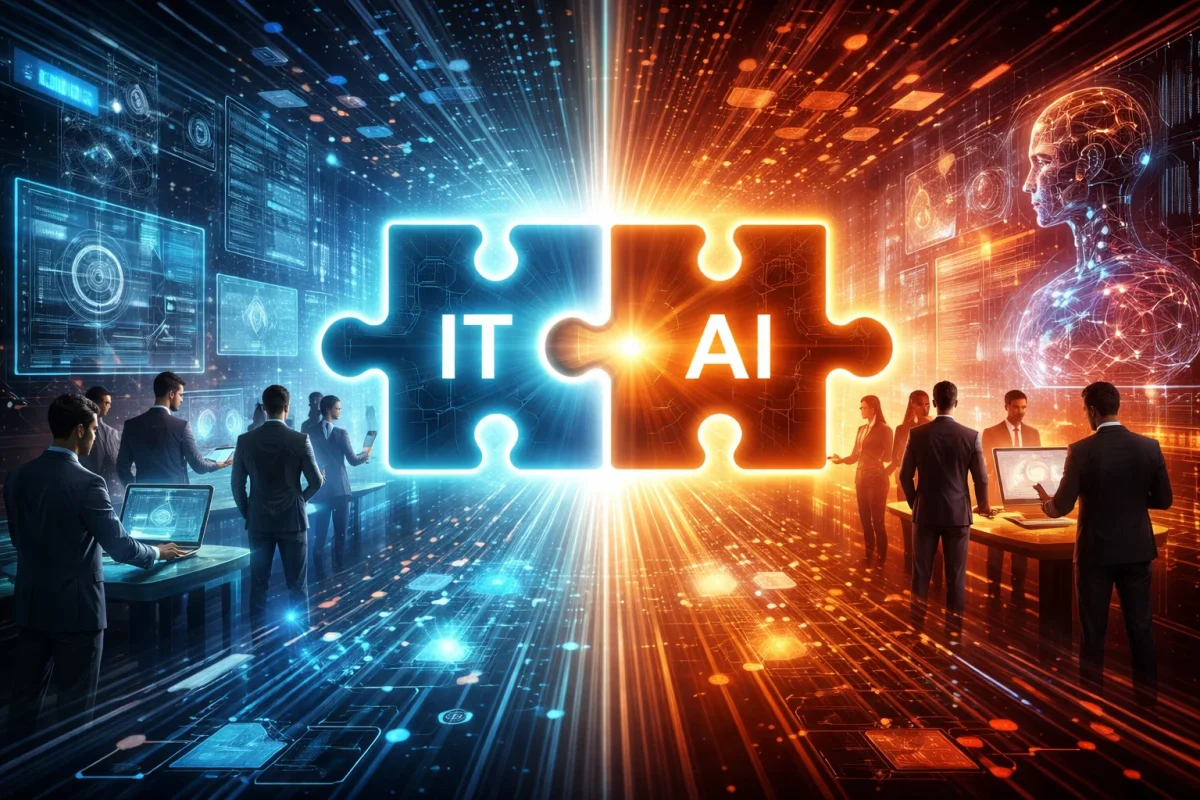
Every data point in this article points to the same conclusion: AI strategy and IT strategy are the same strategy, and organizations that treat them as separate disciplines will continue to fail at rates that should alarm any CEO or board.
The companies beating the odds are not the ones with the most advanced AI ambitions. They are the ones whose technology leadership refuses to separate AI from the data architecture, security posture, cloud infrastructure, and operational backbone it depends on. They invest disproportionately in foundations. They redesign workflows before selecting models. They maintain unified leadership across AI and IT, or at minimum enforce shared KPIs and coordinated timelines between the two.
For mid-market organizations, where resources are tighter and second chances are fewer, this integration is not optional. You cannot afford to spend seven figures on an AI roadmap that your IT infrastructure cannot support. You cannot afford to hire an AI strategist who builds a brilliant plan in a vacuum while your data architecture remains stuck in reporting mode. And you cannot afford the organizational whiplash of two separate technology leaders pulling in different directions.
Beat the odds by understanding the problem
If you are a mid-market CEO reading these statistics and wondering whether your organization is positioned to be in the successful minority, here are the questions that matter:
Do you know the current state of your data architecture, and can it support production AI workloads? Is your cloud and compute infrastructure sized and budgeted for AI inference at scale? Does your security posture account for the new attack surfaces that AI deployment creates? Is there a single leader or tightly integrated leadership team accountable for both AI strategy and IT execution? Are your AI initiatives connected to specific, measurable business outcomes with pre-defined success criteria?
If the answers to most of those questions are uncertain, you are statistically likely to join the 80–95% that fail. The good news is that the path to the successful minority is well-documented. It starts not with an AI strategy but with an honest assessment of your IT and data readiness; it continues with integrated technology leadership that treats AI and IT as one discipline; and it matures into a sustained transformation program with executive sponsorship that does not waver when the first quarter’s results are not yet visible.
The $547 billion in failed AI investment is not a cautionary tale about AI. It is a cautionary tale about what happens when organizations try to bolt transformative technology onto foundations that were never designed to support it. The technology works. The question is whether your organization is built to let it.