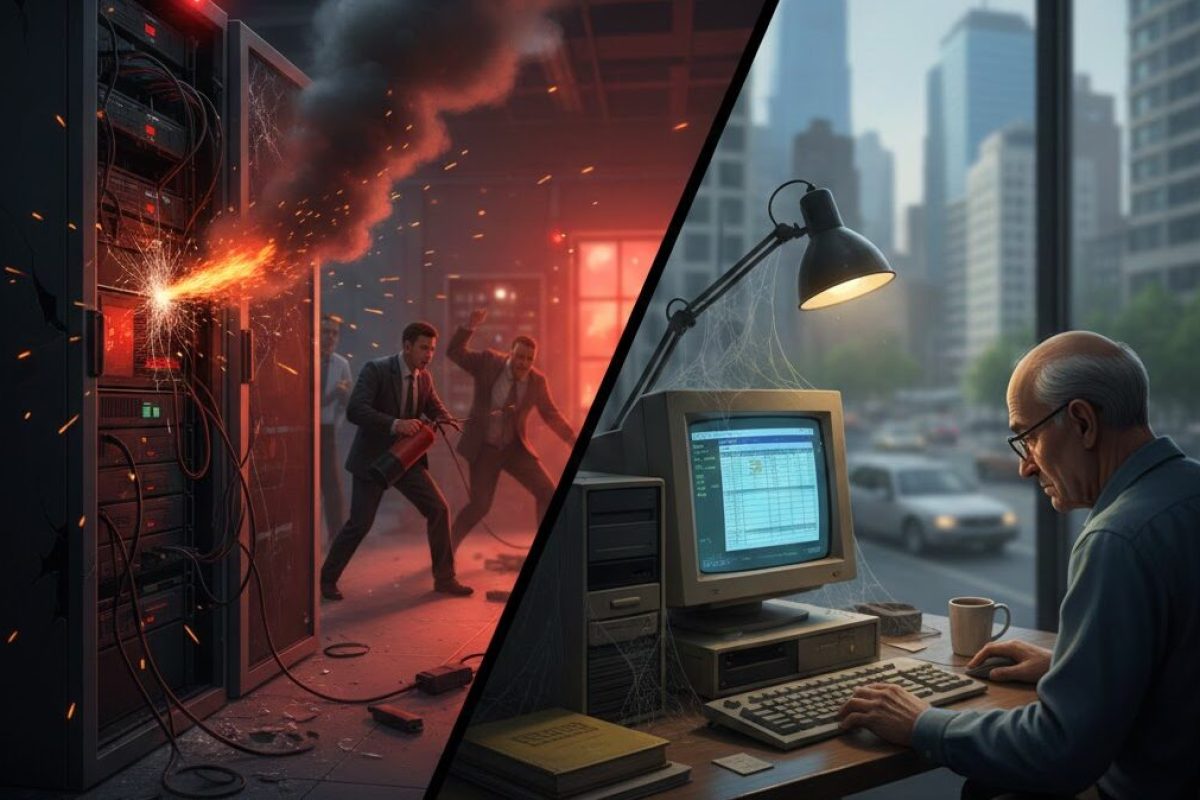
In the high-stakes world of enterprise operations, there is a specific kind of silence that should terrify every C-suite executive. It isn’t the silence of a data center after a catastrophic crash, nor the frantic quiet of a war room during a security breach. It is the hum of a machine that is working perfectly today but has no place in tomorrow.
We often treat “broken” and “obsolete” as synonyms, but in a strategic context, they are polar opposites. Broken technology is a loud, visible enemy that demands resources and forces immediate resolution. Obsolete technology, however, is a silent killer. It is the carbon monoxide of the corporate world: colorless, odorless, and capable of ending an organization’s life before anyone realizes there is a leak.
The Ironic Mercy of the Crash
When a core system breaks – when the ERP crashes, the server room floods, or a critical database corrupts – the organization enters a state of high-intensity clarity. The “broken” status acts as a flare gun fired into the dark. It commands the undivided attention of leadership, justifies emergency spending, and suspends the usual bureaucratic friction that prevents progress.
In these moments, the spotlight is blinding. Because the pain of a “down” system is felt instantly in the profit and loss statement, leadership often undergoes a psychological shift. They move from viewing IT as a cost center to viewing it as a survival center. Once the immediate fire is extinguished, this spotlight usually lingers long enough for a powerful mandate to emerge: “Never let this happen again.”
The broken component is replaced, the vulnerability is patched, and the organization often emerges more resilient than it was before the failure. In this sense, a crash is a spark for progress; painful, yes, but useful.
The Dangerous Seduction of the “Working” Obsolete
The danger of obsolete technology lies in its stability. An obsolete system can be “up and running” for years, even decades, performing its primary function with deceptive reliability. Fewer changes equates to fewer risk points for crashes & downtime, which can make everything seem not just fine, but better than average. This is especially true in organizations with long-tenured middle management and veteran IT staff who have spent a career learning the quirks, “where the bodies are buried,” and the manual workarounds required to keep the gears turning.
And therein lies the problem. To a CEO looking at a dashboard, the light is green. The system isn’t broken, so why fix it? This is the “functional trap.” Because the tech is technically operational, it fails to trigger the alarm bells that a crash would. It doesn’t demand the spotlight. Instead, it slowly accumulates technical debt, drifting further and further away from the modern ecosystem of APIs, cloud integrations, and AI-driven efficiencies.
In this environment, the staff becomes a group of specialized caretakers for a museum piece. They aren’t building for the future; they are performing a continuous act of digital taxidermy. They keep the skin looking real, but the insides have long since rotted away.
The Hidden Weight of the Dig-Out
The true cost of obsolescence is only revealed when the market shifts. When a competitor launches a customer-facing app that requires real-time data integration, or when a new regulatory requirement demands a level of transparency the old system can’t provide, the organization finally decides to modernize.
This is when the realization hits: the “dig-out” is massive.
Unlike a broken component that can be swapped out, an obsolete foundation often requires a total architectural overhaul. You aren’t just replacing a part; you are replacing the language the company speaks. Because the system has been obsolete for so long, the leap to modern standards is no longer a step; it’s a chasm. The data is locked in proprietary formats, the original vendors have gone out of business, and the code is a “spaghetti” of patches applied over twenty years.
The effort, time, and capital required to bridge this gap are often enough to paralyze a company. While the competition is iterating on their next big feature, the obsolete organization is spending eighteen months just trying to get their data into a readable format. The “working” tech of yesterday becomes the anchor that drowns the company today.
The Knowledge Silo and the Middle Management Shield
The silent nature of obsolete tech is often facilitated by a protective layer of human intervention. Middle managers and specialized IT staff often pride themselves on their ability to “make it work” despite the limitations of the tools. They develop complex manual processes (the “Excel shadows”) to bridge the gaps where the technology fails.
From the perspective of leadership, this looks like efficiency. In reality, it is a dangerous dependency. This tribal knowledge acts as a shield that prevents the spotlight from hitting the IT department. As long as the reports are delivered on Monday morning, no one asks how many manual reconciliations and fragile macros were required to produce them.
The problem arises when these “keepers of the flame” retire or leave the company. Suddenly, the organization realizes they haven’t just been using obsolete tech; they have been relying on a human-powered life support system for that tech. When the experts leave, the system doesn’t just become obsolete, it becomes unrecoverable.
Reclaiming the Spotlight Before the Crisis
To survive, organizations must learn to fear the “green light” on an old system more than the “red light” on a new one. Avoiding the trap of the silent killer requires a fundamental shift in how we value technology. Tech should not be judged solely on whether it is “running,” but on its “empowerment potential”, i.e. how easily it can adapt to the next unforeseen business need.
If your leadership only talks about IT when things are broken, you are already in the danger zone. The goal is to bring the spotlight to the technology while it is still working, forcing the “never again” conversation before the catastrophe occurs.
Waiting for a crash to justify an upgrade is a luxury modern businesses can no longer afford. In the race for digital relevance, a broken system is a hurdle you can jump over. An obsolete system is a swamp you might never crawl out of.