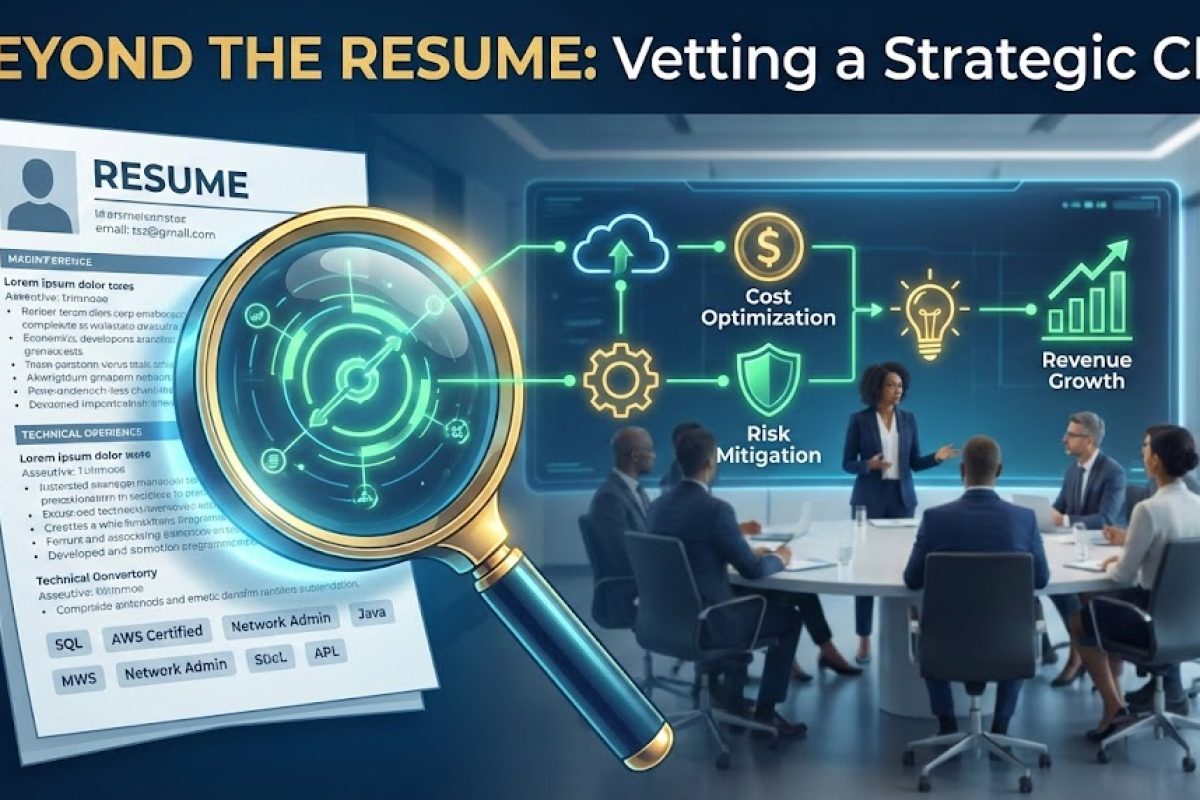
The resume lands on your desk, and it looks perfect. It is heavy with acronyms you recognize but don’t fully understand (ERP, SOC2, AWS, AI), lists a progression of impressive titles, and perhaps even features a recognizable logo from a Fortune 500 tech giant.
For a non-technical CEO, this document is a comfort blanket. It suggests competence. It suggests safety. It suggests that this person knows the “black box” of IT better than you do.
But relying on the resume is the single most common failure point in executive technology hiring.
A resume tells you what a candidate has managed; it does not tell you how they think. In the modern mid-market, where technology is no longer just a utility but the primary driver of competitive advantage, hiring a CIO based on technical keywords is a strategic error. You don’t need a “Super-SysAdmin” who keeps the servers cold and the lights on. You need a business executive who happens to specialize in technology.
This article outlines how to look beyond the pedigree and vet for the one attribute that matters most: Strategic Capability.
The “Resume Trap”: Why Qualifications Deceive
When a non-technical leader reviews a CIO resume, they often over-index on “Hard Skills” – certifications, specific software experience, and technical depth.
The problem? Technical skills have a half-life of about three years, and CIOs should be relying on staff and vendor specialists to keep up on that curve. Strategic instincts, in contrast, are timeless – and FAR more rare in IT leaders.
A candidate who spent the last decade managing an on-premise data center for a massive bank may look qualified on paper. But if your business needs to pivot to a nimble, cloud-native AI strategy, that candidate’s “impressive” experience is actually a liability. They are trained to protect the status quo, not to innovate beyond it.
To vet a Strategic CIO, you must stop asking, “Does this person know the tech?” and start asking, “Does this person understand how tech can be a lever for growth in my business?”
The Three Pillars of a Strategic CIO
To separate the operational managers from the strategic leaders, structure your vetting process around three core competencies that rarely appear in a bullet point on a CV.
1. The “Bilingual” Test (Translation Capability)
The most dangerous CIO is one who retreats behind a wall of jargon. If a candidate cannot explain a complex technical risk in terms of revenue, margin, or brand reputation, they are not an executive; they are a department head.
A Strategic CIO is bilingual: they speak “Tech” to their team and “Business” to the Board.
The Vetting Question: “Pretend I am the Board. Explain to me why we need to increase our cybersecurity budget by 20% next year, but you are forbidden from using the words ‘firewall,’ ‘encryption,’ or ‘ransomware.’ Speak only in terms of risk and P&L.”
- The Tactical Candidate: Will struggle. They will inevitably revert to technical threats (“We need better endpoint protection”) because they view security as a technical problem.
- The Strategic Candidate: Will pivot to business continuity and asset protection. “If we are down for three days, we lose $X in revenue and $Y in market trust. This investment is an insurance policy with a premium of $Z to protect that specific revenue stream.”
2. The “Investment” Test (Financial Acumen)
Many IT leaders view the company checkbook as an allowance. They fight for budget to buy the “best” tools, often ignoring the law of diminishing returns.
A Strategic CIO views IT spend as an investment portfolio. They understand the difference between OpEx and CapEx, and they know when to accept “good enough” technology to free up capital for high-growth initiatives.
The Vetting Question: “Walk me through a time you voluntarily cut your own budget or killed a pet project. Why did you do it?”
- The Tactical Candidate: Will often say they never have enough budget. They measure success by the size of the empire they build (headcount and software licenses).
- The Strategic Candidate: Will share a story about redirecting funds. “We were spending $100k on a legacy tool that only 5% of staff used. I killed it, took the heat from the users, and redirected that money to a customer-facing portal that drove sales.”
3. The “Future-Proof” Test (Innovation Beyond Efficiency)
Operational CIOs focus on Efficiency: “How do we do what we do today, but faster/cheaper?” Strategic CIOs focus on Efficacy: “Are we doing the right things? How can technology change what we sell, not just how we sell it?”
In an era where AI is reshaping industries overnight, you cannot afford a CIO who only looks at the bottom line. You need one who looks at the horizon.
The Vetting Question: “Look at our industry. What is a technological trend that is currently hyped but you think we should ignore? Conversely, what is a quiet trend that threatens our business model?”
- The Tactical Candidate: Will likely mention a specific software version or a generic buzzword like “Cloud” without context.
- The Strategic Candidate: Demonstrates market awareness. They might say, “Everyone is talking about Generative AI for marketing copy, but for us, the real threat is if our competitors use AI to automate their supply chain pricing, undercutting our margins by 15%.”
Red Flags: Identifying the “False” CIO
As you interview, be wary of these archetypes. They often interview well because they sound confident, but they struggle in the seat.
- The “No” Man: This candidate prides themselves on security and stability above all else. Their answer to every new marketing idea is “That’s too risky” or “Compliance won’t like that.” They don’t facilitate business; they obstruct it. Listen for someone who will “find a way to say Yes, not a reason to say No”.
- The Vendor Proxy: This candidate solves every problem by buying a new tool. They have great relationships with salespeople but poor relationships with their own internal users. They build a “Franken-stack” of disconnected software that drains your budget.
- The Solo Artist: If they talk about “my network,” “my servers,” and “my code,” be careful. Taking accountability and ownership is good, but a CIO’s job is to build an organization, not a personal fiefdom. Watch for “I” vs. “We” ratios in their stories.
Hire a CIO for the Mindset to “Thrive at Altitude”
The shift from a functional IT Director to a Strategic CIO is a change in altitude. At the executive level, the air is thinner; decisions are harder because there is no clear “right” technical answer, only trade-offs between risk, speed, and cost.
When you look beyond the resume, you are looking for the candidate who can breathe at that altitude.
You do not need to know how to configure a server to hire a great CIO. You simply need to verify that they understand the mechanism of your business better than they love the mechanism of the technology.
If they can translate tech into value, manage the P&L like an investor, and spot the future before it hits your bottom line, hire them. If they just have a great list of certifications? Let them go work for your competitor.