Most mid-market technology transformations fail quietly. Not with a dramatic collapse, but with a slow fade — projects approved, consultants engaged, dashboards built, and three years later, leadership struggles to point to a single line item on the P&L that moved because of it.
This is the story of a transformation that didn’t fade.
The Starting Point: Good IT, Zero Impact
The company — a commercial real estate firm with roughly 2,000 employees — had done the foundational work right. Infrastructure was stable. Systems were running. The IT organization was operationally solid by any reasonable benchmark.
What it lacked was any meaningful connection to the outcomes that actually matter to a CEO: revenue growth, margin improvement, competitive differentiation. IT was a cost center — well-managed, but essentially invisible to both the top and bottom lines.
That’s not an unusual condition in mid-market companies. In fact, it’s the norm. The question isn’t whether the gap exists; it’s whether leadership has the framework to close it without guessing.
The Diamond Phase: Listening Before Deciding
The engagement began not with a technology recommendation, but with a structured discovery process — what Innovation Vista calls the Diamond framework. The design is deliberately divergent before it is convergent: surface every possible opportunity before filtering any of them.
Fifty stakeholders were interviewed across the organization. Two facilitated brainstorming sessions brought cross-functional perspectives into the same room. The output was a long list — roughly four dozen potential data and technology initiatives, ranging from quick operational wins to multi-year strategic investments.
Not everyone was comfortable with this approach at first.
As the sessions progressed, a predictable pattern of skepticism emerged. Some participants pushed back on the exercise itself — why were they spending time on ideas that would “never see the light of day”? If most of these initiatives weren’t going to be funded, what was the point of generating them?
It’s a fair question, and it has a precise answer: the Diamond framework deliberately separates the divergent ideation phase from the triage and prioritization that follows. These are not the same cognitive task, and conflating them is one of the most common ways strategic planning goes wrong. When people know their ideas are being immediately evaluated as they emerge, they self-censor. The most unconventional — and often most valuable — candidates never surface. Keeping ideation and judgment in separate rooms, so to speak, is what produces a genuine inventory of possibilities rather than a pre-filtered list shaped by whoever has the most authority in the room.
Once that logic was explained, the skeptics came around. By the end of the process, some of the most vocal early critics had become the engagement’s most enthusiastic advocates. That shift is itself a signal worth noting: when executives understand why a process is structured the way it is, they stop tolerating it and start contributing to it.
Project Vista: Where the Real Work of Prioritization Happens
From four dozen candidates, eight initiatives were funded and launched. That selection process — Project Vista — is where the framework delivers its most distinctive value for CEOs.
Standard project prioritization is straightforward: estimate the benefits, estimate the costs, rank by ROI, fund the top items until the budget runs out. It’s a defensible methodology. It also frequently produces mediocre outcomes, because it evaluates each initiative as if it exists in isolation.
Project Vista adds a dimension that changes the calculus entirely: adjacent possible impact — the degree to which completing one project reduces the cost or increases the probability of success of future projects. In data-driven organizations, infrastructure investments don’t just produce their own returns; they reshape the economics of everything downstream.
One initiative made this principle impossible to ignore.
The Light-Bulb Moment
The top-priority project selected through Project Vista was a foundational data integration effort — consolidating the organization’s scattered data assets into a coherent, accessible architecture. On a standalone ROI basis, it wasn’t the most dramatic item on the candidate list. Estimated cost: $1M. Year-one benefit: $1.5M. A 50% return is solid, but it wouldn’t have risen to the top of a standard ranking exercise.
What the Project Vista analysis revealed was what the standalone math couldn’t see: this single initiative was a direct prerequisite for 15 other projects on the candidate list. Completing it would reduce the “I” — the investment required — in the ROI calculations of every downstream project that touched data. It wasn’t just a project with a good return; it was a project that would make a significant portion of the remaining roadmap substantially cheaper to execute.
The CEO understood this immediately. Not every executive does. Approving a project partly on the basis of what it unlocks rather than what it delivers in isolation requires a particular kind of strategic confidence — the ability to see the portfolio, not just the line item. That moment of alignment between analytical rigor and executive judgment is, in retrospect, what made everything that followed possible.
The data integration project was completed in seven months.
What the Foundation Unlocked
The first visible output built on the new foundation was an internal BI dashboard — a single source of truth for operational and performance metrics that had previously required manual assembly from disconnected systems. Real value, immediately.
But the foundation’s promise was always about what came next.
Since that initial capability went live, eleven additional projects from the original Project Vista candidate list have been approved and completed. Three client-facing dashboards have been deployed — shifting the firm’s client relationships from periodic reporting to continuous, data-driven transparency, with direct competitive implications. Five AI and automation models are now in production, handling work that previously demanded significant human time and judgment.
The cumulative financial impact: $1M in documented cost savings and $2M in new revenue, the latter driven primarily by staff capacity freed from manual processes and redirected toward business development. Total realized benefits now exceed $3M against the original $1M investment — and several initiatives remain underway.
Seven-figure impact on both the top and bottom lines. From a starting point of zero.
What CEOs Need to Take From This
Three things made this outcome possible, and all three are decisions a CEO makes — not a CIO, not a consultant.
Commit to a genuine divergent phase. Fifty stakeholders isn’t a token consultation exercise; it’s a serious organizational commitment to hearing signal from people who aren’t in your leadership meetings. The best ideas in this engagement didn’t all originate from the people with the most authority. Build a process that makes that possible, and protect it from the impatience that wants to shortcut straight to answers.
Prioritize by what projects unlock, not just what they return. The initiative that drove this entire transformation would have been buried under a standard ROI ranking. Project Vista’s adjacent possible framework surfaced it. If you’re evaluating your technology roadmap as a list of independent bets rather than an interconnected portfolio, you are systematically undervaluing your best investments.
Make sure you understand the logic, not just the recommendation. The CEO in this engagement didn’t simply approve a consultant’s prioritization — he grasped the reasoning well enough to defend it. That mattered when the project was seven months in and stakeholders were asking whether the investment was going to pay off. Conviction based on understanding holds; conviction based on delegation doesn’t.
The Pattern That Repeats
The Diamond and Project Vista frameworks aren’t a one-time event. They’re a cycle. This commercial real estate firm ran one full iteration and is running the next — eight projects funded from four dozen candidates, eleven more completed since, additional initiatives still in progress, benefits still accruing.
For mid-market CEOs who have done the foundational IT work and are still waiting for the business impact to follow, the answer is almost never more technology. It’s almost always a better method for deciding which technology, in which order, for which reasons — and the organizational discipline to execute that method even when it feels slower than just picking the obvious projects and starting.
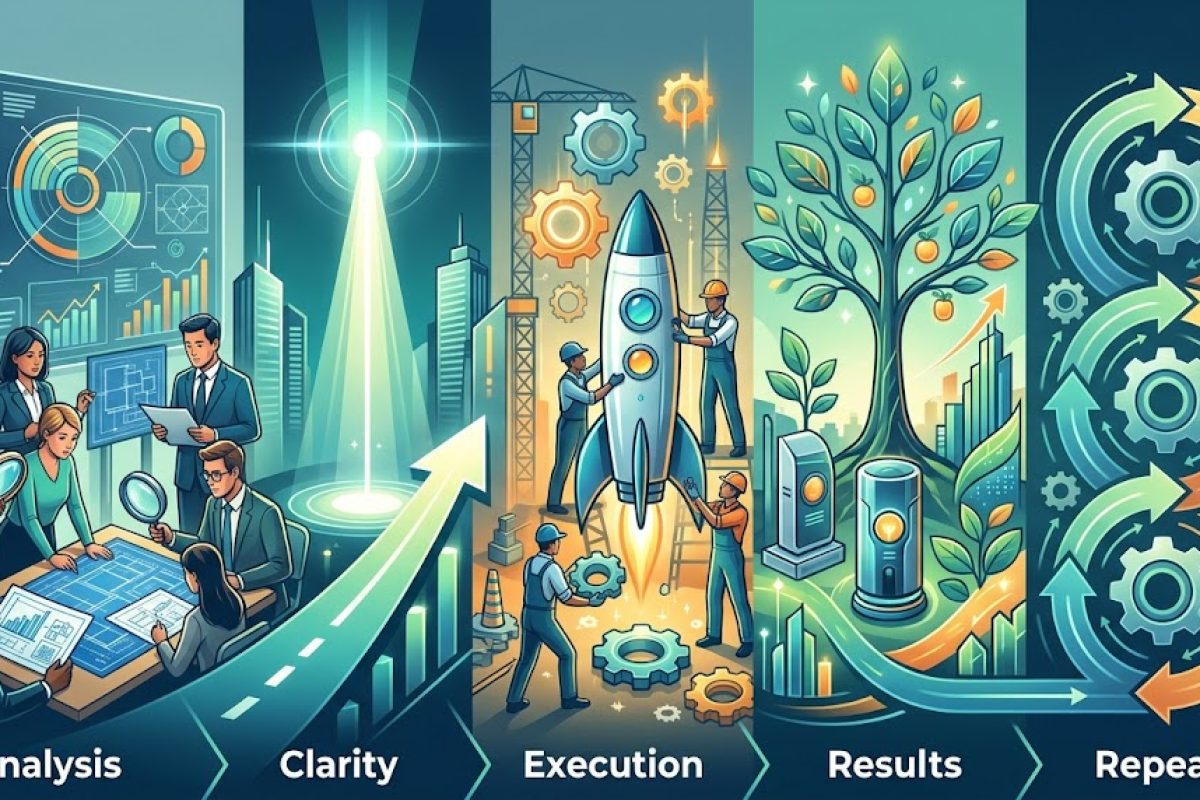
Analysis. Clarity. Execution. Results.
Then repeat.