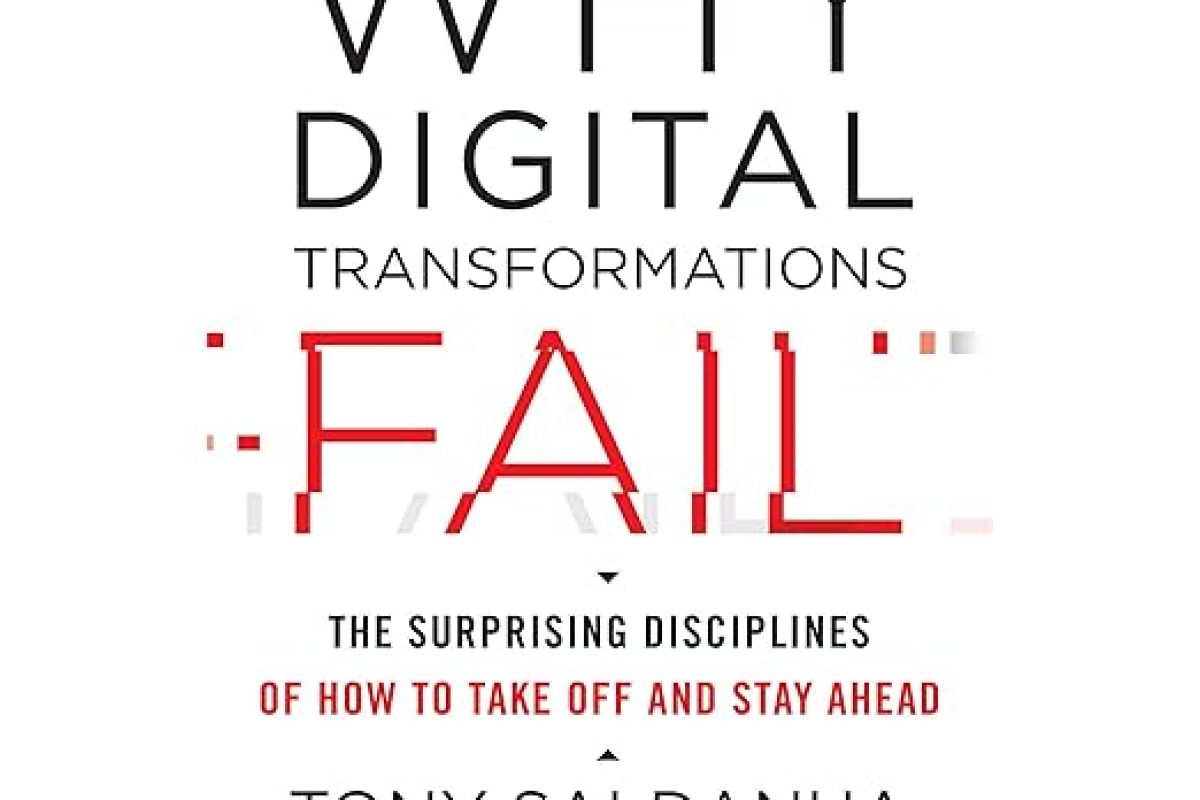
Tony Saldanha’s Why Digital Transformations Fail is not a technology book in the way most executives mean that phrase. It is a management book about how organizations change, why they do not, and how leaders accidentally sabotage their own programs by treating transformation like a large project instead of a multi-year rewiring of how the business runs. The title is blunt, but the tone is practical. Saldanha is arguing that failure is less about picking the wrong platforms and more about misunderstanding the nature of transformation itself.
At its core, the book is a corrective to the sloppy, overused term “digital transformation”. Saldanha pushes readers to stop using the phrase as shorthand for “install new systems” or “modernize IT”. Instead, he frames transformation as an enterprise program with distinct stages, different leadership requirements at each stage, and predictable failure modes when leaders skip steps or mix them up.
The thesis, in one sentence
Digital transformations fail because companies treat them as technology initiatives rather than business transformations, and because they attempt to jump to “digital” outcomes without building the organizational capabilities and operating model changes required to sustain them.
That sentence matters because it forces a reclassification. If you accept it, then transformation cannot be delegated “to IT”, cannot be run as a one-time implementation, and cannot be measured primarily by go-live milestones. It must be owned by the business, executed with discipline, and designed to outlast the original program team.
The model that gives the book its backbone
One of the strengths of the book is that it offers a structured framework rather than a grab bag of anecdotes. Saldanha describes a staged approach to transformation, moving from foundational work toward more advanced, digitally enabled business models. Even if a reader never adopts his terminology exactly, the sequencing logic is the value:
- Build and standardize the basics before promising disruptive outcomes.
- Improve and automate processes before calling something “digital”.
- Use data and modern architecture as enablers, not as trophies.
- Only then pursue new digital business models and scalable innovation.
This is where the book earns its keep for mid-market leaders. Many organizations try to “monetize” digital capabilities when they are still struggling to “stabilize” operations. The result is a familiar pattern: shiny tools layered over inconsistent processes, fragmented data, and unclear decision rights. Saldanha’s framework pushes leaders to acknowledge maturity and sequence ambition accordingly.
What the book gets especially right
Saldanha is at his best when describing the organizational and leadership dynamics that make transformation hard.
First, he is clear-eyed about incentives. Leaders are rewarded for shipping visible change, not for doing the unglamorous groundwork. That bias causes overinvestment in front-end experiences and underinvestment in data quality, process discipline, architecture, and governance. The transformation then looks successful right until it becomes unmaintainable.
Second, he emphasizes operating model clarity. Transformations die when nobody knows who owns the process, who owns the data, who makes cross-functional tradeoffs, and who funds the “last mile” adoption. In many companies, those questions are either political or undefined. The book repeatedly returns to the idea that you cannot transform a business with ambiguity in decision rights.
Third, he treats change management as central, not decorative. Training, communication, incentives, adoption metrics, and leadership behavior are positioned as core components of the system. This is a welcome departure from the typical posture where change management is a late-stage add-on after the technology build is mostly complete.
The failure patterns that should make leaders uncomfortable
The book’s title promises a diagnosis, and it delivers a useful taxonomy of why transformations go off the rails. Several patterns stand out.
A common failure is confusing digitization with transformation. Converting paper to workflow tools is useful, but it is not transformation if it does not change performance, decision-making, and customer value. Another failure is treating transformation as a portfolio of disconnected projects rather than a coherent program with shared architecture, data, standards, and governance. That fragmentation produces local wins and enterprise chaos.
Saldanha also critiques the “big bang” temptation. Leaders often want a single heroic moment where the organization emerges transformed. Real transformation is iterative, staged, and continuous. Companies that bet everything on a single cutover tend to discover, too late, that people and processes do not change at the speed of a deployment plan.
Finally, the book calls out leadership inconsistency. Transformation requires leaders to behave differently, not just approve budgets. When executives continue to reward old behaviors, tolerate workarounds, and allow exceptions for politically powerful teams, they silently teach the organization that the transformation is optional.
Where the book is most helpful for mid-market executives
For mid-market CXOs, the most practical use of the book is as a diagnostic lens before launching a major initiative.
If you are a CEO, it helps you see why delegating “digital” to the CIO is a category error. The CIO can lead major parts of the program, but the CEO must own the business transformation and enforce the cross-functional decisions it requires.
If you are a CFO, it clarifies why ROI math fails when the operating model is not changed. You can fund new systems and still not get benefits if adoption, process compliance, and data discipline are not enforced. The book implicitly argues for benefits realization as a leadership discipline, not a spreadsheet exercise.
If you are a COO, it validates the uncomfortable truth that process standardization and operational clarity are not the enemy of innovation. They are often the prerequisite for scaling it.
And if you are a CIO, the book is a gift you can hand to peers. It translates what many IT leaders know instinctively into a business-first narrative: technology is rarely the limiting factor, but organizational alignment often is.
What I would critique
The book is intentionally structured, which is a strength, but also means it can feel a bit programmatic in places. Some readers may want more “how” detail on building specific capabilities such as modern data governance, product operating models, or platform teams. Saldanha is more focused on the transformation logic and leadership mechanics than on providing a technical playbook.
It also assumes a level of organizational scale and process maturity that may not map cleanly to smaller firms or to businesses in highly variable, bespoke service environments. Mid-market leaders can still apply the principles, but they may need to right-size the formality of the stages and governance to avoid creating bureaucratic overhead.
Who should read it, and when
This is a pre-flight book. The best time to read it is before you launch a transformation or when you suspect you are already in trouble but cannot articulate why.
Read it if you are about to replace ERP, overhaul CRM, modernize analytics, implement AI-enabled processes, or re-architect customer experience. Read it if the organization keeps saying “we need to be digital” but cannot define what will change in the operating model. Read it if you have shipped major systems and still cannot point to sustained performance improvement.
If you are already mid-flight, the book is still useful as a reset tool. It can help leaders reframe the program around capabilities, governance, adoption, and sequencing, and it provides language for making the hard call: slow down to fix foundations so you can speed up later.
A Thought-Provoking Work Well-Worth the Read
Why Digital Transformations Fail is a disciplined argument for treating transformation as a staged business program, not a technology event. Its value is not in novelty, but in clarity. It names the traps that leaders routinely fall into, then gives a framework that makes the work feel governable rather than mystical.
If you want a single takeaway to carry into your next steering committee meeting, it is this: transformation is not what you install. It is what the organization becomes.