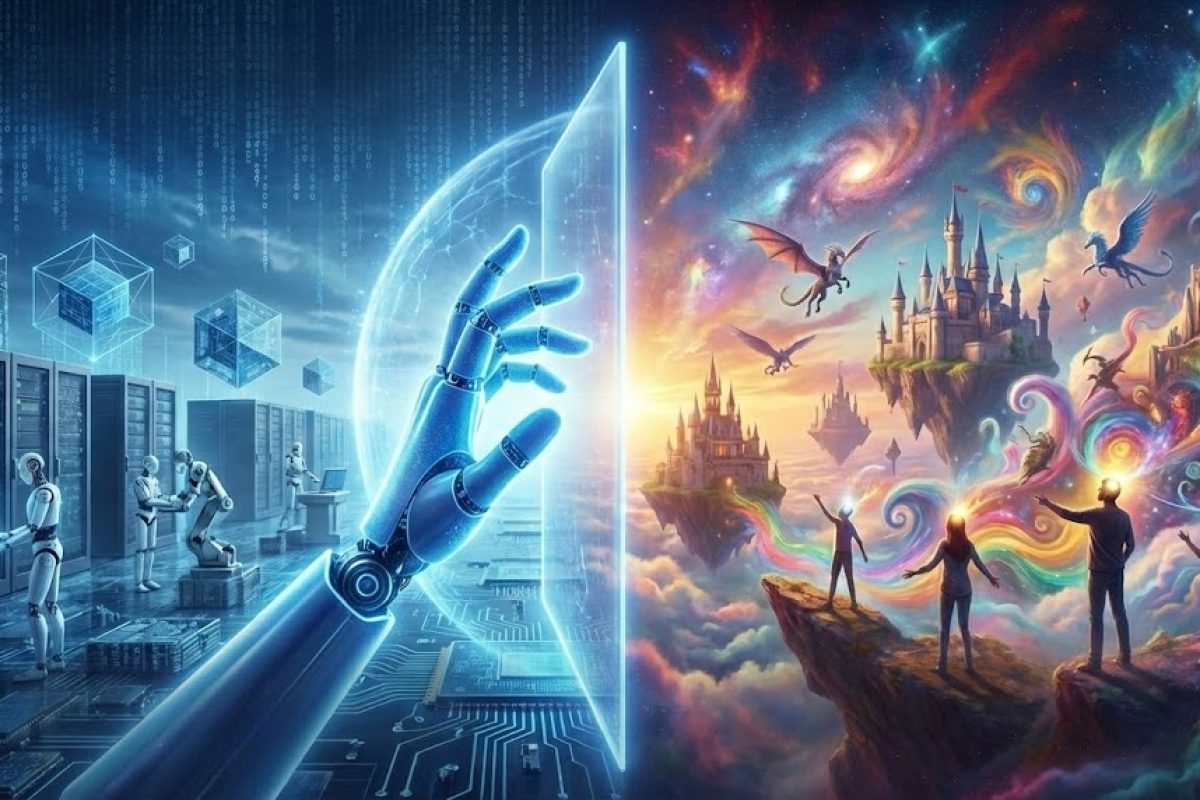
Why “Counterfactual Reasoning” Separates Human Intelligence from Machine Intelligence
Of all the capabilities that distinguish human intelligence from artificial systems, imagination may be the most important. It is the ability to step outside the current context, construct possibilities that have no precedent, and reason as if those new worlds were real. This counterfactual reasoning is not “creativity” in the artistic sense. It is a strategic capability that enables leaders, scientists, founders, and innovators to envision futures that have never existed and then work backward to make them real.
AI, even at the frontier of today’s models, remains unable to make this leap. The reason is not simply that it lacks consciousness or agency. The deeper barrier is that AI is constrained by its training data. Without examples of a never-before-seen world, it can only remix prior patterns or share specific ideas that have been imagined by humans in the past. Humans, by contrast, rely on internal simulation, intuition, and embodied experience to produce insights that are not anchored in precedent.
This gap of “imagination” is crucial for organizations navigating the fast-changing landscape, and it may be the most durable moat humans maintain over AI over the long-term.
The Technical Block: AI Cannot Reason Far Outside Its Training Distribution
Large language models and generative systems operate by identifying statistical relationships in massive corpora of human-generated content. These systems excel at interpolation (filling in gaps within known patterns) and can even attempt extrapolation (stretching beyond known patterns), but both are bounded by what the model has already consumed.
When you ask an AI to imagine a world with new physics, a market with rules that have never existed, or a technology whose operating principles defy prior examples, it runs into a fundamental wall:
- There is no training data for the new world.
- There are no latent patterns to extend.
- There is no embedded causal model of how truly novel systems behave.
Humans can mentally construct rules and see what emerges. AI can only generate something “like” the past.
This is why speculative scenarios often distort into familiar tropes when described by AI. Its “imagination” is not real imagination… it is recombination.
Why This Matters: Strategy Happens Outside the Current Context
The most important decisions in organizations require counterfactual leaps:
- What if a competitor rewrites the category?
- What if the regulatory environment flips?
- What if our customers begin behaving in ways our analytics have never observed?
- What if AI automates a third of this industry in five years?
Human leaders do not wait for patterns to emerge. They hypothesize the next reality. They pressure-test futures with no historical precedent. They experiment mentally before experiments happen operationally.
AI can accelerate analysis, but it cannot originate these leaps.
This is the cornerstone of strategic leadership. It is also why no AI model, however large, can replace sector-matched human experts in envisioning second-order consequences or planning transformation.
The Ramifications for Professions: Who Thrives and Who Gets Automated
The imagination gap will shape the future of work far more than most forecasts suggest. Occupations fall into three broad categories:
1. Jobs Defined by Pattern Matching → High Automation Risk
Roles dependent on repeating prior experience – auditing, contract drafting, scheduling, code generation, customer service, even portions of medical diagnostics – fit neatly within AI’s sweet spot. They are governed by patterns and precedent. They stay inside known distributions.
These professions will not vanish, but they will be reshaped by AI serving as the primary producer with humans supervising.
2. Jobs Defined by Counterfactual Reasoning → Low Automation Risk
Roles that require imagining scenarios without historical precedent – C-suite leadership, founders, strategists, architects, scientists, policymakers, consultants, designers – depend heavily on counterfactual invention.
These professionals create the next context rather than operating within the current one. Their value comes from asking questions no dataset has prepared answers for.
If you are paid to imagine possibilities, not just process information, AI will amplify your capabilities rather than replace you.
3. Jobs Defined by Human Stakes, Trust, and Judgment → Hybrid Futures
Professions such as education, therapy, medicine, law, and organizational leadership occupy the middle zone. They involve pattern-matching tasks that AI can handle, but also emotional resonance, ethical decision-making, cultural context, and imaginative scenario planning that require human presence.
These roles evolve into hybrid models: AI for the known, humans for the unknown.
Implications for Industries: Diverging Trajectories of Disruption
Industries that operate on stable rules – insurance underwriting, logistics, retail optimization, manufacturing, banking – will see profound automation because their systems change slowly and the training data for those systems is immense.
Industries defined by shifting rules – venture capital, M&A strategy, R&D, entertainment, advertising, national defense, and most executive roles – are far less vulnerable because the target context is always moving.
AI thrives in equilibrium. Humans thrive when equilibrium breaks.
The more dynamic the industry, the larger the premium on imagination.
The Future of Human–AI Collaboration: Complementary Strengths, Not Competition
The winning organizations of the next decade will not pit humans against AI. They will pair:
- AI’s precision at analyzing the known, with
- Human imagination at inventing the unknown.
This hybrid operating model is already forming:
- AI identifies latent patterns; humans interpret their strategic meaning.
- AI accelerates analysis; humans envision uncharted futures.
- AI optimizes processes; humans redefine processes.
- AI tests scenarios; humans generate the scenarios worth testing.
This is why strategic consulting remains a high-ROI offering for mid-market organizations: AI alone cannot identify transformational possibilities. It can only support the reasoning that follows once humans imagine them – and even that, only to the extent that the future rules match the training datasets it has used
The Strategic Takeaway for Leaders
Don’t misunderstand this analysis as skepticism of the value of AI – quite the opposite, as the problem space covered by LLM training datasets (the entire internet) is vast, and barely tapped. AI will continue advancing rapidly, but imagination will remain out of reach for the foreseeable future, because it is not a statistical function and there is no dataset which can be ingested and analyzed for it. (Note: Researchers are working on creating “synthetic” data as-needed for imaginative AI modeling, but this will be limited until AI can have a true grasp of our scientific laws and social dynamics, not just go by what it’s read…)
Imagination is a generative act of agency. Humans do not need training data to imagine what has never been seen, so for awhile, at least, we will continue to dominate this kind of “intelligence”.
This keeps human leadership essential. It keeps human strategy essential.
Professionals who can articulate “counterfactual” imaginative visions, design new futures never seen before, and blend AI precision with human intuition will define the next era of competitive differentiation.
AI will eventually master everything within context.
But the future will be truly shaped by those who can create new contexts.