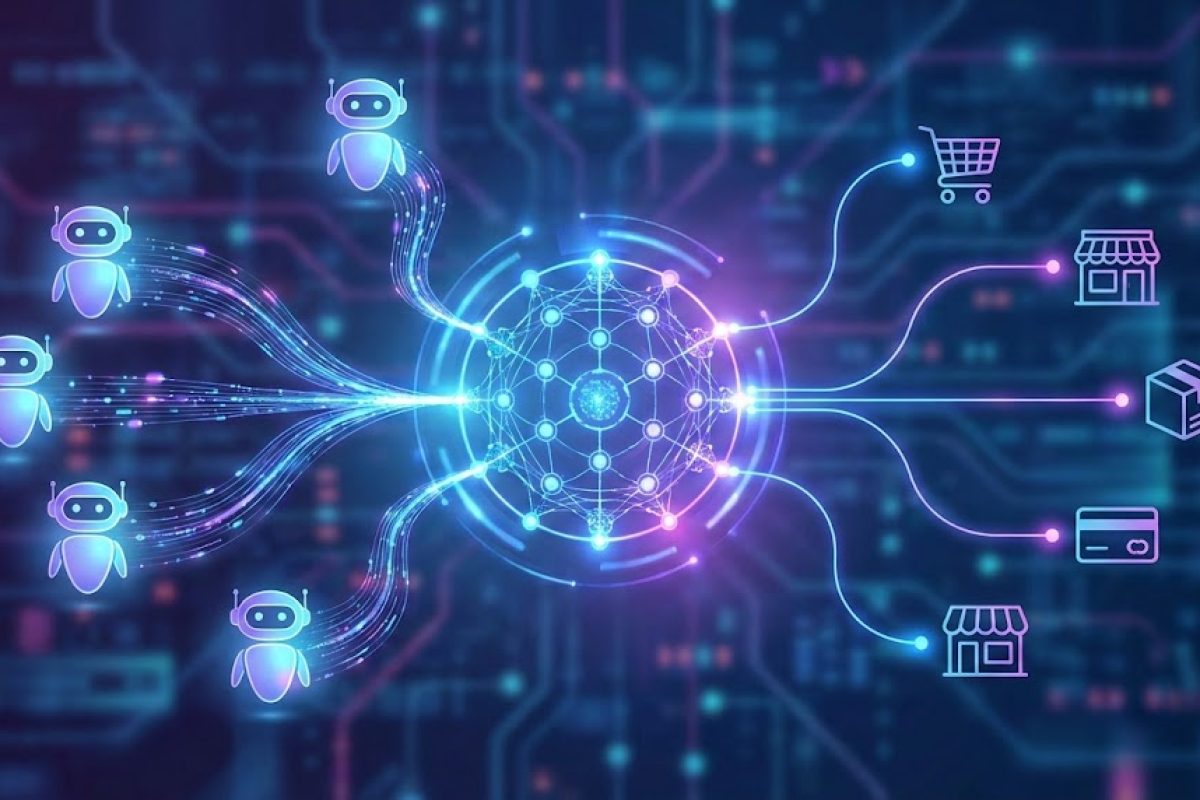
The promise of the generative AI boom, now well into its third year, has always been “agentic” capability. We didn’t just want chatbots that could write poetry or summarize emails; we wanted digital assistants that could act on the world. We wanted agents that could book the flight, reserve the table, and buy the birthday present.
Until this week, however, the reality of AI commerce has been a frustrating exercise in “look but don’t touch.” An AI model like Gemini could plan a perfect week of meals, identify the necessary ingredients, and even find the best prices. But when it came time to actually purchase those groceries, the process broke down. The AI would unceremoniously dump a list of links on the user, forcing them back into the manual drudgery of account logins, cart management, and checkout flows across multiple vendor sites.
The friction wasn’t an intelligence problem; it was an architecture problem.
This week, Google moved to solve that structural deficit with the announcement of the Universal Commerce Protocol (UCP). Supported at launch by heavyweights including Shopify, Walmart, Target, Etsy, and Wayfair, UCP is not a new marketplace or a consumer-facing app. It is infrastructure – specifically, a standardized “hub architecture” designed to let AI agents finally execute transactions across the fragmented landscape of global e-commerce.
The Fragmentation Problem
To understand why UCP is necessary, one must understand the logistical nightmare of pre-2026 automated commerce.
For years, e-commerce has operated on a spoke-without-a-hub model regarding third-party automation. Every retailer, from massive box stores to boutique Shopify sites, maintains its own unique backend systems, APIs (if they even have them), inventory management protocols, and checkout security hurdles.
If an AI developer wanted their agent to purchase items on behalf of a user, they faced an unsustainable “N-squared” integration problem. Building a reliable connector for Amazon was hard. Building one for Amazon, and Target, and Best Buy, and thousands of independent Shopify merchants was functionally impossible. The maintenance overhead alone (constantly updating connectors as retailers changed their website code) doomed most efforts.
The result was that AI agents were excellent window shoppers but incapable buyers. They were trapped outside the walled gardens of vendor checkout systems.
The Hub Architecture Solution
The Universal Commerce Protocol changes this dynamic by introducing a standardized middleware layer – the hub.
UCP is an open standard that defines a common language for essential commerce functions. It standardizes how an AI agent requests product availability, how it adds an item to a secure cart, how it applies discount codes, and, crucially, how it executes a compliant payment handoff.
Instead of an AI agent needing to learn thousands of different retailer “languages,” it now only needs to speak UCP.
Retailers, in turn, only need to build a single adapter connecting their backend to the UCP standard. Once a retailer is UCP-compliant, they are theoretically accessible to any authorized AI agent, whether it’s Google’s Gemini, an OpenAI model, or a specialized vertical agent.
This hub architecture decouples the agent from the retailer. It transforms commerce from a series of brittle, one-off custom integrations into a scalable, networked ecosystem. It is the difference between hand-wiring every appliance in your house to the power plant versus simply installing standard electrical outlets.
The Coalition of the Willing
The success of any protocol depends entirely on adoption. A standardized plug is useless if no one installs the socket. This is why the roster of launch partners announcing support for UCP this week is perhaps more significant than the technical specs themselves.
By securing commitments from platforms like Shopify (representing millions of merchants) and retail giants like Walmart and Target, Google has ensured day-one liquidity for the protocol.
For these retailers, adopting UCP is a defensive and offensive strategic move in the age of AI. Defensively, they cannot afford to be invisible to the AI agents that will increasingly become the primary interface for consumer spending. Offensively, UCP allows them to meet consumers where they are, inside a conversational interface, rather than hoping the consumer navigates to their specific URL or app.
It indicates a massive shift in power dynamics. Retailers are acknowledging that the “front door” of their store is moving away from their homepage and into the user’s AI assistant.
From Click-Based to Intent-Based Commerce
For the end-user, the implementation of the UCP hub architecture signifies the transition from click-based commerce to intent-based commerce.
Today, online shopping is a hunt-and-peck process of keyword searches, filtering results, managing browser tabs, and manual data entry at checkout.
In an intent-based, UCP-enabled world, a user expresses a high-level goal: “My nephew is turning seven; buy him the highest-rated LEGO set under $50 that can be delivered by Saturday, using my primary card.”
The AI agent, utilizing the UCP hub, can instantaneously query inventory across multiple connected retailers (Target, Walmart, a specialized toy store on Shopify), identify the best match based on price and delivery speed, secure the cart, and execute the purchase. The user confirms the action, not the individual steps.
The Road Ahead
The announcement of UCP in January 2026 is just the foundational pouring. Significant challenges remain.
Trust and security will be paramount. While UCP utilizes tokenized payment credentials to ensure AI agents never directly handle raw credit card data, consumers must become comfortable delegating purchasing authority to software. Furthermore, the protocol will need to robustly handle the messy reality of physical commerce: sudden out-of-stock events, complex return policies, and shipping exceptions.
However, the architecture is now in place. By establishing a viable hub for transaction data, Google UCP has removed the largest structural barrier to agentic commerce. The pipes are laid; now the data, and the money, can begin to flow.